Saving Seafood

  • Home
  • News
    • Alerts
    • Conservation & Environment
    • Council Actions
    • Economic Impact
    • Enforcement
    • International & Trade
    • Law
    • Management & Regulation
    • Regulations
    • Nutrition
    • Opinion
    • Other News
    • Safety
    • Science
    • State and Local
  • News by Region
    • New England
    • Mid-Atlantic
    • South Atlantic
    • Gulf of Mexico
    • Pacific
    • North Pacific
    • Western Pacific
  • About
    • Contact Us
    • Fishing Terms Glossary

Louisiana to help pay for devices that can save sea turtles from shrimp nets

October 21, 2020 — Louisiana is starting a financial assistance program to help shrimpers buy new gear to make their nets less lethal for endangered sea turtles.

The new $250,000 state program will reimburse up to 60% of the cost for special metal grates known as TEDs, or turtle excluder devices, for shrimping nets used in the Gulf of Mexico. TEDs create an opening that allows trapped turtles to escape nets before they drown.

Starting in April, a federal law will expand TED requirements to include skimmer vessels that are 40 feet long and longer. About 1,500 TEDs will need to be purchased for 400 boats in Louisiana, according to the state Department of Wildlife and Fisheries, which will oversee the Skimmer Turtle Excluder Device Reimbursement Program.

Read the full story at NOLA.com

Louisiana helps inshore shrimpers buy turtle escape hatches

October 14, 2020 — Louisiana will help inshore shrimpers buy turtle escape hatches that will be required next year for some boats in the Gulf of Mexico and southeastern Atlantic, Gov. John Bel Edwards said Tuesday.

The $250,000 program will pay up to 60% of the cost for two of the grates called “turtle excluder devices,” or TEDs, a news release said. Some of the money comes from BP payments to restore the Gulf after the oil spill in 2010.

Big offshore shrimp trawlers have had to use such devices since late 1989. Protests against that rule included shrimp-boat blockades of Texas and Louisiana ship channels.

Read the full story at the Associated Press

Northeast shrimp: Surveys canceled over covid,
with no sign yet of recovery

October 13, 2020 — In Maine and New England, northern shrimp (Pandalus borealis) used to be a regional and seasonal staple. But, for seven consecutive years, the fishery has been shuttered. The last year there was a commercial season was in 2013, and at that time, dealers paid fishermen an average of $1.81 a pound.

Dustin Leaning, a fishery management plan coordinator for the Atlantic States, says “the Gulf of Maine stock remains depleted, and as of yet, has not shown a positive response to the commercial fishing moratorium. Reducing fishing mortality has historically been fishery managers’ most effective tool in rebuilding a stock that has reached low levels of biomass.”

The moratorium on fishing in Maine is in place until 2021.

“They’re resilient,” says Maggie Hunter, Maine’s head shrimp biologist. “They’ve recovered from collapses before (early 1950s, late 1970s), but we’ve never documented one in the Gulf of Maine lasting this long before.”

A 2019 Gulf of Maine survey by the Northern Shrimp Technical Committee revealed indices of abundance, biomass and spawning stock biomass at new time-series lows, and recruitment the third-lowest in the time series (1984-2019). Warming waters, like those in the Gulf of Maine, are also detrimental to shrimp populations. 

A Maine-New Hampshire inshore survey, along with spring and summer shrimp surveys, were all canceled this year because of covid-19 concerns.

Read the full story at National Fisherman

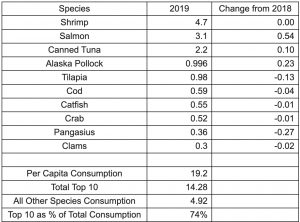
Behind the Scenes of the Most Consumed Seafood

October 1, 2020 — The following was released by NOAA Fisheries:

Shrimp, tuna, clams—the most popular seafood items in the United States are familiar names to both seafood lovers and the occasional consumer. You may have wondered about the environmental impact of consuming more of a popular product.

We’ve got good news: U.S. seafood is sustainable seafood! Thanks to our robust quotas, retention limits, and other management measures, you can be confident that U.S. seafood products were harvested sustainably.

Around 75 percent of the shrimp harvested in the United States comes from the Gulf of Mexico. Three species dominate the catch there: white shrimp, pink shrimp, and brown shrimp. Each of these species currently have population levels above the targets set by scientists.

Federally permitted shrimp fishermen are required to report their landings. They also provide information on fishing effort, including the number of fishing trips they take. The data is used in shrimp stock assessments and to support the sustainable management of red snapper. Depending on the gear they use, shrimpers must also use special equipment that reduces incidental catch, including sea turtle bycatch.

Read the full release here

Outer Banks seafood sent to Louisiana as part of Hurricane Laura relief

September 16, 2020 — More than 11,000 pounds of Outer Banks shrimp and fish is going to help with storm relief in Louisiana, another area known for seafood and devastating hurricanes.

The North Carolina Fisheries Association coordinated the effort with companies in Wanchese, Grantsboro, Washington, N.C., and Hampton, Va., to gather and ship 11,225 pounds of seafood, including more than 2,000 pounds of shrimp and nearly 9,000 pounds of filleted flounder and other fish, said Jerry Schill, government affairs director for the fisheries organization, in an email.

The seafood shipment was part of a relief effort to help those affected by Hurricane Laura.

“Hurricanes hit the Atlantic and Gulf coasts on a regular basis so we need to have the infrastructure in place and do what we can, just as they would do the same for us,” Schill said.

Read the full story at  The Virginian-Pilot

The future of food from the sea, explained

September 15, 2020 — In the year 2050, Earth will have almost 10 billion humans who will eat over 500 billion kilograms of meat. That is 2 billion more people and 177 billion more kilograms of meat than Earth currently has. With land-based meat fraught with climate and environmental impacts, how much animal protein can be sustainably supplied by the ocean? A new (open access) paper in Nature titled, The Future of Food from the Sea, answered that question and provided an economic roadmap for sustainable ocean food production.

The authors conclude that by 2050, the ocean could sustainably provide 80-103 billion kilograms of food, a 36-74% increase compared to the current yield of 59 billion kilograms. Crucially, the 2050 numbers were not a simple calculation of the carrying capacity of food production, but instead reflected the economic realities of growing and harvesting food in the ocean. The authors identified four key steps towards a more bountiful ocean:

  1. Improve fishery management
  2. Implement policy reforms to address mariculture
  3. Advance feed technologies for fed mariculture
  4. Shift consumer demand

In this post, I explain the numbers behind potential food production in the ocean and what the policy and governance process might look like going forward.

Read the full story at Sustainable Fisheries UW

USDA wants to buy more US wild shrimp, pollock

September 14, 2020 — Not long after purchasing hefty amounts of U.S. pollock, salmon, and other seafood, the United States Department of Agriculture (USDA) is now asking for bids on large quantities of wild shrimp and wild Alaska pollock nuggets.

The USDA is asking suppliers to bid on 318,000 containers of frozen peeled and deveined shrimp – required to be in two- or five-pound primary packages further packaged into 20-pound shipping containers – by 18 September. The shrimp will be delivered to several U.S. cities between 1 November, 2020, and 31 January, 2021.

Read the full story at Seafood Source

FDA rejects historically low seafood imports in July

August 25, 2020 — The U.S. Food and Drug Administration (FDA) refused only 37 seafood entry lines in July, continuing a trend where federal officials were rejecting a historically low number of products.

According to the Southern Shrimp Alliance, that amount is by far a record low for the month. It’s only 21.3 percent of this historical average the alliance has tracked since 2002. It’s also significantly lower than the previous record low of 91 entry lines, which occurred last year.

Read the full story at Seafood Source

The U.S. government is donating gulf shrimp to food banks

August 18, 2020 — COVID-19 has impacted agriculture around the country, and that extends to U.S. shrimp fisheries, which are largely located along the coastline of the Gulf of Mexico. With restaurants and hotels closed around the country the demand for shrimp is way, way down, leading to fears that the price of shrimp will collapse. To help offset this, the U.S. government has stepped in and announced it will be buying $30 million worth of U.S.-harvested shrimp.

As reported by the Associated Press (with a hat-tip to Modern Farmer for alerting us to the story), the massive shrimp buy is the result of lobbying from both Louisiana and Mississippi, two states that produce shrimp and stand to be impacted by COVID-related factors. In a press release Mississippi’s two U.S. senators and one of its house members stated that they had sent a letter to Agriculture Secretary Sonny Perdue in May, asking that the USDA purchase shrimp (thus propping up the industry) and distribute that same shrimp to people being impacted by the pandemic.

Read the full story at The Takeout

ASC releases first evaluation report on impact of certified aquaculture

August 10, 2020 — The Aquaculture Stewardship Council (ASC) has made public its first monitoring and evaluation report, which showcases the impact of certified responsible aquaculture.

The report, released 5 August, highlighted improvements in the environmental performance of salmon farms in Norway, Canada, and Chile, and shrimp farms in Vietnam.

Read the full story at Seafood Source

  • « Previous Page
  • 1
  • …
  • 8
  • 9
  • 10
  • 11
  • 12
  • …
  • 44
  • Next Page »

Recent Headlines

  • OREGON: Oregon coast lawmakers push back on fish hatchery cuts
  • Sullivan reintroduces sweeping bill targeting bycatch, seafloor impacts
  • GEORGIA: NOAA says snapper permits top priority locally in ‘America-first’ seafood strategy
  • Termination of Gulf of Maine leases casts further uncertainty over offshore wind
  • NOAA identifies six foreign governments engaging in IUU fishing, including Russia and China
  • El Niño is here, and it’s already scrambling fisheries throughout the Pacific
  • New tagging study tracks Dungeness crab movement in Puget Sound
  • NORTH CAROLINA: How one NC fish house ships fresh catch to seafood markets across US

Most Popular Topics

Alaska Aquaculture ASMFC Atlantic States Marine Fisheries Commission BOEM California China Climate change Coronavirus COVID-19 Donald Trump groundfish Gulf of Maine Gulf of Mexico Hawaii IUU fishing Lobster Maine Massachusetts Mid-Atlantic National Marine Fisheries Service National Oceanic and Atmospheric Administration NEFMC New Bedford New England New England Fishery Management Council New Jersey New York NMFS NOAA NOAA Fisheries North Atlantic right whales North Carolina North Pacific offshore energy Offshore wind Pacific right whales Salmon South Atlantic Virginia Western Pacific Whales wind energy Wind Farms

Daily Updates & Alerts

Enter your email address to receive daily updates and alerts:
  • This field is for validation purposes and should be left unchanged.
Tweets by @savingseafood

Copyright © 2026 Saving Seafood · WordPress Web Design by Jessee Productions