Saving Seafood

  • Home
  • News
    • Alerts
    • Conservation & Environment
    • Council Actions
    • Economic Impact
    • Enforcement
    • International & Trade
    • Law
    • Management & Regulation
    • Regulations
    • Nutrition
    • Opinion
    • Other News
    • Safety
    • Science
    • State and Local
  • News by Region
    • New England
    • Mid-Atlantic
    • South Atlantic
    • Gulf of Mexico
    • Pacific
    • North Pacific
    • Western Pacific
  • About
    • Contact Us
    • Fishing Terms Glossary

El Niño is back, and ocean temperatures are already near record highs – that can spell disaster for fish and corals

June 15, 2026. — It’s official: El Niño is back. By late fall 2026, forecast models give a 2-in-3 chance of a strong-to-very strong El Niño affecting the weather, climate and ocean temperatures across the planet.

El Niño is the climate system’s biggest player and one side of the El Niño-Southern Oscillation, or ENSO. It’s the heads to La Niña’s tails.

During El Niño, a swath of ocean stretching 6,000 miles (about 10,000 kilometers) westward off the coast of Ecuador warms for months on end, typically by 2 to 4 degrees Fahrenheit (about 1 to 2 degrees Celsius). A few degrees may not seem like much, but in that part of the world, it’s more than enough to completely reorganize wind, rainfall and temperature patterns all over the planet.

I’m a climate scientist who studies the oceans. With an El Niño expected to strengthen through the summer and fall, water temperatures will heat up even more. It’s time to start preparing.

How does El Niño affect the planet?

No two El Niño events are exactly alike, though we’ve seen enough of them that forecasters have a pretty good idea of what’s likely to happen.

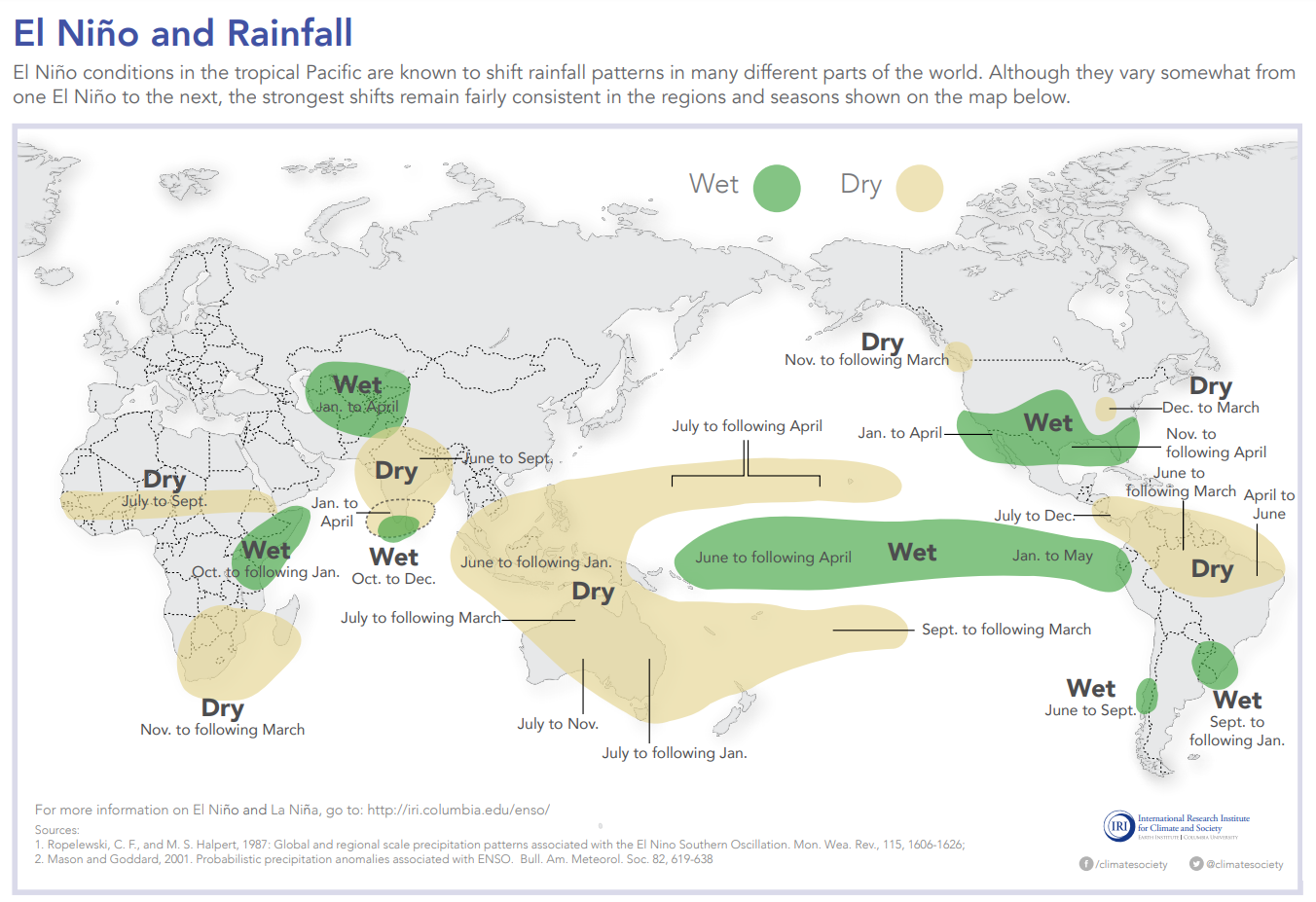
People tend to focus on El Niño’s impact on land, justifiably. The warm water affects air currents that leave areas wetter or drier than usual. It can ramp up storms in some areas, like the southern U.S., while tending to tamp down Atlantic hurricane activity.

El Niño can also wreak havoc on the many marine ecosystems that support the world’s fishing industries, including coral reefs and seagrass meadows.

Specifically, El Niño tends to trigger intense and widespread periods of extreme ocean warming known as marine heat waves.

Global ocean temperatures are already near record highs, so El Niño-induced marine heat waves could push many sensitive fisheries to a breaking point.

Read the full article at the Conversation

El Niño is officially here, and this one could be a doozy

June 12, 2026 — Prepare for intense heat, drought and some flooding — it’s officially El Niño season, the National Weather Service announced Thursday.

This El Niño event could be on par with some of the strongest documented in the past, according to models from the NWS.

“There is a 63% chance that we’re looking at a very strong El Niño during the November to January time period that could rank amongst the largest El Niño events in the historical record,” Ariel Cohen, a meteorologist for the NWS in Los Angeles, said at a news conference held by the Aquarium of the Pacific in Long Beach, California. “We’re already seeing those warm temperatures lining up.”

El Niño is a natural climate pattern that causes warm surface temperatures in the tropical Pacific Ocean. It’s associated with higher average global temperatures, so its effects exacerbate warming from climate change. The pattern is linked to fewer hurricanes in the Atlantic and more in the Pacific.

In the U.S., El Niño’s influence is most obvious in the winter, as it shifts the typical flow of the jet stream, the ribbon of air that encircles the Northern Hemisphere and drives weather patterns. The pattern typically pushes the jet stream south.

In the Pacific Northwest, that creates dry, warmer-than-usual conditions in winter, which is a concern this year because much of the region is already mired in drought after receiving middling snow. In Southern states, the trend typically brings unusually wet weather in the winter, which could prime the region for flooding.

El Niño can also drive powerful marine heat waves and scramble sea life, causing mass die-offs and bringing unusual tropical fish to coastal waters.

Read the full article at NBC News

Congress should heed the Pacific Ocean’s super El Niño warning

June 4, 2026 — Listen up, lawmakers: The Pacific Ocean is trying to send you a message about the federal budget.

About once every two to seven years, the Pacific trade winds weaken and water temperatures shift, causing profound impacts for the global climate. The phenomenon is called “El Niño.” The latest data from the world’s largest ocean are telling us that a “super El Niño: will likely develop this year, possibly among the most powerful such events ever recorded.

The possibility of a strong El Niño should serve as a wake-up call to Congress. Lawmakers are now considering the Trump administration’s proposed budget cuts to the National Oceanic and Atmospheric Administration — the agency known by the acronym NOAA (pronounced “Noah”), which serves as America’s eyes and ears on the world of weather.

If lawmakers choose to hollow out and treat this agency as a set of separable parts, the consequences for American communities and for the national economy will be dire.

Lawmakers in Washington must fully fund the agency’s work to monitor global weather patterns and keep Americans informed. By doing so, they will protect us all.

Read the full article at The Hill

Marine heatwave could combine with El Niño in Alaska this summer

May 19, 2026 — Marine heatwaves can wreak all sorts of havoc in Alaska: last year, a marine heatwave in the North Pacific ocean fueled Typhoon Halong, which devastated Alaskan communities. This summer there could be an extra hiccup: a strong El Niño event is likely according to the World Meteorological Organization, which could make the effects of a heatwave even worse.

El Niño events happen as a result of slower trade winds along the equator, which slows down the upwelling of cold water from deep in the ocean and causes overall warmer water conditions.

“We’re expecting a massive El Niño this year,” said Alaska Fisheries Science Center Director Bob Foy during a commercial fisheries trade show in Kodiak on April 16. “And it’s going to be larger than usual, it’s going to make its way to Alaska, we’ll probably see the effects of it this summer.”

The El Niño event could hit as another marine heatwave is brewing. Marine heatwaves happen when the temperature of the ocean is 4-5 degrees Fahrenheit higher than the baseline average for that area. According to research from the University of Alaska, Fairbanks, temperatures in the Gulf of Alaska have been generally trending upwards over the past fifty years, with an average increase of around 0.2 degrees C per decade. But marine heatwaves across the Pacific have hit even higher temperatures, and have become more frequent since the mid 2010s.

Read the full article at KMXT

What’s a ‘super El Niño’? And other El Niño questions, answered

May 18, 2026 — The odds are in El Niño’s favor right now.

This natural weather phenomenon, part of the El Niño-Southern Oscillation, or ENSO, occurs when warmer-than-average water extends throughout most of the equatorial Pacific Ocean just below the surface. That’s happening now. And powerful bursts of westerly wind have pushed immense amounts of warm water eastward, toward the Niño3.4 region where sea surface temperature, along with other atmospheric conditions, is used to assess the state of ENSO.

On May 14, in its monthly ENSO outlook, the NOAA/National Weather Service Climate Prediction Center gave an 82% chance that El Niño will be in place for the period May through July, which implies that it’ll be here within weeks.

How do experts know when El Niño has arrived?

El Niño conditions are declared when the atmosphere and ocean are in sync and the Niño3.4 sea surface temperature is at least 0.5 degrees Celsius (0.9°F) warmer than the seasonal average.

But just as hurricanes can and do stray from the “cone of uncertainty” at times, it’s vital to remember that El Niño can do much the same. Preparing for the prototypical outcomes is a smart move, as long as you keep in mind that forecasting the El Niño-Southern Oscillation is more a matter of probabilities than certainties.

NOAA now uses a Relative Oceanic Niño Index, or RONI, in which the Niño3.4 value is adjusted relative to the world’s tropical oceans as a whole; the goal is to keep global warming from smudging the signal of El Niño and La Niña events themselves.

Nearly all seasonal forecast ensembles used to predict ENSO at agencies around the world now concur that the imminent event is likely to bring Niño3.4 warming of at least 1.5°C, which would push it into the “strong” category. And some of the ensemble averages are now going well above 2°C, even for the adjusted RONI index. That would put it in the ballpark of the biggest El Niño events in the NOAA database going back to 1950.

Individual ensemble members still cover a fairly broad range, with outcomes varying from a weak event to a record-stomping one, but as shown below, they’re about as close to being unanimous on a significant El Niño as you’re likely to see. (This output is mainly using the traditional pre-RONI index, which tends to run slightly hotter on recent El Niño events.)

Read the full article at Yale Climate Connections

What is a ‘super El Niño’? Scientists predict record-breaking climate event this year

March 24, 2026 — The ever-shifting, interconnected system of global air and ocean currents dictates the weather we experience daily.

This year, however, scientists are warning that a particularly potent version of one of Earth’s most infamous climate phenomena, El Niño, could dramatically alter these patterns.

Climate scientist Daniel Swain recently posted on X (formerly Twitter), stating: “Whew. All signs are increasingly pointing to a significant, if not strong to very strong, El Niño event.”

This sentiment was echoed by Washington Post meteorologist Ben Noll, who cautioned that “changes in location, intensity and frequency of droughts, floods, heat waves and hurricanes are all likely.”

Read the full article at the Independent

West Coast Waters Experiencing Another Large Marine Heatwave

March 4, 2026 — A massive marine heatwave has dominated waters off the West Coast since last summer. This marks only the third time on record that such a large section of the coastal ocean has remained so warm for so long—particularly into winter months—without it being an El Niño, NOAA scientists report. NOAA Fisheries and our partners are tracking possible heatwave impacts, which can include harmful algal blooms that can sicken marine mammals and close shellfish fisheries.

Third Time as Warm

At one point last September, the current marine heatwave rivaled the enormous 2013–2016 marine heatwave known as “The Blob” in terms of size and surface temperatures. The current heatwave has raised the temperature of waters along the West Coast roughly 3 to 4 degrees Fahrenheit above normal. On September 9, 2025, the northeast Pacific reached its highest ever average temperature of 20.6 degrees Celsius, or about 69 degrees Fahrenheit. That’s almost a half-degree warmer than ever before. Past marine heatwaves shook up marine ecosystems that drove shifts of species, die-offs, and other disruptions of ecosystems in the Northeast Pacific Ocean.

“We have forecast tools that provide some insight, but we are also watching carefully for implications on the marine ecosystem,” said Andrew Leising, a research oceanographer at NOAA Fisheries’ Southwest Fisheries Science Center. He runs the California Current Marine Heatwave Tracker. The tracker has been documenting marine heatwaves off the West Coast through NOAA data from satellites, ships, and buoys since 2019.

The North Pacific has repeatedly hit record or near-record temperatures since The Blob. Like others before it, the current marine heatwave weakened and receded from the coast in October and November 2025. Unlike others, it has since strengthened and returned. “We’re in La Niña, but water temperatures along our coast look much different,” Leising said. “The conditions are hard to reconcile. We want to be cautious in our interpretation, but at the same time this is not a situation that we have seen before.”

Heatwaves Shift Species

The current heatwave has brought news of species in unusual areas, such as tunas caught in large numbers in Alaska last fall. The Blob and other marine heatwaves have been shown to reduce the survival of salmon in the ocean, leaving fewer fish to catch and to return to rivers to spawn. “We know these marine heatwaves alter ecosystem conditions, which affects fish and other marine life,” Leising said. “We’re very interested in what the fishing fleet and others who are out on the water are seeing and are looking into new ways to collect this information. Are there species in unusual places, or what might be changing?”

In addition, the unusual warmth could begin to set the stage for a repeat of last year’s harmful algal bloom off Southern California. It hit unusually early in 2025 and killed hundreds of California sea lions, dolphins, and seabirds. Harmful algal blooms can also close fisheries, especially recreational fisheries involving shellfish that concentrate the toxins, affecting the coastal economy.

Read the full article at NOAA Fisheries

Satellite data reveals 2023 was record-breaking for marine heatwaves — are we at a ‘climate tipping point?’

July 25, 2025 — A recent study that tapped into satellite data has revealed that 2023 marked an unprecedented year for marine heatwaves, with record-breaking levels of duration, reach and intensity observed across the world’s oceans.

The study’s scientists say tackling this growing climate threat will require better forecasting tools, smarter adaptation strategies, and faster action toward curbing climate change, which is primarily driven by human activities like burning coal for cheap power.

“The North Atlantic [marine heatwave], lasting 525 days, revealed the scale of persistent ocean warming,” wrote the research team in the paper published in the journal Science, “whereas the Southwest Pacific [heatwave] surpassed previous records with its extensive spatial coverage and prolonged persistence. In the Tropical Eastern Pacific, [marine heatwaves] peaked at 1.63°C during El Niño development, and the North Pacific sustained an ongoing anomaly over 4 years.”

Read the full article at Space.com

IFFO Members’ Meeting: Industry recovers from El Niño, charts future with byproducts and diversification

June 2, 2025 — IFFO’s Members’ Meeting, held in Madrid from May 13-14, 2025, brought together a record 267 delegates from 36 countries. This year, the main highlight was the industry’s recovery following the El Niño event.

During the meeting, Enrico Bachis, market research director at IFFO, presented 2025 projections for fishmeal and fish oil: 5.6 million tons of fishmeal and 1.2-1.3 million tons of fish oil. With Peruvian production recovering and other global producers maintaining stable levels, fishmeal and fish oil production are expected to remain consistent in 2025.

However, El Niño impacted more than just production levels, it also drove structural change in the industry. “This year, we saw Cooke acquiring Copeinca, and Centinela was acquired by Exalmar. Last year, another Peruvian company was also sold. Some companies are better positioned to withstand fishing bans, so after El Niño, we are seeing consolidation in the industry,” Bachis said.

Read the full article at Aquafeed.com

El Niño Yields to Upwelling in the California Current, Renewing Productivity of West Coast Ecosystem

March 10, 2025 — According to the NOAA California Current Integrated Ecosystem Assessment’s annual report, the California Current Ecosystem pulled out of a strong El Niño pattern in 2024. That El Niño delayed the onset of the annual spring upwelling of nutrient-laden water that, was nevertheless strong enough to fuel the rich West Coast ecosystem and improv environmental conditions  for salmon.

NOAA Fisheries scientists presented the report to the Pacific Fishery Management Council to inform upcoming decisions on fishing seasons. The report provides a snapshot of ocean conditions, fish population abundance and habitat, and fisheries landings and fishing communities’ conditions. It gives short-term forecasts and longer term projections of how conditions across the ecosystem may evolve in 2025 and beyond.

Report Highlights

  • Upwelling resumed even more strongly and consistently than normal, supplying a greater influx of nutrient-rich waters that improved forage conditions for many species
  • Productive waters supported abundant forage speciessuch as anchovy and krill and strong production of young hake and juvenile rockfish that could contribute to commercial fisheries in future years
  • Improved freshwater streamflows should support survival of juvenile salmon migrating downstream in California to the ocean
  • California sea lions found enough prey amid the El Niño warming, while experiencing harmful algal blooms that led to premature birth of pups and strandings along the coast

“Each year we learn more about how this marine ecosystem functions and what we should be watching to anticipate change,” said Andrew Leising, a research oceanographer at NOAA Fisheries’ Southwest Fisheries Science Center who coauthored the new report. “We’re getting better at forecasting what is coming at us, at the same time we see some new twists.”

Read the full article at NOAA Fisheries

  • « Previous Page
  • 1
  • 2
  • 3
  • 4
  • 5
  • …
  • 7
  • Next Page »

Recent Headlines

  • ALASKA: Alaska fishing and wildlife groups raise alarm over proposal for underwater Cook Inlet data center
  • US Congress sends Illegal Red Snapper and Tuna Enforcement Act to Trump
  • US Senator Ed Markey blocks quick passage of Bycatch Reduction Act
  • Kelp Farms and Marine Life Co-Exist in Southeast Alaska
  • MAINE: Restaurants, DTC suppliers highlight Maine lobster during Maine Lobster Week
  • 21 states challenge ESA changes that could affect US fisheries
  • North Carolina to appeal judge’s ruling on failed state fisheries management
  • LOUISIANA: Fishermen question LNG industry’s efforts to boost Louisiana fisheries

Most Popular Topics

Alaska Aquaculture ASMFC Atlantic States Marine Fisheries Commission BOEM California China Climate change Coronavirus COVID-19 Donald Trump Florida groundfish Gulf of Maine Gulf of Mexico IUU fishing Lobster Maine Massachusetts Mid-Atlantic National Marine Fisheries Service National Oceanic and Atmospheric Administration NEFMC New Bedford New England New England Fishery Management Council New Jersey New York NMFS NOAA NOAA Fisheries North Atlantic right whales North Carolina North Pacific offshore energy Offshore wind Pacific right whales Salmon South Atlantic Virginia Western Pacific Whales wind energy Wind Farms

Daily Updates & Alerts

Enter your email address to receive daily updates and alerts:

  • This field is for validation purposes and should be left unchanged.
Tweets by @savingseafood

Copyright © 2026 Saving Seafood · WordPress Web Design by Jessee Productions