Saving Seafood

  • Home
  • News
    • Alerts
    • Conservation & Environment
    • Council Actions
    • Economic Impact
    • Enforcement
    • International & Trade
    • Law
    • Management & Regulation
    • Regulations
    • Nutrition
    • Opinion
    • Other News
    • Safety
    • Science
    • State and Local
  • News by Region
    • New England
    • Mid-Atlantic
    • South Atlantic
    • Gulf of Mexico
    • Pacific
    • North Pacific
    • Western Pacific
  • About
    • Contact Us
    • Fishing Terms Glossary

MASSACHUSETTS: Fisheries Center Might Move Out Of Woods Hole

December 23, 2015 — The National Oceanic and Atmospheric Administration is exploring the possibility of relocating the Northeast Fisheries Science Center to a new facility outside of Woods Hole.

NOAA’s chief of research communications Teri Frady said Monday that the United States Department of Commerce, which oversees the NEFSC, has been evaluating the feasibility of the existing facility for about a year. She said a report will be completed by spring 2016 outlining options for the facility, which could include moving operations to a new building outside of Woods Hole.

The fisheries center, which operates as a research division of NOAA Fisheries, was founded by Spencer Fullerton Baird upon his appointment by President Ulysses S. Grant as the country’s first fisheries commissioner in 1871. The original facility was built on Water Street in 1885. After the facility was destroyed during Hurricane Carol, the current building was constructed in the same location in 1961.

Today, the Woods Hole branch manages operations of four other fisheries laboratories in the northeast, including those in Sandy Hook, New Jersey; Milford, Connecticut; Narragansett, Rhode Island; and Orono, Maine.

Ms. Frady said NOAA sees relocating as a way of possibly bringing all the fisheries operations together. In addition to its headquarters on Water Street, the fisheries houses its observer program on Carlson Lane, while its social sciences department operates out of leased space in the Falmouth Technology Park. The organization also operates a warehouse in Pocasset.
Read the full story at The Falmouth Enterprise

Rare North Atlantic right whale spotted off Gloucester, Mass.

December 1, 2015 — GLOUCESTER, Mass. — Lucky Gloucester residents got a rare glimpse of a North Atlantic right whale this week within 300 feet of the city’s rocky shoreline.

The whale sighted Sunday morning is one of only about 500 North Atlantic right whales left in existence, and though the animals regularly swim along the coast, they are seldom seen.

Researchers have confirmed that the whale spotted off Gloucester was a right whale.

“It’s one of the rarest individuals in the world, so to have this sighting is special,” said Amy Knowlton, a research scientist at the New England Aquarium. “They were hunted nearly to extinction … and they really have not recovered very quickly.”

The aquatic mammals feed on copecods, crustaceans that are abundant on Jeffreys Ledge, about 20 miles northeast of Gloucester, according to Tim Cole, a biologist with the National Oceanic and Atmospheric Administration’s Fisheries Science Center in Woods Hole.

Read the full story at the Boston Globe


Woods Hole Report: Climate, weather and the economy

October 31, 2015 — The coastal ocean and its fisheries have played a huge role in the cultural and economic development of Cape Cod. Yet recent changes in the atmosphere and deep ocean threaten the natural rhythms that govern the ecosystems of the shallow waters surrounding Cape Cod.

One factor affecting the coastal ocean in the northeastern United States is a change in the motions of the atmospheric jet stream. We felt the effects during the past winter, which was exceptionally cold and snowy. In recent years, the north-south movements of the jet stream have been increasing. However, the eastward motion has been stalling, resulting in more persistent weather patterns – cold or warm – that affect the temperature distribution in the coastal ocean.

In early 2015, the jet stream dipped well southward of its normal position and stalled, bringing a steady burst of storms moving along the coast and cooling the coastal ocean. By contrast, the jet stream remained well north of its normal wintertime position in the winter of 2011-2012 so that warm air remained over New England for much of the winter. As a result, spring water temperatures were much warmer than usual, 3-4 degrees Fahrenheit above normal over a six-month period, and as high as 10 degrees Fahrenheit for short time periods.

Research at Woods Hole Oceanographic Institution found temperatures of continental shelf waters in 2012 off New England were the highest they’ve been in 150 years of measurements.

Read the full story at The Metrowest Daily News


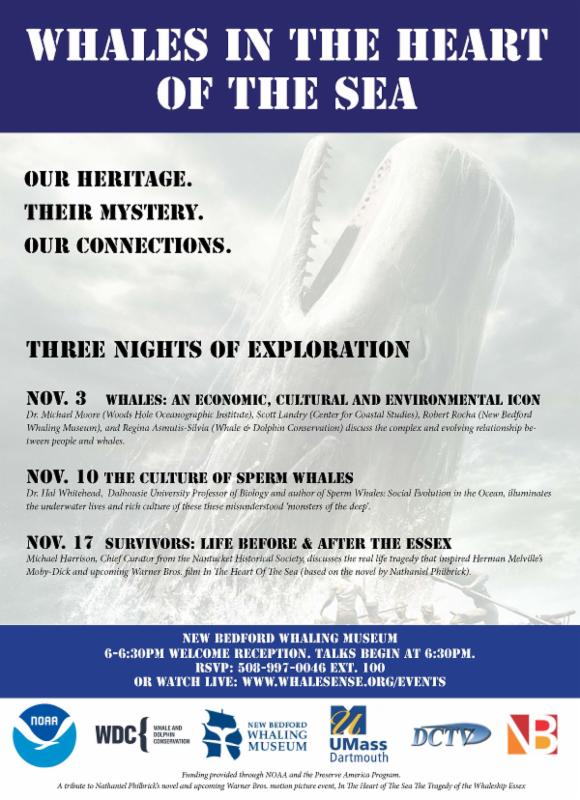
MASSACHUSETTS: Lecture Series: Whales in the Heart of the Sea

October 27, 2015 — The following was released by NOAA Fisheries:

The following free lectures exploring our evolving relationship with whales will take place at the New Bedford Whaling Museum. 

6:00 p.m. Reception  |  6:30 p.m. Lecture

Tuesday, Nov 3

Whales: An Economic, Cultural, and Environmental Icon

Dr. Michael Moore (Woods Hole Oceanographic Institute), Scott Landry (Center for Coastal Studies), Robert Rocha (New Bedford Whaling Museum), and Regina Asmutis-Silvia (Whale & Dolphin Conservation) discuss the complex and evolving relationship between people and whales.

Tuesday, Nov. 10 

The Culture of Sperm Whales 

Dr. Hal Whitehead, Dalhousie University Professor of Biology and author of Sperm Whales: Social Evolution in the Ocean, illuminates the underwater lives and rich culture of these these misunderstood “monsters of the deep.”

Tuesday, Nov. 17 

Survivors: Life Before & After the Essex 

Michael Harrison, Chief Curator from the Nantucket Historical Society, discusses the real life tragedy that inspired Herman Melville’s Moby-Dick and upcoming Warner Bros. film In The Heart of the Sea (based on the novel by Nathaniel Philbrick).

Save your seat by calling 508-997-0046 x 100 or register online.

These events will also be broadcast live online.  

This lecture series is supported by a grant from the NOAA Preserve America Initiative.

Questions? Contact Jennifer Goebel, Regional Office, at 978-281-9175 or Jennifer.Goebel@noaa.gov.


Changing coastal ocean affects Cape Cod economy

October 26, 2015 — The coastal ocean and its fisheries have played a huge role in the cultural and economic development of Cape Cod. Yet recent changes in the atmosphere and deep ocean threaten the natural rhythms that govern the ecosystems of the shallow waters surrounding Cape Cod.

One factor affecting the coastal ocean in the northeastern United States is a change in the motions of the atmospheric jet stream. We felt the effects during the past winter, which was exceptionally cold and snowy. In recent years, the north-south movements of the jet stream have been increasing. However, the eastward motion has been stalling, resulting in more persistent weather patterns — cold or warm — that affect the temperature distribution in the coastal ocean.

In early 2015, the jet stream dipped well southward of its normal position and stalled, bringing a steady burst of storms moving along the coast and cooling the coastal ocean. By contrast, the jet stream remained well north of its normal wintertime position in the winter of 2011-2012 so that warm air remained over New England for much of the winter. As a result, spring water temperatures were much warmer than usual, 3-4 degrees Fahrenheit above normal over a six-month period, and as high as 10 degrees Fahrenheit for short time periods.

Research at Woods Hole Oceanographic Institution found temperatures of continental shelf waters in 2012 off New England were the highest they’ve been in 150 years of measurements.

Read the full story at the Cape Cod Times


Woods Hole Science Stroll Sunday, August 9 Offers Free Family Science Activities

August 6, 2015 — Interested in touring a research vessel, seeing the submersible ALVIN and other ocean robots, or learning about research on whales and sea turtles, squid, plastics in the ocean, and climate change?

These activities are just a few of the many exhibits, demonstrations and displays to be featured by Woods Hole science organizations during the Woods Hole Science Stroll.

The free public event will be held Sunday, August 9 from 11 am to 3 pm on Water Street in Woods Hole. 

The NOAA Ship Henry B. Bigelow will be open for tours at the Woods Hole Oceanographic Institution (WHOI) dock, with the submersible ALVIN and other WHOI ocean robots on display nearby. The WHOI Ocean Science Exhibit Center, featuring interactive ocean exhibits, will be open on School Street. Visitors can see squid and other aquatic organisms in research tanks at the Marine Biological Laboratory’s Marine Resources Center, and learn about biology, biomedicine, and environmental science research at their Visitors Center on Water Street.

Get all the details about the day’s events or get directions and more information.

Questions? 

Contact Shelley Dawicki, Northeast Fisheries Science Center, at 508-289-2252 or Shelley.Dawicki@noaa.gov.

  • « Previous Page
  • 1
  • …
  • 11
  • 12
  • 13

Recent Headlines

  • Ocean Indicators We’re Tracking for El Niño’s Arrival on the West Coast
  • eDNA could play a bigger role in stock assessments
  • CALIFORNIA: El Niño bringing changes to Northern California ocean conditions and marine life
  • US Court Says Gulf of Mexico Fishery Council Has Too Much Power, but Overfishing Rule Can Stand
  • Western Pacific Scientists to Review Fishing Rules and Bottomfish Catch
  • US appeals court rejects challenge to turtle excluder device requirements in Louisiana
  • ALASKA: Seagrant launches Alaska Oyster Voyage interactive map and logging tool to encourage oyster consumption
  • Seafood Task Force launches first-of-its-kind tuna vessel monitoring program

Most Popular Topics

Alaska Aquaculture ASMFC Atlantic States Marine Fisheries Commission BOEM California China Climate change Coronavirus COVID-19 Donald Trump groundfish Gulf of Maine Gulf of Mexico Hawaii IUU fishing Lobster Maine Massachusetts Mid-Atlantic National Marine Fisheries Service National Oceanic and Atmospheric Administration NEFMC New Bedford New England New England Fishery Management Council New Jersey New York NMFS NOAA NOAA Fisheries North Atlantic right whales North Carolina North Pacific offshore energy Offshore wind Pacific right whales Salmon South Atlantic Virginia Western Pacific Whales wind energy Wind Farms
Tweets by @savingseafood

Copyright © 2026 Saving Seafood · WordPress Web Design by Jessee Productions