Saving Seafood

  • Home
  • News
    • Alerts
    • Conservation & Environment
    • Council Actions
    • Economic Impact
    • Enforcement
    • International & Trade
    • Law
    • Management & Regulation
    • Regulations
    • Nutrition
    • Opinion
    • Other News
    • Safety
    • Science
    • State and Local
  • News by Region
    • New England
    • Mid-Atlantic
    • South Atlantic
    • Gulf of Mexico
    • Pacific
    • North Pacific
    • Western Pacific
  • About
    • Contact Us
    • Fishing Terms Glossary

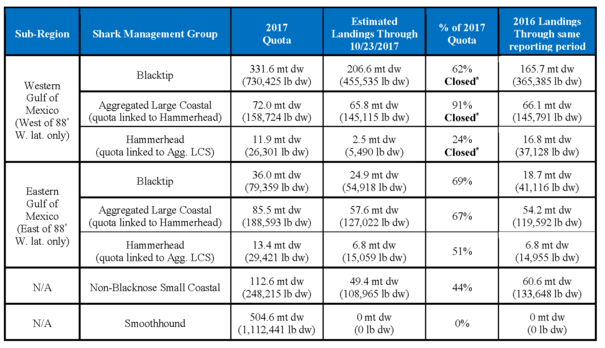
Shark Landings Update Through October 23, 2017

October 27, 2017 — The following was released by NOAA Fisheries:

The following are preliminary landings estimates in metric tons (mt) and pounds (lb) dressed weight (dw) for the Atlantic shark commercial fisheries; 1 mt is equal to 2,204.6 pounds.  These preliminary estimates are based on dealer reports and other information received from January 1 through October 23, 2017.  The estimates include landings by state-only permitted vessels, federally permitted vessels, and the 2017 shark research fishery participants.  We provide percentages of landings instead of estimated landings where needed to continue ensuring participant confidentiality.  The fishing seasons for all shark management groups opened on January 1, 2017, except for the aggregated LCS, blacktip shark, and hammerhead shark management groups in the western Gulf of Mexico sub-region which opened on February 1, 2017.

Gulf of Mexico Region

  • Includes any landings south and west 25° 20.4’ N. long.
  • As of 10/23/2017, the retention limit for directed permit holders is 45 large coastal sharks other than sandbar sharks per vessel per trip in the eastern Gulf of Mexico sub-region and no retention of large coastal sharks in the western Gulf of Mexico sub-region*.
  • The retention limit for directed permit holders can change throughout the season.

GOM

* Fishery closed at 11:30 p.m. local time on May 2, 2017 (82 FR 20447).

NMFS will announce closures of management groups when landings reach or are projected to reach 80 percent of the quota.  Management groups that are quota linked close when landings of either of the linked management groups reach or are projected to reach 80 percent of the quota.

For the full list of shark landings by region visit NOAA Fisheries

NOAA Fisheries Seeks Comments on Proposed Rule for Northeast Skate

October 20, 2017 — The following was released by NOAA Fisheries:

NOAA Fisheries seeks public comment on a proposed rule to modify the Northeast Skate Complex Fishery Management Plan.

Framework 4 would alter effort controls and possession limits to help reduce the risk of the skate bait fishery closing down as it did in fishing year 2016. Several measures are proposed to de-couple the skate wing and bait accountability measures, control catch, and provide a more consistent supply of skate bait to the lobster fishery. We propose to:

  • Reduce the Season 3 (November through April) bait skate possession limit from 25,000 lb to 12,000 lb;
  • Reduce the Season 3 bait skate in-season possession limit reduction threshold trigger from 90 to 80 percent;
  • Establish an 8,000-lb incidental possession limit for skate bait when a seasonal threshold trigger is reached; and,
  • Close the skate bait fishery when 100 percent of the quota is projected to be harvested.

To get all the details on these proposed management measures, read the proposed rule as published in theFederal Register today and the background documents available on the Regs.gov website.

We are accepting comments through November 6.

Please submit comments either through the online e-rulemaking portal or by mailing your comments to: John Bullard, Regional Administrator, National Marine Fisheries Service, 55 Great Republic Drive, Gloucester, MA, 01930.

Please mark the outside of the envelope, “Comments on the Proposed Rule for Skates Framework 4.”

Questions? Contact Jennifer Goebel at 978-281-9175 or jennifer.goebel@noaa.gov.

Feds seek dismissal of lawsuit over extended red snapper season

October 19, 2017 — WASHINGTON — U.S. officials accused of allowing red snapper to be overfished in the Gulf of Mexico have called on a federal judge to enter a summary judgement in their case, saying the environmental organizations suing them have a moot point.

The rule challenged by Ocean Conservancy and the Environmental Defense Fund to extend the recreational fishing season has already expired, said Jeffrey Wood, the acting assistant attorney general for the Environmental and Natural Resources Division of the U.S. Department of Justice. Wood also claims the federal court has no jurisdiction over the case.

“Even if the court were to find it has jurisdiction, the only appropriate course at this juncture is to remand to the agency for further action consistent with the Magnuson-Stevens Fishery Conservation and Management Act,” Wood argued in a 13 October filing.

The two organizations filed suit against Commerce Secretary Wilbur Ross, the National Oceanic and Atmospheric Administration and the National Marine Fisheries Service in July, a month after officials added 39 more days to the recreational fishing season.

Read the full story at Seafood Source

Alaska: Electronic monitoring rolling out in 2018 after years of work

October 19, 2017 — JUNEAU, Alaska — Alaska fishermen will see changes to the mandatory observer program next year.

After years of requests, testing and prepping, the National Marine Fisheries Service is rolling out a more-complete electronic monitoring program for small boat fishermen who are directed to have partial observer coverage as part of the 2018 observer program.

Electronic Monitoring uses cameras and sensors to record and monitor fishing activities, and help ensure the accuracy of catch records. Normally, that work is done by human observers who are placed on fishing vessels.

But when the North Pacific Fishery Management Council moved to put observers on smaller fishing vessels (those 60 feet or shorter) several years ago, to get a better sense of what was happening on those boats, captains said it could be problematic to take an extra person on their boats.

It was difficult to find them space to sleep, keep them safe and out of the way while actually catching fish and bringing them onboard, and hard (or burdensomely expensive) to ensure that there was enough life raft capacity and safety gear for an extra person. Instead, they asked for a camera system.

Developing such a system has taken several years, from the 2013 decision to restructure the observer program to see what was happening on smaller boats, to 2016, when 51 vessels participated in a pre-implementation program.

Read the full story at the Alaska Journal of Commerce

Live Cam May Show True Status of Atlantic Cod Fishery

October 18, 2017 — Atlantic cod, New England’s most iconic fish, has been reported at historic lows for years, but fishermen hope a new video monitoring technique will prove there are more of the fish than federal surveyors believe.

Ronnie Borjeson, who has been fishing for more than 40 years, says the federal surveys don’t match up with what fishermen are seeing. “I don’t care if you’re a gillnetter, a hook and line guy, a trawl guy,” he said, “there’s codfish everywhere up there. Everywhere. You can’t get away from them.”

Borjeson helped test a video rig designed by researchers at the University of Massachusetts Dartmouth that allows them to record fish underwater and count them on the video later. With this rig, scientists can sample a larger area in the same amount of time and hopefully improve federal estimates of how many cod are left.

According to the National Marine Fisheries Service, cod are overfished, and in 2014, the spawning population reached its lowest numbers ever recorded. The once-booming cod fishery has been subject to increasingly strict regulations since the 1990s, forcing commercial fishermen to target less-profitable species while they wait for the cod population to recover.

Read the full story at PBS

Restaurant demand fuels Maine, NH fish-to-table movement

October 17, 2017 — ELIOT, Maine — The vibrantly colorful Memorial Bridge passes overhead, briefly cutting through the early morning darkness, casting alternating hues of blues, reds, greens and yellows on the slack tide waters of Portsmouth Harbor.

It is 1:36 a.m. Friday, Sept. 8 and the crew of the small fishing boat F/V Finlander, a 36-foot Northern Bay, leaves the protection of the channel and ventures into the open Atlantic Ocean.

The pilot house of the Finlander is dark, illuminated only by a sole Global Positioning System (GPS) display screen showing navigational information and an eastward course plot. The boat begins to pitch as sea swells grow larger and cross winds increase.

“Today is going to be a rough one.” says Capt. Tim Rider, a Dover, New Hampshire, native and owner of the Finlander. “The wind is coming from a different direction than the swells, it’s going to bounce us all over. It’s going to get rougher the farther out we go, but I think we can handle it.”

The Finlander and her five-member crew are headed to fishing grounds approximately 60 miles due east of Portsmouth, New Hampshire, an ocean-going commute of four hours in five-foot seas. They will be fishing for Atlantic pollock, considered a successful and sustainable species of whitefish, according to the National Marine Fisheries Service FishWatch website, and whose popularity among Seacoast chefs is increasing.

Demand for locally caught fresh fish by Seacoast restaurants has created a viable market for the crew of the Finlander.

Read the full story from Foster’s Daily Democrat at the Bangor Daily News

Feds: Popular Species Of New England Flounder Is Overfished

October 17, 2017 — PORTLAND, Maine — Federal ocean managers say a popular species of New England food fish is overfished, and conservation measures are needed to rebuild its population.

The National Marine Fisheries Service says the Northwestern Atlantic witch flounder stock is overfished, and the status of whether overfishing is still occurring is unknown.

Witch flounder are mostly brought to shore by fishermen in Maine and Massachusetts.

Read the full story from the Associated Press at Maine Public

Survey shows GOA cod biomass down 71 percent

October 16, 2017 — CORDOVA, Alaska — Surveys and preliminary modeling for the 2018 Pacific cod stock assessment show that Pacific cod biomass is down substantially in the Gulf of Alaska, a NOAA Fisheries research biologist told the North Pacific Fishery Management Council during its fall meeting in Anchorage.

The data for the report by Steve Barbeaux of the Alaska Fisheries Science Center in Seattle only became available several days before the council meeting and the council’s Scientific and Statistical Committee expressed its appreciation of the rapid and extensive investigation that Barbeaux and others made, the SSC said.

The most salient survey result was a 71 percent reduction in the Gulf of Alaska bottom trawl survey Pacific cod biomass estimate from 2015 to 2017, a drop observed across the Gulf and particularly pronounced in the Central Gulf, Barbeaux told the SSC.

Barbeaux also presented additional data sets to the SSC that appeared to corroborate the trawl survey results, including a 53 percent drop in the National Martine Fisheries Service 2017 longline survey, and low estimates in recent years by the Alaska Department of Fish and Game large mesh trawl survey. Barbeaux said Pacific cod fishery data from 2017 indicated slower rates of catch accumulation and lower catch per unit effort over the season, at least in the central Gulf, compared to other recent years, and a change in depth distribution toward deeper waters.

Read the full story at The Cordova Times

Commerce extended red snapper season knowing it would lead to overfishing, memos reveal

October 16, 2017 — WASHINGTON — Internal memos show top Trump administration officials knew extending the recreational fishing season in the Gulf of Mexico from three to 42 days this summer would lead to significant overfishing.

But they did it anyway.

In memos released in response to a lawsuit, Commerce Department officials defended the move by saying that keeping the three-day season would be “devastating” to the recreational marine industry and the communities whose economies are tied to it.

And extending the time would also help solve a long-running dispute with states who have much longer seasons and want to wrest control of red snapper management from federal managers, they argued.

“It would result in overfishing of the stock by six million pounds (40%), which will draw criticism from environmental groups and commercial fishermen,” Earl Comstock, director of Policy and Strategic Planning for Commerce, conceded in a June 1 memo to his boss, Secretary Wilbur Ross. “However NMFS (National Marine Fisheries Service) agrees that this stock could handle this level on a temporary basis.”

Read the full story at USA Today

Sylvia Spalding: Congressman Was Wrong About Lobbying

October 10, 2017 — The Honolulu Civil Beat article “Congressman Blasts Fishery Council for ‘Improper Lobbying’” by Kirstin Downey repeats unsubstantiated and serious allegations of Congressman Gregorio Sablan (D-CNMI). These allegations could have been clarified through review of the procedures and regulations of the Western Pacific Regional Fishery Management Council, which are publicly available.

Green sea turtle petition: After considering the improved abundance and distribution information on Hawaii green sea turtles, the Council voted to direct Council staff to assist in the preparation of a request to the National Marine Fisheries Service to classify the population as a Distinct Population Segment as a step toward potential delisting.

The Council routinely makes conservation and management recommendations related to fisheries stocks, protected species and marine ecosystems, as authorized by the Magnuson-Stevens Fishery Conservation and Management Act (MSA).

Read this full opinion piece at the Honolulu Civil Beat

  • « Previous Page
  • 1
  • …
  • 82
  • 83
  • 84
  • 85
  • 86
  • …
  • 111
  • Next Page »

Recent Headlines

  • VIRGINIA: Comment period closes on proposed Virginia offshore mineral lease
  • USDA announces grants to extend cold chain to food assistance programs
  • Amazon greenwashing lawsuit drags dialogue around certification overreliance back into the spotlight
  • Trump’s offshore drilling revival survives early court challenge
  • Canada announces retaliatory tariffs on US, targets fish and seafood
  • From buoys to boats: Turning ocean data into tools for fishermen
  • DC Circuit upholds FERC approval of Louisiana LNG terminal
  • ALASKA: Record-breaking pink run surges into Sitka

Most Popular Topics

Alaska Aquaculture ASMFC Atlantic States Marine Fisheries Commission BOEM California China Climate change Coronavirus COVID-19 Donald Trump groundfish Gulf of Maine Gulf of Mexico Hawaii IUU fishing Lobster Maine Massachusetts Mid-Atlantic National Marine Fisheries Service National Oceanic and Atmospheric Administration NEFMC New Bedford New England New England Fishery Management Council New Jersey New York NMFS NOAA NOAA Fisheries North Atlantic right whales North Carolina North Pacific offshore energy Offshore wind Pacific right whales Salmon South Atlantic Virginia Western Pacific Whales wind energy Wind Farms

Daily Updates & Alerts

Enter your email address to receive daily updates and alerts:

  • This field is for validation purposes and should be left unchanged.
Tweets by @savingseafood

Copyright © 2026 Saving Seafood · WordPress Web Design by Jessee Productions