Saving Seafood

  • Home
  • News
    • Alerts
    • Conservation & Environment
    • Council Actions
    • Economic Impact
    • Enforcement
    • International & Trade
    • Law
    • Management & Regulation
    • Regulations
    • Nutrition
    • Opinion
    • Other News
    • Safety
    • Science
    • State and Local
  • News by Region
    • New England
    • Mid-Atlantic
    • South Atlantic
    • Gulf of Mexico
    • Pacific
    • North Pacific
    • Western Pacific
  • About
    • Contact Us
    • Fishing Terms Glossary

NOAA Fisheries Announces 2018/2019 Atlantic Sea Scallop Research Set-Aside Program Funding Opportunity

September 11, 2017 — The following was released by NOAA Fisheries:

NOAA Fisheries, in coordination with the New England Fishery Management Council, is soliciting Atlantic Sea Scallop research proposals under the 2018/2019 Atlantic Sea Scallop Research Set-Aside Program.

Under this program, proceeds generated from the sale of set-aside scallops will be used to fund research activities and compensate vessels that participate in research activities and/or harvest set-aside quota.

Projects funded under the Atlantic Sea Scallop Research Set-Aside Program must enhance the understanding of the scallop resource or contribute to scallop fishery management decisions. Priority is given to funding research proposals addressing the list of 2018 and 2019 Atlantic Sea Scallop Research Priorities listed in the Funding Opportunity.

Read the complete 2018/2019 Atlantic Sea Scallop Federal Funding Opportunity.

To apply for this NOAA Federal Funding Opportunity, go to Grants.gov, and use the following code: NOAA-NMFS-NEFSC-2018-2005322.

Complete proposals/applications must be received on or before 5 p.m. EDT on November 6, 2017.

For proposals submitted through Grants.gov, a date and time receipt will be the basis of determining timeliness. The proposal must be validated by Grants.gov in order to be considered timely. PLEASE NOTE: It may take Grants.gov up to two (2) business days to validate or reject the application. Please keep this in mind in developing your submission timeline.

If you prefer to mail your application, please send one signed original and two hard copy applications postmarked by November 6, 2017 to Cheryl A. Corbett, Northeast Fisheries Science Center, 166 Water Street, Woods Hole, MA 02543, ATTN: 2018/2019 Atlantic Scallop Research Set-Aside Program.

Find out more about Northeast Research Set-Aside Programs.

Questions? Contact Cheryl Corbett at 508-495-2070 or Cheryl.Corbett@noaa.gov.

Reminder to Scallop Fishermen: Closed Area II Access Area Closes August 15

August 10, 2017 — The following was released by NOAA Fisheries:

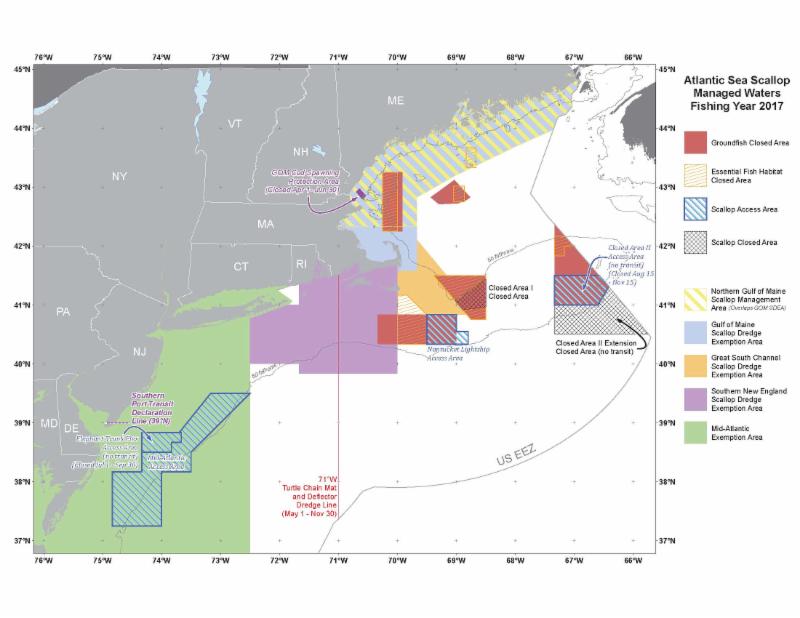
The Scallop Closed Area II Access Area will close at 12:01 am on August 15 and will remain closed through November 15. All vessels must be out of the area prior to the time of the closure.

Any unharvested Closed Area II pounds can be harvested once the area reopens on November 16.

For more information, see our new story map that describes the scallop fishery regulations for 2017, or see our large map of the scallop management areas (also below).

Fisheries Survival Fund Corrects the Record on Gulf of Maine Scallops

WASHINGTON — March 22, 2017 — The following was released by the Fisheries Survival Fund:

Atlantic sea scallops remain one of the most sustainably harvested stocks in the United States. With recent media attention on scallops in the northern Gulf of Maine (NGOM), the Fisheries Survival Fund, which represents the majority of the full-time Limited Access scallop fleet, has produced a fact sheet clarifying the true status of scallops in the region.

Recent data from the New England Fishery Management Council, which is responsible for sustainably managing the region’s scallop population, shows that Atlantic sea scallops in the NGOM are not overfished, nor are they experiencing overfishing. The Limited Access fleet is operating within its allocated federal quota, and the Atlantic sea scallop fishery remains certified as sustainable by the Marine Stewardship Council. It also shows that most fishing in the area does not actually take place in the geographical NGOM, but rather in southwestern Stellwagen Bank, off the coast of Massachusetts. There are currently 36 active NGOM scallop fishing vessels in the NGOM, only 18 of which are home-ported in Maine.

We have provided a fact sheet below using the official documents in order to clarify these claims.

Fact Sheet on Scallops in the Northern Gulf of Maine

  • There is no overfishing of the Northern Gulf of Maine (NGOM) scallop stock, nor is it rebuilding, as scallops in the NGOM are not considered a separate, unique stock. There are not separate reference points for NGOM scallops, nor are there separate Annual Catch Limits. For all management and scientific purposes, NGOM scallops are part of the overall scallop stock, and are included in the full scallop assessment. According to that assessment, scallops are not overfished and are not experiencing overfishing.
  • The catch limit for the general category scallop boats in NGOM, currently set at 70,000 pounds, is based upon historical catch. The NGOM scallopers were given these allocations because they did not qualify for the limited access scallop fleet. More information can be found in Amendment 11 to the scallop Fishery Management Plan on the NEFMC website: http://www.nefmc.org/library/amendment-11
  • There are 81 NGOM permits and only 36 active NGOM scallop vessels fishing in NGOM. Out of those, only 18 are home-ported in Maine. This can be verified in Table 4 below, which was obtained from the New England Fishery Management Council website, from the March 1 meeting of the Scallop Plan Development Team. The table can also be found in section 3.2.1 of Draft Discussions Document on NGOM management.
  • Most of the scallop fishing activity in the NGOM does not occur near Maine, but offshore Massachusetts, in the southwest corner of Stellwagen Bank. Some of this activity is outside the actual NGOM management area. A table illustrating this can be found below, and can also be found in the Draft Discussions Document on NGOM management in section 3.1.
  • The fishing activity of the limited access scallop fleet in the NGOM does not count towards the quota of the NGOM. The limited access fleet operates on a federal quota, in federal waters, under an entirely separate management system. This is not new: the limited access scallop fleet has been fishing in this area under this management program for many years.
  • The Atlantic Sea Scallop fishery is certified as sustainable by the Marine Stewardship Council. The scallop fishery’s commitment to sustainability is also reflected in their participation in the Research Set Aside program. Every year, a portion of revenue from the scallop catch is redirected towards research, which allows the scallop fishery to be managed by the most up-to-date science.
  • All points made have been confirmed with the most up to date NEFMC findings. These links are provided below:
  • http://www.nefmc.org/calendar/mar-1-2017-scallop-plan-development-team-meeting
  • http://www.nefmc.org/library/amendment-11
  • http://s3.amazonaws.com/nefmc.org/Doc4-170224_NGOM-Discussion-Draftv.2.pdf
  • http://s3.amazonaws.com/nefmc.org/Doc4a-NGOM-PDT_DataRequest_Feb2017_V2.pdf


Read the release here 

Scallop RSA proposals now being solicited for 2017 and 2018

August 9, 2016 — The following was released by the New England Fishery Managment Council:

Scallop industry members and partners have until 5 p.m. on Oct. 7, 2016 to submit applications for the latest round of funding available through the Scallop Research Set-Aside (RSA) Program.

The program was established through the Scallop Fishery Management Plan (FMP) to address scallop research priorities identified by the New England Fishery Management Council. The National Marine Fisheries Service (NMFS), in coordination with the Council, is now soliciting proposals for the 2017 and 2018 Atlantic Sea Scallop Federal Funding Opportunity (FFO).

To apply, go to www.grants.gov and use the following funding opportunity number: NOAA-NMFS-NEFSC-2017- 2004963.

NMFS emphasized, “Projects funded under the Scallop RSA Program must enhance the understanding of the scallop resource or contribute to scallop fishery management decisions. Priority is given to funding research proposals addressing the list of 2017 and 2018 Atlantic Sea Scallop Research Priorities listed in the FFO.”

Read the full release from the New England Fishery Management Council

  • « Previous Page
  • 1
  • …
  • 5
  • 6
  • 7

Recent Headlines

  • Virginia Menhaden Fishery Welcomes VIMS Dean Derek Aday’s Call for Science to Guide Chesapeake Bay Decisions
  • New NOAA Rule Helps Fishing Crews Reduce Whale Entanglements and Save Time
  • ‘We’re All Commercial Fishermen’: Maine and Virginia Stand Together on Menhaden
  • Shark Finning Bans Aren’t Stopping Shark Mortality. Here’s Why.
  • US data shows shark depredation tripled in Gulf, Southeast Atlantic over 20 years
  • ALASKA: Alaska seafood harvesting jobs are up for the first time since 2019
  • Revolution Wind fully operational, Ørsted reports
  • Maine, Virginia fishermen unite against further menhaden quota cuts

Most Popular Topics

Alaska Aquaculture ASMFC Atlantic States Marine Fisheries Commission BOEM California China Climate change Coronavirus COVID-19 Donald Trump Florida groundfish Gulf of Maine Gulf of Mexico IUU fishing Lobster Maine Massachusetts Mid-Atlantic National Marine Fisheries Service National Oceanic and Atmospheric Administration NEFMC New Bedford New England New England Fishery Management Council New Jersey New York NMFS NOAA NOAA Fisheries North Carolina North Pacific offshore energy Offshore wind Pacific right whales Salmon South Atlantic Virginia Washington Western Pacific Whales wind energy Wind Farms

Daily Updates & Alerts

Enter your email address to receive daily updates and alerts:

  • This field is for validation purposes and should be left unchanged.
Tweets by @savingseafood

Copyright © 2026 Saving Seafood · WordPress Web Design by Jessee Productions