Saving Seafood

  • Home
  • News
    • Alerts
    • Conservation & Environment
    • Council Actions
    • Economic Impact
    • Enforcement
    • International & Trade
    • Law
    • Management & Regulation
    • Regulations
    • Nutrition
    • Opinion
    • Other News
    • Safety
    • Science
    • State and Local
  • News by Region
    • New England
    • Mid-Atlantic
    • South Atlantic
    • Gulf of Mexico
    • Pacific
    • North Pacific
    • Western Pacific
  • About
    • Contact Us
    • Fishing Terms Glossary

Government Scientists Say A Controversial Pesticide Is Killing Endangered Salmon

January 12, 2018 — The federal government’s top fisheries experts say that three widely used pesticides — including the controversial insecticide chlorpyrifos — are jeopardizing the survival of many species of salmon, as well as orcas that feed on those salmon.

It’s a fresh attack on a chemical that the Environmental Protection Agency was ready to take off the market a year ago — until the Trump administration changed course.

Chlorpyrifos is widely used by farmers to protect crops like strawberries, broccoli and citrus fruit from insect pests. In recent years, though, scientists have found evidence that exposure to chlorpyrifos residues can harm the developing brains of small children, even in the womb.

Two years ago, the Environmental Protection Agency issued a proposal that would have stopped farmers from using chlorpyrifos. The final decision, however, fell to the Trump administration, and EPA Administrator Scott Pruitt decided to keep the chemical on the market while the agency continues to study its risks.

This new report, however, examines another danger entirely — the risk that chlorpyrifos and two other pesticides, diazinon and malathion, are washing into streams and rivers and harming wildlife.

The National Marine Fisheries Service concluded that continued use of the chemicals is likely to jeopardize the survival of endangered species of salmon, as well as orcas that eat the salmon. According to the report, use of chlorpyrifos is affecting 38 species of endangered fish, and it’s having negative effects on 37 areas that have been designated as “critical habitat” for endangered species.

Read the full story at New England Public Radio
 

Foes, friends praise retiring NOAA official’s approach

December 26, 2017 — He’s been called a Neanderthal and the most reviled man in the region’s fishing community. At a public meeting broadcast on national TV, a fisherman once accused him to his face of lying for a living.

As the regional fisheries administrator of the National Oceanic and Atmospheric Administration, John Bullard has drawn ire from all sides — fishermen, environmentalists, and politicians alike. His decisions have been routinely controversial, and he has rarely minced words in defending them.

Yet he has also earned widespread respect during his tenure as the region’s top fishing regulator, the rare public official willing to say what he thinks, no matter how unpopular. Earlier this year, he even publicly criticized his bosses, an offense that nearly got him fired.

As he prepares to retire from one of New England’s most influential — and thankless — government positions, Bullard, 70, has few regrets.

Read the full story at the Boston Globe


Trump team may have broken law to score red snapper win

December 19, 2017 — The Trump administration scored last week when a House panel voted to give Gulf of Mexico states more power in managing the popular red snapper, but court records suggest it may be a tainted victory.

Internal memos show that Commerce Secretary Wilbur Ross and a top adviser may have knowingly violated federal fisheries law in June when they extended the Gulf red snapper season, hoping the move would pressure Congress to act.

In a June 1 memo, Earl Comstock, the Commerce Department’s director of policy and strategic planning, told Ross that a longer season “would result in overfishing” of the stock by as much as 40 percent and possibly prompt a lawsuit.

But Comstock urged Ross to extend the season anyway, saying it could lead to “a significant achievement” by forcing Congress to liberalize the federal law and transfer more authority to Gulf states.

“It would allow a reset in the acrimonious relationship and set the stage for Congress to adopt a long-term fix,” Comstock told Ross.

Comstock followed up with a second memo on June 7, reminding his boss that both the White House and a dozen congressmen from Gulf states had asked Ross to explore the possibility of a longer fishing season.

The next week, Ross decided to extend the season from three to 42 days, much to the joy of recreational anglers in Florida, Texas, Louisiana, Mississippi and Alabama (Greenwire, Sept. 20).

Critics say the memos offer proof that Commerce and NOAA Fisheries plotted to bypass the Magnuson-Stevens Fishery Conservation and Management Act, a 1976 law that sets quotas as a way to rebuild overfished stocks, including the red snapper.

“I appreciate it when people are transparent about their intentions,” said Janis Searles Jones, the CEO of Ocean Conservancy, a nonprofit environmental group.

Commerce made the memos public as part of its response to a lawsuit filed in July in U.S. District Court in Washington by Ocean Conservancy and the Environmental Defense Fund. The complaint accuses Ross, NOAA and NOAA Fisheries of mismanagement by allowing overfishing.

Read the full story at E&E News


Zinke urges commercial fishing in 3 protected areas

December 7, 2017 — Much of the attention to Interior Secretary Ryan Zinke’s review of national monuments has focused on sites across the West, but recommendations he made to President Trump show that a trio of marine monuments could also see significant changes.

In a report Interior released yesterday, Zinke advised that commercial fishing be introduced to three ocean sites: Rose Atoll, Pacific Remote Islands, and Northeast Canyons and Seamounts marine national monuments.

Advocates for fishermen cheered the recommendations, asserting the restrictions had created an “economic burden” for their industry.

“The marine monument designation process may have been well intended, but it has simply lacked a comparable level of industry input, scientific rigor, and deliberation,” said New Bedford, Mass., Mayor Jon Mitchell in a statement released by the National Coalition for Fishing Communities.

He added: “That is why I think hitting the reset button ought to be welcomed no matter where one stands in the current fisheries debates, because the end result will be better policy and better outcomes.”

In the report, Zinke criticized restrictions on commercial fishing in the three monuments, discounting the industry’s impact on areas such as the Northeast Canyons and Seamounts near the Massachusetts coast.

Read the full story at E&E News


NCFC Members Reaffirm Support for Interior Department’s Marine Monument Recommendations

December 5, 2017 — The following was released by Saving Seafood’s National Coalition for Fishing Communities:

Following today’s official release of Interior Secretary Ryan Zinke’s recommendations to alter three marine national monuments, members of Saving Seafood’s National Coalition for Fishing Communities are reiterating their support for these recommendations, which will lessen the economic burden on America’s fishing communities while still providing environmental protections for our ocean resources.

In September, NCFC members expressed initial support for the changes when a draft of the recommendations were reported in the press. Because the final recommendations are identical to those initially reported, NCFC members stand by their initial statement, which is reproduced below:

Secretary Zinke’s recommendations to President Donald Trump would allow commercial fishing managed under the Magnuson-Stevens Act (MSA) in the recently designated Northeast Canyons and Seamounts Marine National Monument. He also  recommended revising the boundaries or allowing commercial fishing under the MSA in the Pacific Remote Islands Marine National Monument and the Rose Atoll Marine National Monument. NCFC members in the Pacific hope that the White House will extend these recommendations to the Papahānaumokuākea Marine National Monument, and appreciate the open and transparent process by which Secretary Zinke reviewed these designations.

Marine monument expansions and designations have been widely criticized by commercial fishing interests as well as by the nation’s eight regional fishery management councils, which in a May 16 letter told Secretary Zinke and Commerce Secretary Wilbur Ross that marine monument designations “have disrupted the ability of the Councils to manage fisheries throughout their range.” Fishing industry members believe these monuments were created with insufficient local input from stakeholders affected by the designations, and fishing communities felt largely ignored by previous administrations.

“The Northeast Canyons and Seamounts Marine National Monument was designated after behind-closed-door campaigns led by large, multinational, environmental lobbying firms, despite vocal opposition from local and federal officials, fisheries managers, and the fishing industry,” said Eric Reid, general manager of Seafreeze Shoreside in Narragansett, R.I., who has been critical of the Obama Administration’s process in designating the monument. “But the reported recommendations from the Interior Department make us hopeful that we can recover the areas we have fished sustainably for decades. We are grateful that the voices of fishermen and shore side businesses have finally been heard,” Mr. Reid concluded.

“There seems to be a huge misconception that there are limitless areas where displaced fishermen can go,” said Grant Moore, president of the Atlantic Offshore Lobstermen’s Association. “Basically with the stroke of a pen, President Obama put fishermen and their crews out of work and harmed all the shore-side businesses that support the fishing industry.”

“The fisheries management process under the existing Magnuson Act is far from perfect, but its great strength is that it has afforded ample opportunities for all stakeholders to study and comment on policy decisions, and for peer review of the scientific basis for those decisions,” stated Mayor Jon Mitchell of New Bedford, Massachusetts, the nation’s top-grossing commercial fishing port. In March, Mayor Mitchell submitted testimony to Congress expressing concern over marine monuments. “The marine monument designation process may have been well intended, but it has simply lacked a comparable level of industry input, scientific rigor, and deliberation. That is why I think hitting the reset button ought to be welcomed no matter where one stands in the current fisheries debates, because the end result will be better policy and better outcomes,” Mayor Mitchell concluded.

Fishermen in the Pacific are also supportive of the Interior Department’s review, but remain concerned about the effects of the Papahānaumokuākea Monument, which was omitted from the version of the recommendations being reported. “We are appreciative of Secretary Zinke’s review, and his reported recommendations to support commercial fishing in the Pacific Remote Islands Monument,” said Sean Martin, president of the Hawaii Longline Association. Hawaii’s longline fishing fleet supplies a large portion of the fresh tuna and other fish consumed in Hawaii. “However, we hope that the White House will extend these recommendations to the Papahānaumokuākea Monument, where President Obama closed an area nearly the size of Alaska without a substantive public process. The longline fleet caught about 2 million pounds of fish annually from the expanded area before it was closed to our American fishermen. That was a high price to pay for a presidential legacy,” Mr. Martin continued.

The recommended changes come after an extensive and open public comment period in which the Interior Department solicited opinions from scientists, environmentalists, industry stakeholders, and members of the public. As part of the Interior Department’s review process, Secretary Zinke engaged with communities around the country affected by monument designations. This included a meeting with local fishermen in Boston who explained how the designation of the Northeast Canyons and Seamounts Monument has negatively impacted their livelihoods.

Critics of the monument designation include the regional fishery management councils; numerous fishing groups on the East Coast; and mayors from fishing communities on both coasts.

Additionally, fishery managers in Hawaii have been critical of expansions of both the Papahānaumokuākea Monument and the Pacific Remote Islands Monument. In an April 26 letter to Secretary Zinke, the Western Pacific Regional Fishery Management Council stated that marine monuments around Hawaii “impose a disproportionate burden on our fishermen and indigenous communities,” and noted that they have closed regulated domestic commercial fishing in 51 percent of the U.S. exclusive economic zone in the region.

Florida charter fishermen applauded the review, and a return to the process of established law that guides fishery management. “Destin, Florida was founded by commercial fishermen before the turn of the 20th century, and continues to be a major port for commercial and charter fishing fleets,” said Captain Gary Jarvis, president of the Destin Charter Boat Association. “To our fishing community, it’s extremely important to address closures of historical fishing grounds through the Magnuson-Stevens mandated regional council process.”

Curiously, although President Obama’s September 2016 monument designation prohibited sustainable low-impact commercial fishing, it allowed other extractive activities including recreational fishing, and even far more destructive activities such as the digging of trenches for international communications cables.

NCFC members supporting the Interior Department’s reported recommendations include:

  • Atlantic Offshore Lobstermen’s Association
  • Destin Charter Boat Association
  • Fisheries Survival Fund
  • Garden State Seafood Association
  • Hawaii Longline Association
  • Long Island Commercial Fishing Association
  • North Carolina Fisheries Association
  • Seafreeze Shoreside
  • Southeastern Fisheries Association
  • Western Fishboat Owners Association
  • West Coast Seafood Processors Association

Learn more about the National Coalition for Fishing Communities here.


Trump Administration Dives Into Fish Fight

November 21, 2017 — WASHINGTON — An unprecedented Trump administration decision over the summer that overruled an interstate fishing commission has drawn the ire of critics who worry that keeping a healthy and viable supply of flounder in the Atlantic Ocean is being sacrificed to commercial profits.

While the fight over fish largely has been out of the public eye, it has implications for Maryland and other coastal states. Critics charge the controversy further underscores environmental backsliding by a White House beholden to business interests seeking fewer restrictions on the potentially harmful exploitation of natural resources.

In July, Secretary of Commerce Wilbur Ross overruled a recommendation by the Atlantic States Marine Fisheries Commission finding New Jersey out of compliance with proposed 2017 harvest limits of summer flounder along the Atlantic coast.

The reversal marked the first time since passage of the Atlantic Coastal Act in 1993 that the Department of Commerce overruled the commission’s finding of noncompliance, said commission spokeswoman Tina Berger.

“It was a big surprise that the commission’s authority would essentially be disregarded by the Commerce Department,” said Maryland Del. Dana Stein, D-Baltimore, one of the fisheries commissioners. “I was very disappointed upon hearing about this.”

Read the full story from the Associated Press at U.S. News and World Report

Rep. Walter Jones weighs in for North Carolina fishermen

November 2, 2017 — WASHINGTON — The following was released by the office of Congressman Walter Jones:

Congressman Walter B. Jones (NC-3) is moving to help Eastern North Carolina fishermen who could be hurt by legislation pending before Congress. The bills threaten America’s domestic shark fisheries, and a significant piece of those fisheries is in Eastern North Carolina. They are sustainably managed and help support the economy in coastal North Carolina and other small fishing communities around the country.

The bills – H.R. 1456 and S. 793 – purport to be an attempt to stop the practice of shark finning (i.e. the process of removing fins at sea and discarding the shark). They seek to do so by banning the sale of fins, even those harvested legally here in the United States. However well-intentioned the bill sponsors may be, the fact is that shark finning has been illegal in the United States for many years. Advocates for the legislation have countered with the false allegation that the practice is still widespread. They publicly claimed that NOAA Fisheries had 500 cases of shark finning over the last several years. That number sounded impossibly high to Congressman Jones, so in August he asked NOAA Fisheries for the real number of federal shark finning violations assessed over the past five years. According to NOAA, the real number is not 500, it is 22. The Associated Press recently ran a story correcting the record on the ‘fake news’ claims distributed by the bill’s supporters. You can find that story HERE.

“If foreign countries are failing to manage their shark populations appropriately, they should change their ways,” said Congressman Jones. “But we should not put U.S. fishermen out of business in the process.”

This week, Congressman Jones urged U.S. Secretary of Commerce Wilbur Ross to join him in opposing the legislation. The Commerce Department is home to the regulatory agency – NOAA Fisheries – which manages the domestic shark fisheries. As Congressman Jones pointed out to Secretary Ross in a letter, federal law mandates that the domestic shark fishery be managed sustainably. According to renowned shark scientist, Dr. Robert E. Heuter of Florida’s Mote Marine Lab, America has “one of the best systems in the world for shark fisheries management and conservation.” The proof can be seen in NOAA Fisheries own data. NOAA Fisheries’ 2015 coastal shark survey captured and tagged “more than 2,800 sharks, the most in the survey’s 29-year history.” The leader of the survey stated that NOAA Fisheries has “seen an increase in the number of sharks in every survey since 2001,” and the agency called the survey results “very good news for shark populations.”

“Mr. Secretary, you know how important good jobs are to America’s future,” said Congressman Jones. “The sustainably managed U.S. shark fishery helps many hard working people in Eastern North Carolina and across the country support their families and their communities. For the sake of the American fishermen who make this country great, I respectfully ask you to oppose these bills.”

Congressman Jones has long been a strong supporter and advocate for Eastern North Carolina fishermen.

Additional information on Jones’ backing of North Carolina fishermen can be found here.


Under threat of lawsuit, Maine lobstermen say Canada is failing to protect right whales

November 1, 2017 — A record number of right whale killings this summer has put environmental groups on the offensive, potentially leading to stricter regulations for Maine lobstermen, even as most of the animals turn up dead in Canadian waters.

A group of environmental organizations has notified federal officials they intend to sue if regulatory agencies fail to better protect the endangered species, following what’s believed to be one of the deadliest summers for North Atlantic right whales in centuries.

Maine lobstermen fear that a lawsuit against the National Marine Fisheries Service could result in more costly restrictions on how they fish, even though none of the 16 right whale deaths have been directly linked to the American lobster fishery. Twelve of the whale deaths occurred in Canada’s Gulf of St. Lawrence, where that country’s snow crab fishery has been cited by experts as a likely factor in several of the deaths.

The remaining four were found off Cape Cod.

With this year’s deaths, the total population of North Atlantic right whales is estimated at fewer than 450.

Early this month, the four environmental organizations sent a letter to Commerce Secretary Wilbur Ross and Chris Oliver, head of the federal fisheries service, saying that federal regulators are violating the Endangered Species Act by not doing more to protect North Atlantic right whales. The groups specifically called on regulators to determine whether additional restrictions should be placed on the American lobster fishery in order to prevent whales from getting entangled in lobster gear.

Read the full story at the Bangor Daily News

NOAA: American fisheries remain a strong economic driver

November 1, 2017 — The following was released by NOAA Fisheries:

Commercial and recreational fisheries remain a strong contributor to the United States economy, according to the annual Fisheries of the United States report released today by NOAA.

Saltwater recreational fishing remains one of America’s favorite pastimes and a key contributor to the national economy—with 9.6 million anglers making nearly 63 million trips in 2016, catching more than 371 million fish (61 percent of which are released alive), and in 2015, contributing $36 billion to the national economy. By weight, striped bass remains the top harvested catch among saltwater anglers, followed by dolphinfish, bluefish, yellowfin tuna, spotted seatrout, and summer flounder.

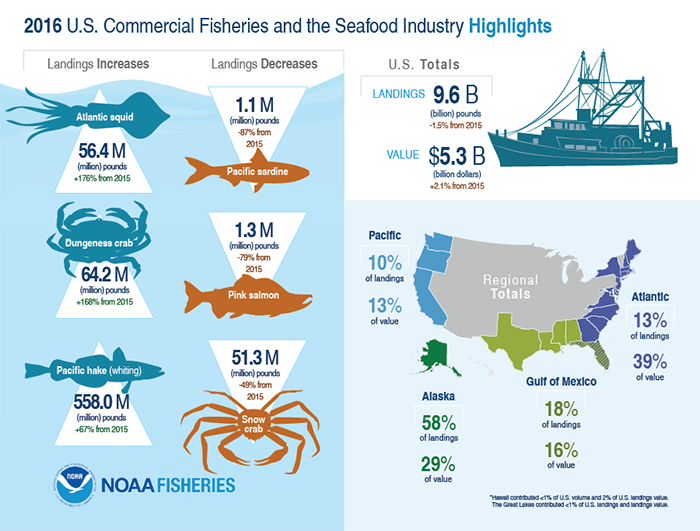
Also in 2016, U.S. commercial fishermen landed 9.6 billion pounds of seafood (down 1.5 percent from 2015) valued at $5.3 billion (up 2.1 percent from 2015). The highest value commercial species were lobster ($723 million), crabs ($704 million), scallops ($488 million), shrimp ($483 million), salmon ($420 million), and Alaska walleye pollock ($417 million). By volume, the nation’s largest commercial fishery remains Alaska walleye pollock, which showed near record landings of 3.4 billion pounds (up 3 percent from 2015), representing 35 percent of total U.S. commercial and recreational seafood landings.

In 2016, the U.S. imported 5.8 billion pounds of seafood (up 1 percent compared to 2015) worth $19.5 billion (up 3.5 percent). However, a significant portion of this imported seafood is caught by American fishermen, exported overseas for processing, and then reimported to the United States. Shrimp and salmon are two of the top three imported species and much of that is farm-raised. The U.S. ranks 16th in total aquaculture production around the world—far behind China, Indonesia and India. In 2015, 1.4 billion pounds of aquaculture production was reported in the U.S.

“With the United States importing billions of pounds of seafood annually, and with so much of that seafood foreign farm-raised, the numbers in this report underscore the untapped potential of aquaculture here at home,” said Secretary of Commerce Wilbur Ross. “Expanding our nation’s aquaculture capacity presents an opportunity to reduce America’s reliance on imports while creating thousands of new jobs.”

The report also shows that the average American ate 14.9 pounds of fish and shellfish in 2016, a decrease from 15.5 pounds the year before. U.S. dietary guidelines recommend 8-12 ounces of a variety of seafood species per week, or 26 to 39 pounds per person per year.

For the 20th consecutive year, the Alaskan port of Dutch Harbor led the nation in 2016 with the highest amount of seafood landed—770 million pounds, valued at $198 million. Walleye pollock accounted for 89 percent of that volume. Likewise, for the 17th year in a row, New Bedford, Massachusetts, claimed the highest value catch from one port—107 million pounds, valued at $327 million. Sea scallops accounted for 77 percent of that value.

NOAA Fisheries will release a detailed look at economic impact of recreational and commercial fisheries on the U.S. economy in the upcoming Fisheries Economics of the United States report.

View more facts and figures or read the report.

SEEKING HELP: Senators ask for funding to help fishing industry

November 1, 2017 — LINCOLN CITY, Oregon — In a bipartisan push led by Oregon’s Senator Jeff Merkley, all eight West Coast Senators—Merkley, Sen. Patty Murray (D-WA), Sen. Lisa Murkowski (R-AK), Sen. Dan Sullivan (R-AK), Sen. Dianne Feinstein (D-CA), Sen. Maria Cantwell (D-WA), Sen. Ron Wyden (D-OR) and Sen. Kamala Harris (D-CA) — today called on congressional leaders and the Trump administration to include disaster aid for fisheries in the next 2017 disaster funding package.

As the Senators pointed out in letters to Office of Management and Budget Director Mick Mulvaney and to congressional appropriations leaders, commercial fishing is a bedrock of the economy in many coastal communities, and leaving recent fisheries disasters unaddressed could have negative ripple effects for years to come.

“While the impacts of an extremely low run in a fishery or a complete fishery closure are harder to visualize than the impact of flood or wind damage, a collapsed fishery is indisputably a disaster for local and regional communities,” wrote the Senators. “Fishermen and women can make their yearly living during a single fishing season, and must continue to pay mortgages on their vessels, mooring fees, maintenance and feed their families while their income is almost entirely eliminated during a fishery closure or disaster.”

“It is essential that the Senate treat fishery disasters appropriately, and provide emergency funding that can enable fishermen and communities to recover from lost catches in the form of grants, job retraining, employment, and low-interest loans,” the Senators concluded.

Currently, the Secretary of Commerce has declared nine disasters for fisheries in 2017, and another disaster assistance request is pending in southern Oregon and northern California. As fishery seasons move forward in the Gulf of Mexico and South Atlantic, it is likely there will also be fishery disaster declarations in those regions.

Read the full story at the News Guard

  • « Previous Page
  • 1
  • …
  • 11
  • 12
  • 13
  • 14
  • 15
  • …
  • 20
  • Next Page »

Recent Headlines

  • Scientists did not recommend a 54 percent cut to the menhaden TAC
  • Broad coalition promotes Senate aquaculture bill
  • Chesapeake Bay region leaders approve revised agreement, commit to cleanup through 2040
  • ALASKA: Contamination safeguards of transboundary mining questioned
  • Federal government decides it won’t list American eel as species at risk
  • US Congress holds hearing on sea lion removals and salmon predation
  • MASSACHUSETTS: Seventeen months on, Vineyard Wind blade break investigation isn’t done
  • Sea lions keep gorging on endangered salmon despite 2018 law

Most Popular Topics

Alaska Aquaculture ASMFC Atlantic States Marine Fisheries Commission BOEM California China Climate change Coronavirus COVID-19 Donald Trump groundfish Gulf of Maine Gulf of Mexico Illegal fishing IUU fishing Lobster Maine Massachusetts Mid-Atlantic National Marine Fisheries Service National Oceanic and Atmospheric Administration NEFMC New Bedford New England New England Fishery Management Council New Jersey New York NMFS NOAA NOAA Fisheries North Atlantic right whales North Carolina North Pacific offshore energy Offshore wind Pacific right whales Salmon South Atlantic Virginia Western Pacific Whales wind energy Wind Farms

Daily Updates & Alerts

Enter your email address to receive daily updates and alerts:
  • This field is for validation purposes and should be left unchanged.
Tweets by @savingseafood

Copyright © 2025 Saving Seafood · WordPress Web Design by Jessee Productions