Saving Seafood

  • Home
  • News
    • Alerts
    • Conservation & Environment
    • Council Actions
    • Economic Impact
    • Enforcement
    • International & Trade
    • Law
    • Management & Regulation
    • Regulations
    • Nutrition
    • Opinion
    • Other News
    • Safety
    • Science
    • State and Local
  • News by Region
    • New England
    • Mid-Atlantic
    • South Atlantic
    • Gulf of Mexico
    • Pacific
    • North Pacific
    • Western Pacific
  • About
    • Contact Us
    • Fishing Terms Glossary

A 14-year-long oil spill in the Gulf of Mexico verges on becoming one of the worst in U.S. history

October 23, 2018 — An oil spill that has been quietly leaking millions of barrels into the Gulf of Mexico has gone unplugged for so long that it now verges on becoming one of the worst offshore disasters in U.S. history.

Between 300 and 700 barrels of oil per day have been spewing from a site 12 miles off the Louisiana coast since 2004, when an oil-production platform owned by Taylor Energy sank in a mudslide triggered by Hurricane Ivan. Many of the wells have not been capped, and federal officials estimate that the spill could continue through this century. With no fix in sight, the Taylor offshore spill is threatening to overtake BP’s Deepwater Horizon disaster as the largest ever.

As oil continues to spoil the Gulf, the Trump administration is proposing the largest expansion of leases for the oil and gas industry, with the potential to open nearly the entire outer continental shelf to offshore drilling. That includes the Atlantic coast, where drilling hasn’t happened in more than a half century and where hurricanes hit with double the regularity of the Gulf.

Expansion plans come despite fears that the offshore oil industry is poorly regulated and that the planet needs to decrease fossil fuels to combat climate change, as well as the knowledge that 14 years after Ivan took down Taylor’s platform, the broken wells are releasing so much oil that researchers needed respirators to study the damage.

“I don’t think people know that we have this ocean in the United States that’s filled with industry,” said Scott Eustis, an ecologist for the Gulf Restoration Network, as a six-seat plane circled the spill site on a flyover last summer. On the horizon, a forest of oil platforms rose up from the Gulf’s waters, and all that is left of the doomed Taylor platform are rainbow-colored oil slicks that are often visible for miles. He cannot imagine similar development in the Atlantic, where the majority of coastal state governors, lawmakers, attorneys general and residents have aligned against the administration’s proposal.
Read the full story at The Washington Post

California and the Trump administration rarely agree on energy policy. Here’s an exception.

October 23, 2018 — Under President Trump, the federal government and the nation’s most populous state have clashed on a number of fronts when it comes to energy and environmental policy.

But there’s at least one thing California and the Trump administration can agree on. Both want to erect wind turbines off of the state’s coast.

The Department of the Interior took its first steps last week toward developing offshore wind energy off the West Coast. “We’re opening the Pacific,” Interior Secretary Ryan Zinke said Wednesday at a wind energy conference in Washington.

“Regardless of what you read in the news, I get along with Jerry Brown,” Zinke added, referring to the outgoing Democratic governor of California who has emerged as one of the fiercest critics of the Trump administration’s energy policies. “Some things are not Republican or Democrat. A lot of things are red, white and blue.”

Read the full story at The Washington Post

MASSACHUSETTS: Cape Cod landing for offshore wind cable approved by Barnstable

October 23, 2018 — If all goes as planned, an underwater transmission cable for the nation’s first commercial-scale offshore wind plant will land at a Cape Cod beach.

Barnstable officials on Thursday agreed to grant Vineyard Wind a power cable easement at Covell Beach in the village of Centerville. The vote followed negotiation of a host community agreement that will pay the town up to $32 million over the next 25 years.

Vineyard Wind, based in New Bedford, says it’s on schedule to build its wind power station 34 miles off Cape Cod and 14 miles from Martha’s Vineyard. The company plans 106 turbines in a $2 billion project, and hopes to be operational in 2021.

The state’s Energy Facilities siting Board will have final say over the cable route, and environmental and fisheries considerations are part of the discussion. Other state and federal permits are still needed.

Vineyard Wind is a 50-50 partnership between Copenhagen Infrastructure Partners and Avangrid Renewables, and was selected in May by state officials and utility representatives to supply 800 megawatts of renewable power to Massachusetts.

The project will reduce the state’s carbon emissions by over 1.6 million tons per year, the equivalent of removing 325,000 cars, and power 400,000 homes, the company stated.

Read the full story at MassLive

RODA Hosts Vineyard Wind Workshop October 31st in Warwick, R.I.

October 22, 2018 — The following was released by the Responsible Offshore Development Alliance:

The Responsible Offshore Development Alliance (RODA) will convene a one-day workshop on October 31st, 2018 at the Crowne Plaza Hotel in Warwick, Rhode Island from 9 am-5 pm. The workshop will have two objectives:

To establish consensus on fishing transit lanes on the Vineyard Wind and adjacent lease sites; and
To provide broad-level input to Vineyard Wind regarding potential fisheries mitigation framework strategies.

This facilitated workshop will include representatives from the affected fishing industry, the states of Massachusetts and Rhode Island, Vineyard Wind, Ørsted, Deepwater Wind, the Bureau of Ocean Energy Management, National Marine Fisheries Service, and others. We urge all interested fishing industry participants to attend and provide feedback on these critically important issues.

Background

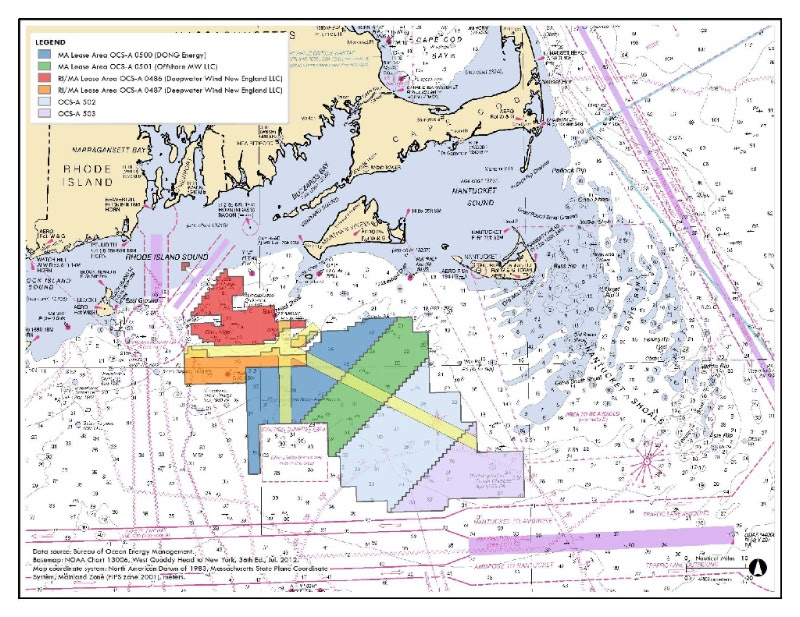
The Massachusetts Fisheries Working Group on Offshore Wind has spent considerable time over the past several months developing consensus on transit corridors through the wind energy lease sites in federal waters off of Massachusetts and Rhode Island that are acceptable to the fishing industry from safety and operational perspectives. The Rhode Island Fisheries Advisory Board has also engaged at length on this issue. At its meeting on September 20th, the Massachusetts group finalized a document that represented broad consensus from fishing industry and other participants. That recommendation is described in the following map:

Since then, certain interests have stated that they will not support the recommendation and there is now a great deal of uncertainty regarding what transit lanes will ultimately be proposed and approved. Therefore, this workshop is intended to consider minor revisions to that recommendation in order to achieve certainty surrounding the transit issue, using the MA consensus document as a starting point for the discussion.

Additionally, Vineyard Wind is in the process of developing fisheries mitigation recommendations for its lease site, which it will finalize in the very near future. This forum will allow an opportunity for the fishing industry to provide general input on elements of a successful mitigation plan for Vineyard Wind’s consideration.

For questions or additional information, please contact Annie Hawkins at annie@rodafisheries.org.

CALIFORNIA: U.S. Department of Interior soliciting interest in developing Central Coast offshore wind farms

October 19, 2018 — The U.S. Department of the Interior is taking public comment on two possible areas for wind farms on the Central Coast.

The Bureau of Ocean Energy Management is accepting interest in three sites off the California coast for potential wind development. One section would stretch from Cambria to San Simeon approximately 32 miles offshore, while a second site sits offshore the present Diablo Canyon Nuclear Power Plant.

The third area for potential wind development in California is near Humboldt Bay. Much of California’s coastline is otherwise off-limits to offshore wind farms.

The U.S. Department of the Interior is accepting interest from companies who want to develop the wind sites. A 100-day public comment period is also open until January 27.

The administration hopes that will lead to the West Coast’s first offshore wind auction.

Trident Winds, a German company, has already expressed interest in the Morro Bay site. Trident has proposed building roughly 100 floating wind turbines that would generate enough power for 300,000 homes.

Read the full story at KSBY

Trump administration to hold Massachusetts offshore wind auction in December

October 19, 2018 — Nearly 400,000 acres of the Massachusetts Wind Energy Area will be up for grabs in December, as the Trump administration holds its next offshore wind auction, officials announced this week.

U.S. Secretary of the Interior Ryan Zinke revealed Wednesday that the Bureau of Ocean Energy Management will auction off 388,569 acres located on the Outer Continental Shelf offshore Massachusetts on Dec. 13.

A total of 19 companies — including Deepwater Wind New England, LLC, Mayflower Wind Energy LLC, and Northeast Wind Energy, LLC, among others — have qualified to take part in the auction, according to the agency’s final sale notice.

The bureau will auction off three leases that are located in an area where two former leases were unsold during the Atlantic Wind Lease Sale in January 2015. The new lease areas will respectively cover about 129,000 acres, 127,000 acres and 132,000 acres.

Zinke touted the December auction, offering that “the Massachusetts sale has a lot of potential for both energy and economic activity.”

“If fully developed, the wind auction could support approximately 4.1 gigawatts of power to supply nearly 1.5 million homes,” he said in a statement. “This is just one example of the importance of fostering wind energy as a new American industry.”

Read the full story at MassLive

Offshore wind farms planned on East and West coasts

October 19, 2018 — The U.S. government is taking steps to develop offshore wind farms off both coasts.

Interior Secretary Ryan Zinke announced this week the Bureau of Ocean Energy Management will hold an offshore wind auction Dec. 13 for nearly 390,000 acres (157,831 hectares) of ocean off Massachusetts.

Zinke said the area, if fully developed, could supply power to nearly 1.5 million homes.

He also announced the bureau is opening its environmental review of a 15-turbine project off Long Island, New York, proposed by Deepwater Wind, operators of the nation’s lone commercial wind farm off Rhode Island.

And in California, Zinke announced the bureau is seeking comment on possible areas for wind development off the state’s central and northern coasts.

Read the full story from the Associated Press at ABC News

MASSACHUSETTS: Feds see much potential in state’s offshore wind

October 19, 2018 — The federal government plans in December to hold an offshore wind auction featuring 390,000 acres off the coast of Massachusetts, an area that officials say could provide enough power to serve 1.5 million homes.

“The Massachusetts sale has a lot of potential for both energy and economic activity,” Interior Secretary Ryan Zinke said in a statement after announcing plans for the Dec. 13 auction while addressing the American Wind Energy Association’s Offshore Wind Conference on Wednesday in Washington.

The federal government has previously leased waters off the coast of Massachusetts for offshore wind development and one of those leaseholders, Vineyard Wind, was selected by state and utility officials to build an 800-megawatt commercial wind energy installation south of Martha’s Vineyard.

On March 30, the Bureau of Ocean Energy Management (BOEM) announced its notice to prepare an environmental impact statement for the construction and operations plan submitted by Vineyard Wind.

Read the full story at The Salem News

Trump administration opens door for California offshore wind farms

October 18, 2018 — The Trump administration is considering allowing companies to build offshore wind farms off the coast of California.

Interior Secretary Ryan Zinke said his department’s Bureau of Ocean Energy Management (BOEM) will start taking comments this week on potential areas within about 1,073 square miles on California’s outer continental shelf that could host wind turbines.

The announcement, initially made at an industry conference Wednesday, came alongside news that BOEM will hold an auction in December to sell the rights to build offshore wind farms in an area off Massachusetts’s coast and that officials will start the environmental review process for the proposed South Fork Wind Project, a 15-turbine wind farm off Rhode Island.

While the Trump administration has sought to promote fossil fuels across numerous policy actions, Zinke said officials also strongly support wind power.

“I’m very bullish on offshore wind, and harnessing this renewable resource is a big part of the Trump administration’s made in America energy strategy,” Zinke said in a statement.

“We are always looking at new ways to increase American innovation and productivity to provide abundant and affordable energy for our homes and manufacturers. I think this is a win for America.”

The United States currently has just one utility-scale offshore wind farm, the Block Island project off Rhode Island. Companies have leased spots off the East Coast for other potential wind projects.

Read the full story at The Hill

EDWARD KRAPLES: We need more, not less, competition for offshore wind

October 15, 2018 — The offshore wind era in the United States is here. With no need to burn fossil fuel, to enrich uranium, to dam rivers, or to build thousands of acres of solar panels, offshore wind is the most benign form of bulk power available to mankind.

Plans to seize the potential of offshore wind already have powerful momentum on the East Coast. Between Massachusetts, New York, and New Jersey alone, more than 8,000 megawatts of wind power is envisioned. Building out 1,000 megawatts entails up to $5 billion of capital investment, drawing the attention of developers far and wide. So far, European companies — mostly giant, state-spawned enterprises with deep experience in the offshore — have been quickest to recognize this enormous investment opportunity. This week the Danish firm Ørsted bought the only remaining independent US company with offshore wind positions, Deepwater.

Ørsted’s acquisition of Deepwater naturally diminishes the amount of competition for offshore wind contracts. Policy-makers in Massachusetts should immediately take two actions: first, Gov. Charlie Baker should ask the US Bureau of Ocean Energy Management to increase the number of planned offshore wind lease areas from two to three. Another lease area would assure that the loss of Deepwater as a competitive entrant will be offset by the emergence of a new lease owner off the coast of Massachusetts.

Second, the Massachusetts Department of Energy Resources should even more strongly promote an ocean grid that serves as a platform for multiple offshore wind developers. The first request for proposals that have solicited offshore power did not stipulate anything about the transmission that will take it to market. Naturally, extremely large and competent offshore wind generators dearly wish to own both the wind farms and the conduit to land and have advanced arguments to the effect that, they, and they alone, can get the job done right.

But letting each generator plan and build and own major transmission lines to shore is akin to letting Walmart plan and build and own the interstate that leads to its stores using its customers money. Bundling generation and transmission limits bidders to the few that have the capacity to do both. Limiting the offshore opportunities to only a few competitors is never good for those paying the bills.

Read the full story at Commonwealth Magazine

  • « Previous Page
  • 1
  • …
  • 93
  • 94
  • 95
  • 96
  • 97
  • …
  • 103
  • Next Page »

Recent Headlines

  • Record Cobia Tournament Shows a Chesapeake Predator Thriving Alongside Menhaden
  • Caribbean Fishery Management: Voices from the Islands
  • Retiring of Calcasieu Pass brings opportunity for a menhaden bait fisherman
  • House to take up bill extending right whale regulatory pause to 2035
  • ALASKA: Mediocre Bristol Bay catch offset by soaring sockeye prices
  • Climate change may halve omega‑3 fatty acids in fish and the organisms they eat
  • ‘We’re facing a double whammy’: America’s hottest tinned fish snack is shrinking by nearly half thanks to climate change and war in Iran
  • $20 a pound — Connecticut consumers shell shocked by seafood prices. Here’s what to know

Most Popular Topics

Alaska Aquaculture ASMFC Atlantic States Marine Fisheries Commission BOEM California China Climate change Coronavirus COVID-19 Donald Trump groundfish Gulf of Maine Gulf of Mexico Hawaii IUU fishing Lobster Maine Massachusetts Mid-Atlantic National Marine Fisheries Service National Oceanic and Atmospheric Administration NEFMC New Bedford New England New England Fishery Management Council New Jersey New York NMFS NOAA NOAA Fisheries North Atlantic right whales North Carolina North Pacific offshore energy Offshore wind Pacific right whales Salmon South Atlantic Virginia Western Pacific Whales wind energy Wind Farms
Tweets by @savingseafood

Copyright © 2026 Saving Seafood · WordPress Web Design by Jessee Productions