Saving Seafood

  • Home
  • News
    • Alerts
    • Conservation & Environment
    • Council Actions
    • Economic Impact
    • Enforcement
    • International & Trade
    • Law
    • Management & Regulation
    • Regulations
    • Nutrition
    • Opinion
    • Other News
    • Safety
    • Science
    • State and Local
  • News by Region
    • New England
    • Mid-Atlantic
    • South Atlantic
    • Gulf of Mexico
    • Pacific
    • North Pacific
    • Western Pacific
  • About
    • Contact Us
    • Fishing Terms Glossary

Can crop insurance offer fishermen a better safety net?

November 12, 2026 — For commercial fishermen, a sudden fishery closure can mean losing an entire season’s income while bills keep coming. Vessel payments, insurance, moorage fees, and other operating expenses don’t disappear when a fishery shuts down, and federal disaster assistance can take years to reach the people who need it.

It’s a familiar problem across the industry, but Noah Oppenheim believes the conversation is finally shifting from identifying what’s broken to finding ways to fix it.

“The fact that conversations about enhanced risk management in commercial fisheries are all of a sudden happening in the industry, in Congress, and in the executive branch, that’s a first,” Oppenheim said in an interview with National Fisherman.

Oppenheim, principal of Homarus Strategies, will moderate a discussion on the issue at Pacific Marine Expo in Seattle on Nov. 20. The session, “Building a Real Safety Net: Risk Management for Commercial Fisheries,” will explore whether insurance programs modeled after those available to American farmers could provide commercial fishermen with a more reliable financial safety net.

For Oppenheim, the objective is to move the conversation beyond another discussion of the shortcomings of federal fishery disaster assistance. “We’re going to assume that we all know the fishery disaster process is a disaster. It’s broken,” he said.
Read the full article at the National Fisherman

ASMFC Coastal Sharks Board Sets Specifications for 2027-2031 to Complement the Federal Default Season Start Date and Retention Limits

November 11, 2026 — The following was released by the Atlantic States Marine Fisheries Commission: 

The Commission’s Coastal Sharks Management Board approved commercial fishery specifications for 2027 through 2031, matching the default season start date and retention limits as specified by the National Marine Fisheries Service final rule published on November 8, 2023. Beginning in 2024, the fishing year for Atlantic commercial shark fisheries automatically starts on January 1 of each year under the base quotas and default retention limits.

 
The Board set specifications that include a commercial possession limit of 55 large coastal sharks (LCS) other than sandbar sharks (i.e., aggregated LCS and hammerhead shark management groups) per vessel per trip and 8 blacknose sharks per vessel trip. NOAA Fisheries may consider in-season adjustments to the commercial possession limits depending on catch rates; states will follow NOAA Fisheries for in-season changes to the commercial possession limit. The Coastal Sharks Board does not actively set quotas for any species contained in the non-blacknose, small coastal shark (SCS), blacknose, aggregated LCS, hammerhead or pelagic species groups but will close the fishery for any species in these groups when NOAA Fisheries closes the fishery in federal waters, as outlined in the Interstate Fishery Management Plan (FMP).
 
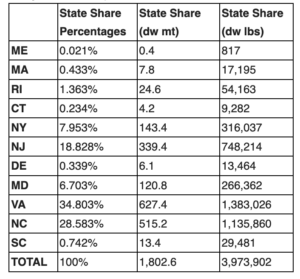
Under Addendum II to the FMP, the Coastal Sharks Board establishes state shares of the base federal coastwide quota for the Atlantic smooth dogfish fishery. At this meeting, the Board approved shares for 2027-2031 based on the base federal quota of 1,802.6 dressed weight (dw) metric tons, or 3,973,902 dw pounds (Table 1). Rollover of unused state shares is not permitted because it could result in overages of the federal coastwide quota.


Under the Coastal Sharks FMP, if a multi-year commercial quota and/or possession limit is implemented, annual review of updated information on the fishery and stock conditions by the Technical Committee and Management Board is required. If scientific review finds that specified measures should be modified based on updates to stock conditions, then the Coastal Sharks Board will be presented with this information and a new specification setting process will be initiated.
For more information, please contact Caitlin Starks, Senior Fishery Management Coordinator, at cstarks@asmfc.org or 703.842.0740.
Table 1. State shares of the coastwide smooth dogfish quota based on the base coastwide quota for the 2027-2031 fishing years (January – December).
###
PR26-18
The press release can also be found at https://asmfc.org/news/press-releases/asmfc-coastal-sharks-board-sets-specifications-for-2026-2031-to-complement-the-federal-default-season-start-date-and-retention-limits/

ALASKA: Alaska seafood harvesting jobs rise 4% after five years of declines

November 10, 2026 — Alaska’s commercial fishing industry recorded its largest increase in seafood harvesting employment in more than a decade in 2025, reversing five consecutive years of job losses as stronger salmon harvests, recovering crab fisheries, and increased groundfish activity helped bring more fishermen back to work.

According to the November 2026 edition of Alaska Economic Trends, published by the Alaska Department of Labor and Workforce Development, seafood harvesting employment increased 4 percent in 2025, adding an average of 216 jobs per month compared with 2024.

The increase marked a turnaround for an industry that had lost approximately 2,300 jobs since 2019, with harvesting employment reaching its lowest level on record in 2024. Despite the improvement, the state’s commercial fishing workforce remains considerably smaller than it was a decade ago.

State economist Joshua Warren, who authored the report, told KUCB that the industry’s prolonged decline was driven partly by the COVID-19 pandemic, along with fishery closures and reduced catch limits.

“Other industries saw some level of return once COVID measures stopped, but those trends just seemed to continue for seafood harvesting,” Warren said.

Closures of major Bering Sea crab fisheries, including snow crab and red king crab, contributed to the losses. However, some fisheries reopened in 2025, and stronger salmon production helped support the industry’s recovery.

“And we had a good salmon year, so there wasn’t a negative pressure that would cause things to continue to decrease,” Warren said.

Read the full article at the National Fisherman

ALASKA: Willapa Bay chum harvest hits five-year high despite early closure

November 10, 2026 — Commercial gillnet fishermen in Washington’s Willapa Bay landed nearly 143,000 chum salmon this fall, marking the fishery’s strongest harvest in at least five years despite an early closure prompted by concerns over coho salmon returns.

According to Washington Department of Fish and Wildlife (WDFW) figures reported by the Chinook Observer, commercial fishermen harvested 142,951 chum salmon during the 2026 season, up from 88,212 in 2025 and 65,057 in 2024. The total marks the third consecutive year of increasing commercial chum landings in Willapa Bay.

Most of this year’s harvest came during a two-week stretch in October. Between Oct. 11 and Oct. 24, fishermen landed 128,195 chum, accounting for nearly 90 percent of the season’s total catch.

Read the full article at the National Fisherman

ALASKA: Alaska seafood harvesting jobs are up for the first time since 2019

November 6, 2026 — Last year, Alaska saw the biggest increase in seafood harvesting jobs in more than a decade, according to a recent report from the state Department of Labor and Workforce Development.

Seafood harvesters include permit holders and boat crews. Their numbers increased by 4% over the previous year, averaging over 200 more jobs per month than in 2024.

That growth follows a five-year decline, with harvesting job numbers hitting an all-time low in 2024 since data collection began more than two decades ago.

Economist Joshua Warren authored the report for Alaska Economic Trends, the labor department’s magazines. He said that five-year decline was in large part due to the pandemic.

“Other industries saw some level of return once COVID measures stopped, but those trends just seemed to continue for seafood harvesting,” Warren said.

On top of that, Warren said some fisheries closed — like red king crab and snow crab in the Bering Sea — and others saw reduced catch limits. But last year there weren’t any new closures.

Read the full article at Alaska Public Media


CALIFORNIA: Northern California Dungeness crab season delayed until 2027

November 4, 2026 — California’s commercial Dungeness crab season will remain closed in the northern part of the state until at least Jan. 1, 2027, as fishery managers respond to humpback whale entanglements.

The California Department of Fish and Wildlife announced the delay Oct. 30, citing the number of humpback whales entangled in fishing gear this year. The department said postponing the commercial opener will give whales more time to migrate out of California waters before crab gear is deployed.

Read the full article at the National Fisherman

CALIFORNIA: No crab for the holidays as 2026 Dungeness season delayed to protect whales

November 2, 2026 — For the seventh consecutive year, California officials are delaying the Bay Area’s commercial Dungeness crab season because of the high number of migrating humpback whales already getting ensnared by old crab-pot fishing lines and other gear.

And again this year, conservation groups are expressing frustration with what they say is a too-slow transition to safer fishing methods that would allow the industry to get back on the water earlier.

The 2026-27 Dungeness season normally would start Nov. 15 – meaning Californians traditionally enjoyed crab on Thanksgiving and for the winter holidays.

Instead, commercial crabbing from the Oregon border south to Point Conception in Santa Barbara County has been postponed until at least Jan. 1, 2027, “due to the number of humpback whale entanglements during the 2026 calendar year,” state officials said.

“Unfortunately,” said senior scientist Geoff Shester, Oceana’s director of fishery innovation, “California is still the nation’s leader – or loser? – with the most entanglements reported of any U.S. state,” according to a recent National Oceanic and Atmospheric Administration report.

Read the full article at The Fresno Bee

Recent Headlines

  • New Research Finds Culling Seals, Sea Lions in the Ocean Unlikely to Benefit Salmon
  • Trump administration auctions deep-sea mining leases near American Samoa in first sale of its kind
  • Senate Republicans propose flat funding for NOAA Fisheries, rejecting Trump’s massive cuts
  • Lawsuit seeks federal action to protect North Pacific gray whales
  • Financing proposals offer hope for aging fishing fleet
  • Guam speakers urge NOAA to reject seabed mining application; company lists island as potential hub
  • Keyport launches first direct-to-consumer crab storefront
  • US Senate committee advances QUAHOG Act

Most Popular Topics

Alaska Aquaculture ASMFC Atlantic States Marine Fisheries Commission BOEM California China Climate change Coronavirus COVID-19 Donald Trump Florida groundfish Gulf of Maine Gulf of Mexico IUU fishing Lobster Maine Massachusetts Mid-Atlantic National Marine Fisheries Service National Oceanic and Atmospheric Administration NEFMC New Bedford New England New England Fishery Management Council New Jersey New York NMFS NOAA NOAA Fisheries North Carolina North Pacific offshore energy Offshore wind Pacific right whales Salmon South Atlantic Virginia Washington Western Pacific Whales wind energy Wind Farms

Daily Updates & Alerts

Enter your email address to receive daily updates and alerts:

  • This field is for validation purposes and should be left unchanged.
Tweets by @savingseafood

Copyright © 2026 Saving Seafood · WordPress Web Design by Jessee Productions