Saving Seafood

  • Home
  • News
    • Alerts
    • Conservation & Environment
    • Council Actions
    • Economic Impact
    • Enforcement
    • International & Trade
    • Law
    • Management & Regulation
    • Regulations
    • Nutrition
    • Opinion
    • Other News
    • Safety
    • Science
    • State and Local
  • News by Region
    • New England
    • Mid-Atlantic
    • South Atlantic
    • Gulf of Mexico
    • Pacific
    • North Pacific
    • Western Pacific
  • About
    • Contact Us
    • Fishing Terms Glossary

NEW JERSEY: Jersey Shore fishermen face another threat at sea. Chemical weapons dumped decades ago.

April 20, 2026 — A fishing crew harvesting clams off the coast of Cape May in October 2023 pulled up an unexpected and dangerous find alongside their catch — a leaking chemical weapon.

The incident led to a fisherman being treated for second-degree burns and the destruction of 32 bushels of surf clams, according to a March 5 report from the Centers for Disease Control and Prevention and the New Jersey Department of Health.

It may seem inconceivable, but it’s not the first time a fisherman in New Jersey has encountered chemical munitions at sea.

“It has happened in the past for some of the clam boats, which mainly operate in Atlantic City and Point Pleasant,” said Scot Mackey of the Garden State Seafood Association, a statewide organization of roughly 1,200 commercial fishers.

Read the full article at NJ.com
 

Fishing crews in the Atlantic keep accidentally dredging up chemical weapons

March 9, 2026 — Until 1970, the US dumped an estimated 17,000 tons of unspent chemical weapons from World War I and II off the coast of the Atlantic Ocean—and that disposal decision continues to haunt commercial fishing operations.

In an article published this week in the Morbidity and Mortality Weekly Report, health officials from New Jersey and the Centers for Disease Control and Prevention report that there were at least three incidents of commercial fishing crews dredging up dangerous chemical warfare munitions (CWMs) off the coast of New Jersey between 2016 and 2023.

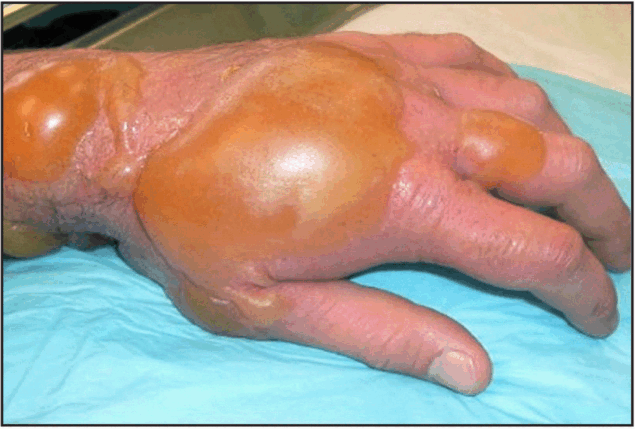
The three incidents exposed at least six crew members to mustard agent, which causes blistering chemical burns on skin and mucous membranes. (An example of these types of burns can be seen here, but be warned, the image is graphic.) One crew member required overnight treatment in an emergency department for respiratory distress and second-degree blistering burns. Another was burned so badly that they were hospitalized in a burn center and required skin grafting and physical therapy.

Read the full article at Ars Technica 

Going fishing? Watch out for chemical weapons

May 15, 2019 — The US Army will destroy stockpiles of mustard gas and nerve agents this summer as part of its commitment to a 1997 treaty banning the production and use of chemical weapons. The undertaking will require specialized personnel—toxic-materials handlers, chemical-accountability managers, surety specialists, ammunition surveillance/quality assurance specialists, and a coterie of supervisors.

In the decades immediately following World War II, America’s military wasn’t quite so buttoned up about its chemical cast-offs. Until Congress outlawed dumping of munitions at sea in 1972, there were an estimated 74 offshore chemical weapons disposals through 1970, 32 of which took place in US waters and 42 abroad.

Oceanographers at Texas A&M University have estimated that at least 31 million pounds of munitions of all types were dumped in waters off 16 states and in the Gulf of Mexico, although “that could be a very conservative estimate.”

The problem is not limited to US waters. Sections of the Baltic and North Seas are known to contain large numbers of abandoned chemical weapons, and such munitions have turned up off the coasts of France, Sweden, and Germany.

Read the full story at Quartz

Recent Headlines

  • Ocean Indicators We’re Tracking for El Niño’s Arrival on the West Coast
  • eDNA could play a bigger role in stock assessments
  • CALIFORNIA: El Niño bringing changes to Northern California ocean conditions and marine life
  • US Court Says Gulf of Mexico Fishery Council Has Too Much Power, but Overfishing Rule Can Stand
  • Western Pacific Scientists to Review Fishing Rules and Bottomfish Catch
  • US appeals court rejects challenge to turtle excluder device requirements in Louisiana
  • ALASKA: Seagrant launches Alaska Oyster Voyage interactive map and logging tool to encourage oyster consumption
  • Seafood Task Force launches first-of-its-kind tuna vessel monitoring program

Most Popular Topics

Alaska Aquaculture ASMFC Atlantic States Marine Fisheries Commission BOEM California China Climate change Coronavirus COVID-19 Donald Trump groundfish Gulf of Maine Gulf of Mexico Hawaii IUU fishing Lobster Maine Massachusetts Mid-Atlantic National Marine Fisheries Service National Oceanic and Atmospheric Administration NEFMC New Bedford New England New England Fishery Management Council New Jersey New York NMFS NOAA NOAA Fisheries North Atlantic right whales North Carolina North Pacific offshore energy Offshore wind Pacific right whales Salmon South Atlantic Virginia Western Pacific Whales wind energy Wind Farms
Tweets by @savingseafood

Copyright © 2026 Saving Seafood · WordPress Web Design by Jessee Productions