Saving Seafood

  • Home
  • News
    • Alerts
    • Conservation & Environment
    • Council Actions
    • Economic Impact
    • Enforcement
    • International & Trade
    • Law
    • Management & Regulation
    • Regulations
    • Nutrition
    • Opinion
    • Other News
    • Safety
    • Science
    • State and Local
  • News by Region
    • New England
    • Mid-Atlantic
    • South Atlantic
    • Gulf of Mexico
    • Pacific
    • North Pacific
    • Western Pacific
  • About
    • Contact Us
    • Fishing Terms Glossary

Vineyard Wind, R.I. fishermen still at odds over turbines

July 30, 2018 — NARRAGANSETT, R.I. — Nearly four months into a review of its proposal by Rhode Island coastal regulators, Vineyard Wind has been unable to allay fears that its proposed offshore wind farm of up to 100 turbines would harm the state’s fishing industry.

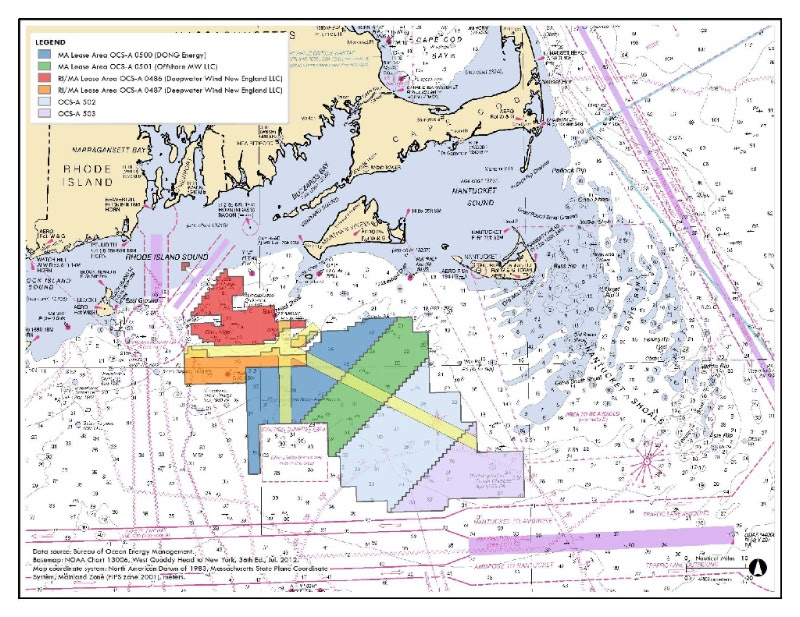
With a key approval from the Coastal Resources Management Council at stake, the New Bedford-based company has agreed to a two-month extension in an attempt to bridge the divide with agency staff and Rhode Island fishermen over the $2-billion project that would be built in 250 square miles of ocean south of Martha’s Vineyard.

At a recent meeting with the company and fishermen, Coastal Resources Management Council executive director Grover Fugate announced the stay, which pushes back a decision by the agency until Dec. 6.

The delay comes after Fugate sent a letter to Vineyard Wind signaling that the agency is unlikely to award a “consistency certification” to the 800-megawatt wind farm as it’s currently configured. Fugate recommended an alternate layout of the turbines to minimize impacts to fishing grounds for squid, lobster and other species that are critical to Rhode Island fishermen.

During the meeting last Thursday of the Fishermen’s Advisory Board, which advises the council on fishing issues related to offshore wind, Rhode Island fishermen complained that Vineyard Wind never took their needs into account when designing the wind farm. Over three hours of back and forth that at points grew heated, they repeatedly said that the orientation of the wind farm and the spacing of the turbines would make it nearly impossible for them to fish within its boundaries.

“You’re talking about gutting an entire industry, the Rhode Island industry,” said Lanny Dellinger, a lobsterman who heads the board. “If you do this, we’re all out of business.”

After the meeting, Fugate was asked if the council could approve the current design of the project.

Read the full story at the Providence Journal


Rhode Island Commercial Fishing Companies Support US House Changes To Magnuson-Stevens Act

July 24, 2018 — Local commercial fishing companies are part of a national coalition backing changes to federal fisheries law.

The law, known as the Magnuson-Stevens Act, has regulated marine fisheries across the country since 1976.

If a stock is being overfished, regional fishery management councils are required to rebuild the species within 10 years. However, the U.S. House of Representatives recently passed a partisan bill, H.R. 200, with largely Republican support that would scrap that rule.

“The 10-year rebuilding timeline was a completely arbitrary number; it was not based on science, it wasn’t based on biology, anything like that. It was just a random number that was picked,” Meghan Lapp, spokeswoman for Rhode Island-based Seafreeze Ltd., said.

Lapp said the company, along with others a part of the National Caolition for Fishing Communities, supports the bill because councils need more flexibility when developing rebuilding plans.

“(The councils) can take into consideration other factors, environmental factors, predator-prey relationships, etc.,” she said. “So, it’s actually more scientifically based than the previous version of Magnuson.”

Lapp said that flexibility could also help regional managers set better annual catch limits.

Read the full story at Rhode Island Public Radio

Rhode Island Environmentalists: Proposed Changes To Fishery Management ‘Could Threaten Years Of Progress’

July 19, 2018 — A local environmental nonprofit is speaking out against proposed changes to federal fishing regulations outlined under the Magnuson-Stevens Act.

The law has regulated fisheries in the U.S. since 1976. It was amended in 1996 and 2007 to help rebuild fish populations and prevent overfishing.

The U.S. House of Representatives recently passed a partisan bill with largely Republican support called H.R. 200 – Strengthening Fishing Communities and Increasing Flexibility in Fisheries Management Act that could give regional fishery councils more freedom to set catch limits.

Jennifer Felt, ocean campaign director for Conservation Law Foundation, said the change could threaten years of progress.

“These new regulations established by this bill would give the (management councils) the legal flexibility to set even looser standards, and we know that this will only compound the problem for fish like Atlantic Cod that are already on the brink,” Felt said.

Read the full story at Rhode Island Public Radio

Front line of climate change: Black sea bass surge off R.I.

July 16, 2018 — Scientists tell us that some fish will be winners and others losers as oceans warm.

In Rhode Island, count lobster, silver hake and winter flounder among the losers, their numbers plummeting as climate change drives water temperatures higher. On the list of winners so far are squid, summer flounder, butterfish.

And black sea bass. The population of the dusky-colored fish with striking blue accents has historically been strongest off the mid-Atlantic Coast, but over the past decade or so its numbers have spiked off New England and it is becoming a more important catch for the region’s fishermen.

In a telling sign of black sea bass’s surge in Rhode Island, the state Department of Environmental Management last month loosened regulations governing the recreational fishery for the species, extending the season by 31 days and increasing the fall possession limit to seven fish per person per day, from five.

Read the full story at The Providence Journal

Deepwater Wind says it can coexist with commercial fishermen

July 13, 2018 — Saying it wants to be “a good neighbor” to commercial fishermen, Deepwater Wind – the company with wind energy turbines off Rhode Island’s coast – announced Thursday it has adopted what it calls “first-of-its-kind” procedures to avoid damaging fishing gear.

Beginning this month, Deepwater said it will provide fishermen with frequent updates on its offshore activities, and the company is requiring all its vessels and personnel to comply with the initiative.

The procedures involve Deepwater’s fisheries liaisons and a team of fisheries representatives in regional ports, as well as online updates for mariners and twice-daily updates on VHF channels.

While Deepwater expects there will be only “limited impact” on fishing gear, the company said it also has adopted a process for handling claims of loss and damage of fishing gear.

Read the full at Providence Business News

House kills Rhode Island’s push to join Mid-Atlantic Fishery Council

July 12, 2018 — The House on Wednesday rejected a push from Rep. Jim Langevin to let his state join the Mid-Atlantic Fisheries Management Council, which regulates several species of fish that are caught mostly by fishermen from Langevin’s home state of Rhode Island.

The amendment would have added two seats on the 21-seat council for the state of Rhode Island. But after explaining why his state should join the group, the House rejected Langevin’s amendment in a voice vote, and Langevin, a Democrat, didn’t demand a recorded vote.

Langevin said on the floor that Rhode Island fishermen catch a large amount of fish that are regulated by the council, including 85 percent of all east coast butterfish, and also catch half of all squid landed on the east coast. Langevin has been pushing for legislation to add Rhode Island to the mid-Atlantic group for at least six years so a representative from his state can have a voice on the council on matters related to these and other kinds of fish.

Read the full story at the Washington Examiner

Rhode Island program trains motivated fishing apprentices

July 11, 2018 — In 40 years of fishing from Point Judith, Rhode Island, and another 12 conducting safety training, Fred Mattera has met many fishermen. Over time, he noticed a change in the crew.

“One of the things I started to see more often was this lack of youth,” said Mattera.

Those he did meet lacked motivation. They didn’t see commercial fishing as a career.

He decided to find some who did. In 2017, he helped launch the Commercial Fishing Apprenticeship Program with $120,000 from the National Fish and Wildlife Foundation. This year, Real Jobs Rhode Island is providing $150,000 to a class of 16 aspiring fishermen who started training on July 2.

In four weeks, apprentices learn about management, stock assessment, cooperative research, and the business of fishing. They spend three days at sea; handle local species in a biology class at the University of Rhode Island; and practice safety drills, rope mending and diesel maintenance. They’re then guided in choosing among local fisheries, including scalloping, trawling, gill netting, lobster and private charters. Graduates receive foul weather gear, a $1,000 stipend and a job.

Zane Maymon, a 24-year-old member of the 2017 class, said fishing had been in the back of his mind while growing up in Narragansett. After struggling with what to do after high school, he saw an ad for the program and applied.

“I liked how it was a cooperation between URI and the fishermen so we get to see the science and research,” said Maymon.

Read the full story at National Fisherman

Feds might allow fishermen to catch more skates

July 10, 2018 — The federal government is looking to allow fishermen to catch more Northeastern skates, which are caught for use as food and bait.

Skates are bottom-dwelling fish that are often sold in fish markets as “skate wing.” The National Oceanic and Atmospheric Administration is proposing to increase the annual catch limit for skates by about 8 percent, to nearly 70 million pounds.

The proposed rule changes would apply to a management plan for Northeastern skate fishery.

The biggest skate producing states are Alaska, Rhode Island and Massachusetts, though the fish are brought to land as far south as California on the West Coast and North Carolina on the East Coast.

The full proposed rule may found at https://bit.ly/2NDexjm

Read the full story from the Associated Press at the Gloucester Daily Times

RHODE ISLAND: Limited Availability of Local Seafood in New England

July 9, 2018 — Those looking to buy local seafood at grocery stores and fish markets in New England may have a difficult time finding much, especially if you’re searching for something other than shellfish. Just 15 percent of the seafood available at markets in the region originated in New England, according to a pilot study by the Rhode Island-based nonprofit Eating with the Ecosystem.

“Unfortunately, the results weren’t super surprising to me,” said Kate Masury, the program director for Eating with the Ecosystem who coordinated the project with University of Rhode Island professor Hiro Uchida and student Christina Montello. “We’re a seafood-producing region, it’s a big part of our economy, but we’re not making it available to our own consumers.”

Rhode Island’s results were better than the regional average, though still not as high as one might expect. About 24 percent of the seafood in Ocean State markets was captured in New England waters, which compares favorably to Massachusetts and Connecticut, at 12 percent each, and New Hampshire and Vermont, at 5 percent. Only Maine, at 33 percent, had more local seafood available in the markets surveyed than those in Rhode Island.

The findings are the result of a citizen science project called Market Blitz that took place over a two-week period in March. Volunteers visited 45 supermarkets and seafood markets in all six New England states to identify what species were available and where they were captured.

Read the full story at ecoRI

Rhode Island squid fishermen fear wind power

July 2, 2018 — Rhode Island fishermen say a patch of the Atlantic Ocean south of Martha’s Vineyard is among the best places around to catch squid.

They are also the same waters in which a developer selected by Massachusetts plans to install up to 100 giant wind turbines that would supply clean, renewable energy to the state.

Now, Rhode Island coastal regulators and the state’s fishing community are raising concerns that the offshore wind farm that Vineyard Wind wants to build in 250 square miles of federally-owned ocean may affect access to the squid grounds that are critical to the Point Judith fleet.

“They cut out scallop fisheries valued by Massachusetts,” said Grover Fugate, executive director of the Rhode Island Coastal Resources Management Council. “But the grounds left are valued by Rhode Island fishermen, particularly for squid.”

Erich Stephens, chief development officer for Vineyard Wind, said the company has worked hard to accommodate the needs of Rhode Island fishermen — such as working to restrict the prospective schedule for laying a transmission cable to avoid the height of the squid fishing season in the summer — but he also acknowledged the dissatisfaction in some quarters with the proposed 800-megawatt wind farm.

“At the end of the day, there are a lot of different interests,” Stephens said. “It’s not possible to come up with a single design that will keep everyone happy.”

Read the full story at the Providence Journal

  • « Previous Page
  • 1
  • …
  • 36
  • 37
  • 38
  • 39
  • 40
  • …
  • 59
  • Next Page »

Recent Headlines

  • Scientists did not recommend a 54 percent cut to the menhaden TAC
  • Broad coalition promotes Senate aquaculture bill
  • Chesapeake Bay region leaders approve revised agreement, commit to cleanup through 2040
  • ALASKA: Contamination safeguards of transboundary mining questioned
  • Federal government decides it won’t list American eel as species at risk
  • US Congress holds hearing on sea lion removals and salmon predation
  • MASSACHUSETTS: Seventeen months on, Vineyard Wind blade break investigation isn’t done
  • Sea lions keep gorging on endangered salmon despite 2018 law

Most Popular Topics

Alaska Aquaculture ASMFC Atlantic States Marine Fisheries Commission BOEM California China Climate change Coronavirus COVID-19 Donald Trump groundfish Gulf of Maine Gulf of Mexico Illegal fishing IUU fishing Lobster Maine Massachusetts Mid-Atlantic National Marine Fisheries Service National Oceanic and Atmospheric Administration NEFMC New Bedford New England New England Fishery Management Council New Jersey New York NMFS NOAA NOAA Fisheries North Atlantic right whales North Carolina North Pacific offshore energy Offshore wind Pacific right whales Salmon South Atlantic Virginia Western Pacific Whales wind energy Wind Farms

Daily Updates & Alerts

Enter your email address to receive daily updates and alerts:
  • This field is for validation purposes and should be left unchanged.
Tweets by @savingseafood

Copyright © 2025 Saving Seafood · WordPress Web Design by Jessee Productions