Saving Seafood

  • Home
  • News
    • Alerts
    • Conservation & Environment
    • Council Actions
    • Economic Impact
    • Enforcement
    • International & Trade
    • Law
    • Management & Regulation
    • Regulations
    • Nutrition
    • Opinion
    • Other News
    • Safety
    • Science
    • State and Local
  • News by Region
    • New England
    • Mid-Atlantic
    • South Atlantic
    • Gulf of Mexico
    • Pacific
    • North Pacific
    • Western Pacific
  • About
    • Contact Us
    • Fishing Terms Glossary

Federal Court Dismisses False Claims Act “Whistleblower” Lawsuit Against Ocean Harvesters, Cooke Inc., Omega Protein

Allegations against all defendants dismissed in full

January 6, 2025 — REEDVILLE, Va. — The following was released by Ocean Harvesters:

The United States District Court for the Southern District of New York on Friday dismissed in full the qui tam “whistleblower” lawsuit United States of America ex rel. Chiles and Manthey v. Cooke Inc. et al. brought by relators W. Benson Chiles and Chris Manthey. From the outset of this case, Cooke Inc., Omega Protein, and Ocean Harvesters have maintained that the lawsuit, which alleged violations of the False Claims Act (FCA), misstated the facts and ignored the law. In granting the companies’ motions to dismiss, the court agreed that the relators’ theory was unfounded and failed as a matter of law.

At issue in the litigation is the companies’ compliance with vessel citizenship laws. For years, federal regulators have repeatedly found Ocean Harvesters to meet the relevant requirements to lawfully engage in commercial fishing activities. Through the lawsuit, the relators attempted to supplant this regulatory regime by substituting their judgment for the considered views of federal officials. In dismissing the lawsuit, the court concluded that the FCA does not permit the relators to do that, as they failed to meet the foundational requirement of even alleging that the companies deprived the U.S. government of money or property.

Separately, the court rejected the relators’ so-called reverse FCA theory, under which they asked the court to step into regulators’ shoes and assess penalties against the companies, notwithstanding the fact that those very same regulators never deemed it appropriate to pursue such remedies. Indeed, as the companies have maintained throughout, their compliance with vessel citizenship requirements meant that there would be no basis to assess any penalties.

Historical Context: Regulatory Compliance and MARAD’s Review
Ocean Harvesters has consistently demonstrated transparency with federal regulators. Beginning in 2020, the U.S. Maritime Administration (MARAD) reviewed Ocean Harvesters documentation and, as reported by Undercurrent News, “found it to be satisfactory and in compliance with fishery endorsement requirements.”

Documentation submitted earlier in the lawsuit by the defendants demonstrated that relevant ownership details were fully disclosed to MARAD, including information regarding the ownership structure. This evidence contradicted the relators’ allegations of improper concealment.

Ocean Harvesters Responds
“We are pleased that the court has dismissed this baseless lawsuit,” said Ben Landry, spokesperson for Ocean Harvesters. “The decision underscores our commitment to full compliance with federal laws and regulations, and vindicates the integrity of our operations. From the outset, we have been transparent with regulators.”

This case was decided by United States District Judge Jesse M. Furman, who has been on the court since 2012.

Monty Deihl: Let’s set the record straight about menhaden fishing

December 18, 2024 — The following is an excerpt from an opinion piece published by The Virginian-Pilot and the Daily Press. It was written by Monty Deihl, the CEO of Ocean Harvesters, Inc. He is a native of Reedville, where he and his wife raised their family, and a retired Air Force officer.

A guest column published on Dec. 11 (“Menhaden harvesting has an impact on local fisheries”) contained several inaccuracies regarding the menhaden fishery — including Reedville-based companies Ocean Harvesters and Omega Protein — and the state of the Atlantic menhaden population.

Omega Protein neither “farms” fish nor engages in aquaculture. Menhaden used in Omega Protein’s products are harvested by Ocean Harvesters, an independent company that operates a fleet of nine vessels out of Reedville. Omega Protein processes the menhaden harvested by Ocean Harvesters into products that improve the nutritional integrity of foods, dietary supplements, and animal feeds.

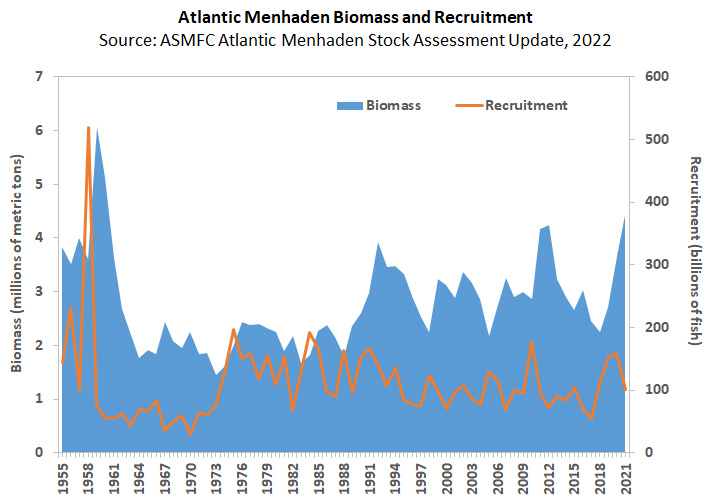
The menhaden population is not “dwindling.” The Atlantic States Marine Fisheries Commission (ASMFC) reports menhaden populations are abundant and sustainably managed. Menhaden are not overfished and are not experiencing overfishing. The biomass exceeded 4.5 million metric tons in 2022, while total commercial landings amounted to just 195,387 metric tons. The ASMFC says menhaden biomass has been stable since the 1960s.

At the August ASMFC meeting, both the representative from the Maryland Department of Natural Resources (DNR) and the Maryland governor’s appointee stated there are “no menhaden” in Maryland. Ironically, in October, the Maryland DNR juvenile striped bass survey found that juvenile menhaden abundance in the Chesapeake Bay over the past two years is at the highest level measured since 1990.

The menhaden fishery is certified sustainable by the Marine Stewardship Council. This required a rigorous, independent evaluation by third-party auditors confirming a healthy biomass, minimal environmental impact and a robust management system.

Atlantic menhaden is the first U.S. species managed to account for predator forage needs. In 2020, after a decade of work, the ASMFC implemented “ecological reference points.” This was applauded by numerous environmental advocates and the Chesapeake Bay Foundation.

Although some critics in the recreational fishing community claim a distinction between the coast-wide and Chesapeake Bay menhaden populations, no evidence supports this. Menhaden are migratory, naturally moving in and out of the Bay. At a Dec. 6, 2022, meeting, Virginia Institute of Marine Science (VIMS) scientists called “localized depletion” claims speculative and unsupported by evidence.

In recent months, the Chesapeake Bay Foundation and other groups publicized a controversial study allegedly linking menhaden harvesting and negative osprey reproductive success. At the August ASMFC meeting, the Chesapeake Bay Foundation’s Maryland executive director offered a motion creating a workgroup to consider more precautionary management of menhaden based on the study. But an article in the current Bay Journal highlights criticism from three VIMS fisheries scientists, who questioned the study’s data, methods and conclusion linking osprey nesting issues to menhaden fishing.

Antagonism between commercial menhaden and recreational fishing interests is nothing new. It was first reported in The New York Times in 1895. But recently, threats on social media and physical attacks on commercial vessels escalated to the point that Virginia amended its laws in 2024 to increase penalties for such dangerous actions. We are thankful to the governor, delegates and commercial watermen from other fisheries who worked hard to change the law to increase public safety.

Today, Ocean Harvesters and Omega Protein are the largest providers of union jobs with full benefits, and the largest minority employers in Northumberland County, serving as key economic drivers. My family has worked in the menhaden industry in Reedville for more than 100 years; it clothed and fed me, put me through school, and today employs my children and supports my grandchildren.

For more than a century, those in the Northern Neck’s menhaden fishing industry have defended their livelihoods against unfounded claims that menhaden purse-seine fishing harms recreational fishing. The debate will continue, but it must be based on fact. And the regulation of this job-creating industry must also be based on fact — not politics and unsubstantiated conjecture.

Read the op-ed at The Virginian-Pilot

Ocean Harvesters, Omega call for increase of wind facility buffers

November 6, 2024 — Ocean Harvesters and Omega Protein are calling on the federal government to increase the buffer for wind energy facilities from 6 miles to 15 miles, stating their operations are incompatible with wind turbine arrays and  critical adjustments are needed to protect the menhaden fishing industry.

The Reedville companies made those statements as part of their public comment to the Bureau of Ocean Energy Management (BOEM), which was soliciting feedback on possible commercial wind energy development in areas off the coasts of New Jersey, Delaware, Maryland, Virginia, and North Carolina.

Read the full article at News On The Neck

Ocean Harvesters and Omega Protein Call for 15-Mile Buffer Zone from Offshore Wind on Central Atlantic Outer Continental Shelf

October 24, 2024 — The following was released by Omega Protein and Ocean Harvesters:

Ocean Harvesters, owner and operator of nine menhaden purse seine vessels, and Omega Protein, which develops healthy products from menhaden, have called for a 15-mile buffer from offshore wind development on the Central Atlantic Outer Continental Shelf. Responding to the Bureau of Ocean Energy Management (BOEM) recently proposed Central Atlantic 2 Call Area (Docket No. BOEM-2024-0040), the two Reedville, Virginia-based companies wrote that their operations are incompatible with wind turbine arrays, and that critical adjustments are needed to protect the menhaden fishing industry.

Ocean Harvesters vessels harvest Atlantic menhaden in the Chesapeake Bay and in Atlantic Ocean waters from the mouth of the Bay to northern New Jersey, providing these catches exclusively to Omega Protein. This fishery, active in the communities of Virginia’s Northern Neck for over 140 years, supports the production of essential products for aquaculture, agriculture, and human nutrition.

On average, nearly 70 percent of Ocean Harvesters’ catch occurs in federal waters, with approximately 93,000 metric tons of menhaden harvested annually in the Exclusive Economic Zone between the Virginia-North Carolina border and Long Island. These operations rely on aerial spotter planes and a complex netting process to harvest menhaden, a method that is incompatible with wind turbine arrays. The range of the nets, the need for spotter planes to fly at low altitudes, and the drift of vessels during harvesting make it essential that a buffer zone be established around wind energy sites.

The companies recommend that BOEM move the boundary of Central Atlantic 2 Call Area seaward from the current six miles to 15 miles to prevent conflicts. Such a change would not only reduce conflicts with the menhaden fishery, but with many other small and large-scale commercial fisheries as well.

Maintaining an appropriate buffer zone is particularly crucial off the coast of Virginia because waters around the Chesapeake Bay are where conflicts with the menhaden fishery would be most acute. Additionally, the confluence of shipping lanes, military operations, and recreational traffic makes this a congested area in the ocean, of importance to numerous existing ocean users.

Ocean Harvesters and Omega Protein remain committed to working collaboratively with BOEM to find a solution that balances offshore renewable energy development with the preservation of vital commercial fisheries.

About Omega Protein
Omega Protein Corporation is a century old nutritional product company that develops, produces, and delivers healthy products derived from menhaden, a fish found abundantly off the U.S. Atlantic Coast and in the Gulf of Mexico. Omega Protein Corporation is a wholly owned subsidiary and division of Cooke Inc., a family-owned company based in New Brunswick, Canada.

Through its subsidiaries, Omega Protein owns three menhaden manufacturing facilities in the United States. Omega Protein also has a long-term supply contract with Ocean Harvesters, which owns 30 fishing vessels which harvest menhaden. All fishing vessels owned and operated by Ocean Harvesters, an independent company, were formerly owned by Omega Protein. Any references to commercial fishing of menhaden relate to Ocean Harvesters, not Omega Protein or Cooke Inc.

U.S. Geological Survey Presentation Raises Questions About Osprey-Menhaden Link Allegations

August 6, 2024 — The following was released by the Menhaden Fisheries Coalition:

Today at the Atlantic States Marine Fisheries Commission (ASMFC) summer meeting, the Menhaden Management Board heard a presentation on osprey populations from U.S. Geological Survey (USGS) scientists; considered but did not agree to a motion to start an addendum on additional commercial menhaden fishing restrictions in the Chesapeake Bay; and ultimately agreed, as a compromise, to create a working group to “consider and evaluate options for further precautionary management of Chesapeake Bay menhaden fisheries.”

The Chesapeake Bay Foundation (CBF) has issued a stunningly deceptive press release, mischaracterizing the tone of today’s ASMFC meeting and the action taken there. The CBF release suggests that the material presented by USGS overwhelmingly indicated a problem with osprey in the Chesapeake Bay, and that there was overwhelming support by ASMFC commissioners for additional regulation of menhaden in the Chesapeake Bay. Neither is true. The Menhaden Fisheries Coalition is issuing this release, together with the full audio of the meeting, to clarify the record. The full audio is available here.

Dr. Barnett Rattner and David Ziolkowski of the U.S. Geological Survey gave a presentation on the health of osprey populations from coast to coast. Mr. Ziolkowski noted that “in North America in the 1950s and 60s, osprey population started declining rapidly due to the effects of volcanic chlorine, pesticides like DDT, and it’s estimated that the Chesapeake Bay probably lost about half or more of its population.”

However, Mr. Ziolkowski explained that after measures were taken, including banning DDT, between 1966 and 2022, the eastern population of osprey increased by about 300%, and the Atlantic Coast population increased by about 587%. In the Chesapeake Bay it’s increased by about 1800% since 1960. He continued, “…what these numbers bear out is that osprey have made an astounding recovery by all accounts. The numbers are now in excess of historical numbers and in part that’s because they’ve returned to a world that’s very different than the world was before they started declining. There’s more suitable nesting structures. Water may be cleaner, et cetera.”

Mr. Ziolkowski did note that during the period from 2012 to 2022, “something’s going on,” as there has been a leveling off in the growth of the osprey populations in the mid-Atlantic. But he explained, “Care must be used when you’re interpreting these kinds of results and to understand what I mean, it’s helpful to look at osprey trends across the country. So here I’ll point out three things that I hope you take notice of in these graphs. On the left-hand side here, for example, California and Washington, opposite coast, you can see that there’s something going on in the same time period as there is here in Maryland, Virginia.”

Dr. Barnett Rattner and David Ziolkowski of the U.S. Geological Survey present a slide to the Menhaden Management Board showing that the recent leveling-off in Maryland and Virginia osprey populations, after years of explosive growth, is a phenomenon also being seen in states across the nation, on both the East and West Coast.

During the Q&A following the presentation, Commissioner Patrick Geer of Virginia, Chief of Fisheries Management at the Virginia Marine Resources Commission, noted that “Dr. [Bryan] Watts has done a survey in Virginia, for a number of years, going back to I believe 1993, which has shown the double crested cormorant population has increased 1416% in 25 years and brown pelicans have been about 882%. Now those species that are primarily piscivores…they’re competing for the same food source…Maybe the [osprey] nests aren’t surviving, maybe they’re moving out and these two species are moving in? Is that possible?” To which Dr. Rattner replied “Yes, it’s possible, certainly.”

After the presentation by the USGS scientists, Commissioner Lynn Waller Fegley of Maryland, Director of Fishing and Boating Services at the Maryland Department of Natural Resources, made a motion to initiate an addendum to the Atlantic Menhaden Interstate Fishery Management Plan to consider Chesapeake Bay-specific management options for menhaden purse seine vessels larger than 300 gross tons in order to support the need of piscivorous birds and fish during critical points of their life cycle, and include options for seasonal closures of Chesapeake Bay waters, but not consider changes to the current Bay cap of 51,000 metric tons.

It became immediately apparent that the board was divided on this proposal.

The provision targeting purse seine vessels over 300 tons was obviously included to target the commercial menhaden reduction fishery, which in Virginia is operated by Ocean Harvesters and supplies menhaden to Reedville-based processer Omega Protein. This was questioned by Commissioner Proxy Eric Reid of Rhode Island, who asked if the motion wasn’t inherently flawed, since although there are carrier vessels over 300 tons, those vessels get their fish from pairs of small purse seine boats, meaning that the motion accomplished nothing. Mr. Reid’s conjecture was confirmed by a member of the delegation from Virginia.

Commissioner Proxy Nichola Meserve of Massachusetts, Fishery Policy Analyst at the Massachusetts Division of Marine Fisheries, raised concerns about “diving immediately into an addendum process,” noting that other addenda in the past began “with a work group, a board work group that discussed the issues and the concerns that developed potential strategies.

After much procedural wrangling, there were two votes to postpone action on the motion, one until the October meeting and another indefinitely. Both of those votes tied 9-9. When it became apparent that the motion to initiate an addendum had reached a stalemate, Commissioner Proxy Dr. Allison Colden, Chesapeake Bay Foundation Maryland Executive Director, offered a substitute motion “to establish a board work group to consider and evaluate options for further precautionary management of Chesapeake Bay menhaden fisheries, including time and area closures, to be protective of piscivorous birds and fish during critical points of their life cycle.

The board members accepted this compromise unanimously by acclamation, without a roll call, and the working group is expected to report the results of their discussion to the Menhaden Management Board at its October 2024 meeting.

“Those attending the ASMFC’s Menhaden Management Board meeting in person or listening online could only come away with one clear message from the respected researchers at USGS, and that is the osprey’s numbers have dramatically increased and any challenges that the seabirds face are complex and multi-faceted, occurring in numerous locations on both the Atlantic and Pacific coasts, and cannot be blamed on the menhaden harvest in the Chesapeake Bay,” stated Ben Landry, Vice President of Public Affairs for Ocean Fleet Services and spokesperson for Ocean Harvesters. “To state otherwise is wholly dishonest, but that is commonplace for the Chesapeake Bay Foundation and its decades-long history of false and hyperbolic statements on menhaden fisheries.”

The menhaden fishery has long been attacked by those who refuse to accept the science-based conclusions of respected government agencies and independent assessment bodies. However, it is important to remember that since 2020, after a three-year, peer-reviewed effort, with input from both industry and environmental conservation groups, menhaden has been managed using ecological reference points that account for menhaden’s role as a forage fish throughout its range.

When the ecological reference points were adopted, Chesapeake Bay Foundation President William C. Baker stated in a release: “This is a historic day for fisheries management. Menhaden have been called the most important fish in the sea for good reason. Menhaden are an essential part of the diet of numerous fish species including striped bass, along with dolphins, whales, osprey and other seabirds.”

In 2020, Chris Moore, Senior Regional Ecosystem Scientist for CBF, wrote in the Bay Journal, “Striped bass, of all the predators studied, were shown to be the most sensitive to changes in the menhaden population. Therefore, adopting ecological reference points that protect striped bass will also protect other predator species that rely less on menhaden.”

Additionally:

  • In 2022, the Atlantic States Marine Fisheries Commission concluded there was no evidence that menhaden were being overfished along the Atlantic coast.
  • The Marine Stewardship Council in 2019 certified the Atlantic menhaden fishery as sustainable.

About the Menhaden Fisheries Coalition
The Menhaden Fisheries Coalition (MFC) is a collective of menhaden fishermen, related businesses, and supporting industries. Comprised of businesses along the Atlantic and Gulf coasts, the Menhaden Fisheries Coalition conducts media and public outreach on behalf of the menhaden industry to ensure that members of the public, media, and government are informed of important issues, events, and facts about the fishery.

Ocean Harvesters seeks dismissal of lawsuit claiming Cooke violated ownership laws

July 11, 2024 — Ocean Fleet Services and Ocean Harvesters have filed a motion to dismiss a lawsuit that claimed Blacks Harbour, New Brunswick, Canada-based Cooke Inc. violated foreign ownership laws when it acquired Omega Protein in 2017.

The lawsuit, filed in 2021, was recently unsealed after the U.S. Department of Justice declined to intervene. Filed in New York’s Southern District Court by W. Benson Chiles and Chris Manthey, the lawsuit claims Cooke could be liable for up to USD 2 billion (EUR 1.84 billion) in fines for exceeding foreign ownership requirements for domestic U.S. fishing fleets.

Read the full article at SeafoodSource

Omega Protein Fishing Partner Christens Two New Vessels, Reedville and Little River

May 7, 2023 — The following was released by Omega Protein:

Ocean Harvesters, Omega Protein’s fishing partner, kicked off the 2023 fishing season by christening two new vessels for the Atlantic menhaden fishery. The F/V Reedville and the F/V Little River are the two latest additions to the fleet of Ocean Harvesters, which fishes for menhaden in Virginia and operates a long-term supply contract with Omega Protein.


The vessels were christened on Saturday April 22 in a ceremony at Omega Protein’s facility in Reedville, Virginia. Kathy Deihl, Kelly Walker, Kristy Hall and Faye Hall, all long-time members of the local fishing community with ties to Omega Protein, served as sponsors of the vessels and assisted in breaking the ceremonial champagne bottles over their hulls. Hannah Long, the environmental manager for the Reedville plant, served as master of ceremonies, with remarks given by members of the Ocean Harvesters team.

F/V Reedville

“This is a symbol of continued investment,” said Monty Deihl, the CEO of Ocean Harvesters, as part of his opening remarks. “It’s not just [an investment] in the plant and in the vessel fleet, but it’s also an investment in the people here and the community of Reedville, and those people who are dependent on this business to support their families.”

F/V Little River

Both the Reedville and the Little River previously served in the Gulf of Mexico as supply ships for the offshore oil industry, before being acquired and refitted by the Omega Shipyard in Moss Point, Mississippi. Reedville was originally built in 1982, and will mark its first fishing season this year. Little River, built in 1977, began its new career fishing in 2020, but was officially christened this season after delays due to Covid.

Ocean Harvesters CEO Monty Deihl, delivering remarks at the ceremony

Reedville and Little River are names with storied histories in the fishery. Both names were previously bestowed on a pair of older, long-serving fishing vessels, which were converted from World War II service boats and then went on to work for decades catching menhaden.

F/V Reedville

“As a 3rd generation employee in the menhaden fishing industry, I am pleased to see this multimillion-dollar investment in the future of our business,” said Andy Hall, General Manager of Reedville Operations for Ocean Harvesters. “It represents Ocean Harvesters’ continuing commitment to provide our employees with the best, safest, and most state-of-the-art menhaden fishing vessels in the world. My hope is that the Reedville and Little River will fulfill their destinies of support to the local communities for decades to come, much like the original Reedville and Little River.”


Menhaden crews rescue boaters in Gulf of Mexico

June 3, 2022 — Menhaden fishermen working in the Gulf of Mexico rescued six boaters, including two children, after their small craft capsized in the Mississippi Sound May 31.

Purse seine crews from the F/V Mississippi Sound and the F/V Frosty Morn, recovered two people from the water and four atop the overturned boat around 2 p.m.

Mississippi Sound captain Joel Deihl said the vessels responded to a Coast Guard broadcast about the boaters in distress and located them. After picking up the boaters the purse seine crews transferred them to the Coast Guard.

Read the full story at National Fisherman

Restrictive Louisiana Menhaden Legislation Would Have Major Costs; New Report Details Fishery’s Economic Value

May 2, 2022 — The following was released by the Menhaden Fisheries Coalition:

A bill introduced in the Louisiana State Legislature earlier this month would enact harsh restrictions on menhaden fishing within the three miles from shore comprising the state’s waters. Now a new economic report, funded by the Science Center for Marine Fisheries (SCEMFIS), shows the economic importance of the Gulf menhaden fishery to Louisiana and Mississippi, illustrating how devastating such legislation could be to coastal communities.

Produced by Thomas J. Murray and Associates and led by a respected former Virginia Institute of Marine Science economist, the report shows that over two-thirds (67.7 percent) of the overall Gulf menhaden catch coastwide occurs within three miles of shore, generating $285 million in economic output. Menhaden fishing in these state waters supports 1,400 jobs, according to the report. Overall, the Gulf menhaden fishery generates $419 million in economic output and supports 2,059 jobs.

Louisiana HB1033 would cap landings within three miles of the Louisiana coastline at 260,000 metric tons (MT), which proponents of the bill acknowledge is likely too low. Additionally, the bill would impose progressively harsher catch limits closer to shore, capping landings at 104,000 MT or 5,250 sets between one and two miles from shore, and 52,000 MT or 2,650 sets within one mile of shore. According to the Murray and Associates report, the fishery made over 25,000 sets within one mile of shore between 2015-2019, and another 29,000 sets between one and three miles from shore.

Despite attempts at further regulation, the Gulf menhaden fishery is already being sustainably managed. The most recent stock assessment found that the species is not overfished nor is overfishing occurring. Since 2019, the Gulf menhaden fishery has been certified sustainable by the Marine Stewardship Council.

“This report demonstrates that these proposals would likely cause real economic harm to not just the menhaden fishery, but to the coastal communities that rely on it,” said Ben Landry, Director of Public Affairs at Ocean Harvesters, which operates a fleet of menhaden fishing vessels. “Severely restricting our fishermen in state waters is both damaging and unnecessary.”

The report looked at the direct, indirect, and induced impacts of the fishery, which is one of the largest in the region. To get a complete picture of the fishery’s economic footprint in Louisiana and Mississippi, the report considered the value of menhaden landings themselves, income generated from fishing, employment activity, and business and tax revenues.

Using landings and employment data provided by the fishery, as well as a statistical model to estimate economic impact, the report found $260 million in direct economic output. It found an additional $45 million in indirect economic output from interactions with other economic sectors that rely on the menhaden fishery and marketing related industries. It found $115 million in induced “third wave” output from increased household expenditures on goods and services throughout the region thanks to the fishery. And it found $25 million in state and local business taxes generated by the fishery.

The report further broke down impacts based on where menhaden were caught relative to shore. The single largest portion of the fishery’s economic impact occurred within one to three miles of shore, with $147 million in output coming from those areas, supporting 719 jobs.

SCEMFIS is partially funded by a grant from the National Science Foundation as part of its Industry-University Cooperative Research Centers program.

Read the full release at Accesswire


Gulf Menhaden Population Continues to be Sustainably Harvested, According to Recent Scientific Stock Assessment

November 12, 2021 — The Gulf menhaden population has once again been confirmed to be sustainably harvested, based on the results of a recently approved stock assessment conducted by NOAA Fisheries biologists and the Gulf States Marine Fisheries Commission (GSMFC). Managers at the GSMFC approved the final assessment at their annual meeting in late October.

The assessment, which is based on data from the Gulf menhaden fishery for 2018-2020, finds that Gulf menhaden are neither overfished, nor are they experiencing overfishing. This confirms the results of the last major Gulf menhaden assessment, released in 2019, which reached the same conclusions about the health of the species.

The assessment document went so far as to state that ‘In general, there is little risk of overfishing or of being overfished.’ This statement truly drives home the point that this is a very healthy stock and responsible fishery.

Read the full story at the Albuquerque Express


  • « Previous Page
  • 1
  • 2
  • 3
  • Next Page »

Recent Headlines

  • Scientists did not recommend a 54 percent cut to the menhaden TAC
  • Broad coalition promotes Senate aquaculture bill
  • Chesapeake Bay region leaders approve revised agreement, commit to cleanup through 2040
  • ALASKA: Contamination safeguards of transboundary mining questioned
  • Federal government decides it won’t list American eel as species at risk
  • US Congress holds hearing on sea lion removals and salmon predation
  • MASSACHUSETTS: Seventeen months on, Vineyard Wind blade break investigation isn’t done
  • Sea lions keep gorging on endangered salmon despite 2018 law

Most Popular Topics

Alaska Aquaculture ASMFC Atlantic States Marine Fisheries Commission BOEM California China Climate change Coronavirus COVID-19 Donald Trump groundfish Gulf of Maine Gulf of Mexico Illegal fishing IUU fishing Lobster Maine Massachusetts Mid-Atlantic National Marine Fisheries Service National Oceanic and Atmospheric Administration NEFMC New Bedford New England New England Fishery Management Council New Jersey New York NMFS NOAA NOAA Fisheries North Atlantic right whales North Carolina North Pacific offshore energy Offshore wind Pacific right whales Salmon South Atlantic Virginia Western Pacific Whales wind energy Wind Farms

Daily Updates & Alerts

Enter your email address to receive daily updates and alerts:
  • This field is for validation purposes and should be left unchanged.
Tweets by @savingseafood

Copyright © 2025 Saving Seafood · WordPress Web Design by Jessee Productions