Saving Seafood

  • Home
  • News
    • Alerts
    • Conservation & Environment
    • Council Actions
    • Economic Impact
    • Enforcement
    • International & Trade
    • Law
    • Management & Regulation
    • Regulations
    • Nutrition
    • Opinion
    • Other News
    • Safety
    • Science
    • State and Local
  • News by Region
    • New England
    • Mid-Atlantic
    • South Atlantic
    • Gulf of Mexico
    • Pacific
    • North Pacific
    • Western Pacific
  • About
    • Contact Us
    • Fishing Terms Glossary

Monty Deihl: Let’s set the record straight about menhaden fishing

December 18, 2024 — The following is an excerpt from an opinion piece published by The Virginian-Pilot and the Daily Press. It was written by Monty Deihl, the CEO of Ocean Harvesters, Inc. He is a native of Reedville, where he and his wife raised their family, and a retired Air Force officer.

A guest column published on Dec. 11 (“Menhaden harvesting has an impact on local fisheries”) contained several inaccuracies regarding the menhaden fishery — including Reedville-based companies Ocean Harvesters and Omega Protein — and the state of the Atlantic menhaden population.

Omega Protein neither “farms” fish nor engages in aquaculture. Menhaden used in Omega Protein’s products are harvested by Ocean Harvesters, an independent company that operates a fleet of nine vessels out of Reedville. Omega Protein processes the menhaden harvested by Ocean Harvesters into products that improve the nutritional integrity of foods, dietary supplements, and animal feeds.

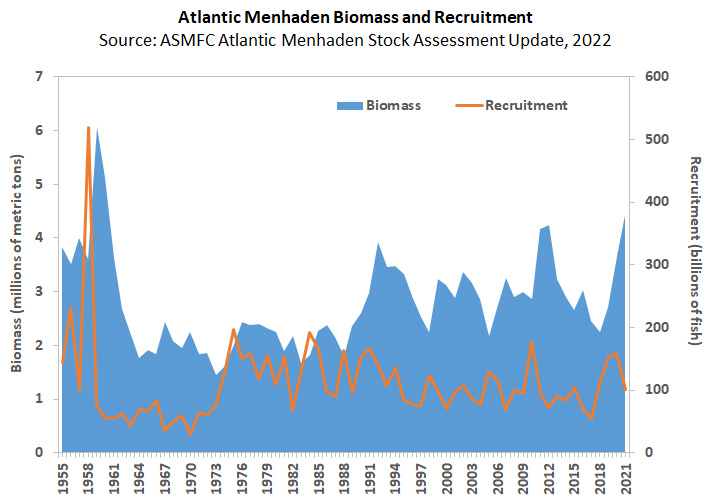
The menhaden population is not “dwindling.” The Atlantic States Marine Fisheries Commission (ASMFC) reports menhaden populations are abundant and sustainably managed. Menhaden are not overfished and are not experiencing overfishing. The biomass exceeded 4.5 million metric tons in 2022, while total commercial landings amounted to just 195,387 metric tons. The ASMFC says menhaden biomass has been stable since the 1960s.

At the August ASMFC meeting, both the representative from the Maryland Department of Natural Resources (DNR) and the Maryland governor’s appointee stated there are “no menhaden” in Maryland. Ironically, in October, the Maryland DNR juvenile striped bass survey found that juvenile menhaden abundance in the Chesapeake Bay over the past two years is at the highest level measured since 1990.

The menhaden fishery is certified sustainable by the Marine Stewardship Council. This required a rigorous, independent evaluation by third-party auditors confirming a healthy biomass, minimal environmental impact and a robust management system.

Atlantic menhaden is the first U.S. species managed to account for predator forage needs. In 2020, after a decade of work, the ASMFC implemented “ecological reference points.” This was applauded by numerous environmental advocates and the Chesapeake Bay Foundation.

Although some critics in the recreational fishing community claim a distinction between the coast-wide and Chesapeake Bay menhaden populations, no evidence supports this. Menhaden are migratory, naturally moving in and out of the Bay. At a Dec. 6, 2022, meeting, Virginia Institute of Marine Science (VIMS) scientists called “localized depletion” claims speculative and unsupported by evidence.

In recent months, the Chesapeake Bay Foundation and other groups publicized a controversial study allegedly linking menhaden harvesting and negative osprey reproductive success. At the August ASMFC meeting, the Chesapeake Bay Foundation’s Maryland executive director offered a motion creating a workgroup to consider more precautionary management of menhaden based on the study. But an article in the current Bay Journal highlights criticism from three VIMS fisheries scientists, who questioned the study’s data, methods and conclusion linking osprey nesting issues to menhaden fishing.

Antagonism between commercial menhaden and recreational fishing interests is nothing new. It was first reported in The New York Times in 1895. But recently, threats on social media and physical attacks on commercial vessels escalated to the point that Virginia amended its laws in 2024 to increase penalties for such dangerous actions. We are thankful to the governor, delegates and commercial watermen from other fisheries who worked hard to change the law to increase public safety.

Today, Ocean Harvesters and Omega Protein are the largest providers of union jobs with full benefits, and the largest minority employers in Northumberland County, serving as key economic drivers. My family has worked in the menhaden industry in Reedville for more than 100 years; it clothed and fed me, put me through school, and today employs my children and supports my grandchildren.

For more than a century, those in the Northern Neck’s menhaden fishing industry have defended their livelihoods against unfounded claims that menhaden purse-seine fishing harms recreational fishing. The debate will continue, but it must be based on fact. And the regulation of this job-creating industry must also be based on fact — not politics and unsubstantiated conjecture.

Read the op-ed at The Virginian-Pilot

U.S. Geological Survey Presentation Raises Questions About Osprey-Menhaden Link Allegations

August 6, 2024 — The following was released by the Menhaden Fisheries Coalition:

Today at the Atlantic States Marine Fisheries Commission (ASMFC) summer meeting, the Menhaden Management Board heard a presentation on osprey populations from U.S. Geological Survey (USGS) scientists; considered but did not agree to a motion to start an addendum on additional commercial menhaden fishing restrictions in the Chesapeake Bay; and ultimately agreed, as a compromise, to create a working group to “consider and evaluate options for further precautionary management of Chesapeake Bay menhaden fisheries.”

The Chesapeake Bay Foundation (CBF) has issued a stunningly deceptive press release, mischaracterizing the tone of today’s ASMFC meeting and the action taken there. The CBF release suggests that the material presented by USGS overwhelmingly indicated a problem with osprey in the Chesapeake Bay, and that there was overwhelming support by ASMFC commissioners for additional regulation of menhaden in the Chesapeake Bay. Neither is true. The Menhaden Fisheries Coalition is issuing this release, together with the full audio of the meeting, to clarify the record. The full audio is available here.

Dr. Barnett Rattner and David Ziolkowski of the U.S. Geological Survey gave a presentation on the health of osprey populations from coast to coast. Mr. Ziolkowski noted that “in North America in the 1950s and 60s, osprey population started declining rapidly due to the effects of volcanic chlorine, pesticides like DDT, and it’s estimated that the Chesapeake Bay probably lost about half or more of its population.”

However, Mr. Ziolkowski explained that after measures were taken, including banning DDT, between 1966 and 2022, the eastern population of osprey increased by about 300%, and the Atlantic Coast population increased by about 587%. In the Chesapeake Bay it’s increased by about 1800% since 1960. He continued, “…what these numbers bear out is that osprey have made an astounding recovery by all accounts. The numbers are now in excess of historical numbers and in part that’s because they’ve returned to a world that’s very different than the world was before they started declining. There’s more suitable nesting structures. Water may be cleaner, et cetera.”

Mr. Ziolkowski did note that during the period from 2012 to 2022, “something’s going on,” as there has been a leveling off in the growth of the osprey populations in the mid-Atlantic. But he explained, “Care must be used when you’re interpreting these kinds of results and to understand what I mean, it’s helpful to look at osprey trends across the country. So here I’ll point out three things that I hope you take notice of in these graphs. On the left-hand side here, for example, California and Washington, opposite coast, you can see that there’s something going on in the same time period as there is here in Maryland, Virginia.”

Dr. Barnett Rattner and David Ziolkowski of the U.S. Geological Survey present a slide to the Menhaden Management Board showing that the recent leveling-off in Maryland and Virginia osprey populations, after years of explosive growth, is a phenomenon also being seen in states across the nation, on both the East and West Coast.

During the Q&A following the presentation, Commissioner Patrick Geer of Virginia, Chief of Fisheries Management at the Virginia Marine Resources Commission, noted that “Dr. [Bryan] Watts has done a survey in Virginia, for a number of years, going back to I believe 1993, which has shown the double crested cormorant population has increased 1416% in 25 years and brown pelicans have been about 882%. Now those species that are primarily piscivores…they’re competing for the same food source…Maybe the [osprey] nests aren’t surviving, maybe they’re moving out and these two species are moving in? Is that possible?” To which Dr. Rattner replied “Yes, it’s possible, certainly.”

After the presentation by the USGS scientists, Commissioner Lynn Waller Fegley of Maryland, Director of Fishing and Boating Services at the Maryland Department of Natural Resources, made a motion to initiate an addendum to the Atlantic Menhaden Interstate Fishery Management Plan to consider Chesapeake Bay-specific management options for menhaden purse seine vessels larger than 300 gross tons in order to support the need of piscivorous birds and fish during critical points of their life cycle, and include options for seasonal closures of Chesapeake Bay waters, but not consider changes to the current Bay cap of 51,000 metric tons.

It became immediately apparent that the board was divided on this proposal.

The provision targeting purse seine vessels over 300 tons was obviously included to target the commercial menhaden reduction fishery, which in Virginia is operated by Ocean Harvesters and supplies menhaden to Reedville-based processer Omega Protein. This was questioned by Commissioner Proxy Eric Reid of Rhode Island, who asked if the motion wasn’t inherently flawed, since although there are carrier vessels over 300 tons, those vessels get their fish from pairs of small purse seine boats, meaning that the motion accomplished nothing. Mr. Reid’s conjecture was confirmed by a member of the delegation from Virginia.

Commissioner Proxy Nichola Meserve of Massachusetts, Fishery Policy Analyst at the Massachusetts Division of Marine Fisheries, raised concerns about “diving immediately into an addendum process,” noting that other addenda in the past began “with a work group, a board work group that discussed the issues and the concerns that developed potential strategies.

After much procedural wrangling, there were two votes to postpone action on the motion, one until the October meeting and another indefinitely. Both of those votes tied 9-9. When it became apparent that the motion to initiate an addendum had reached a stalemate, Commissioner Proxy Dr. Allison Colden, Chesapeake Bay Foundation Maryland Executive Director, offered a substitute motion “to establish a board work group to consider and evaluate options for further precautionary management of Chesapeake Bay menhaden fisheries, including time and area closures, to be protective of piscivorous birds and fish during critical points of their life cycle.

The board members accepted this compromise unanimously by acclamation, without a roll call, and the working group is expected to report the results of their discussion to the Menhaden Management Board at its October 2024 meeting.

“Those attending the ASMFC’s Menhaden Management Board meeting in person or listening online could only come away with one clear message from the respected researchers at USGS, and that is the osprey’s numbers have dramatically increased and any challenges that the seabirds face are complex and multi-faceted, occurring in numerous locations on both the Atlantic and Pacific coasts, and cannot be blamed on the menhaden harvest in the Chesapeake Bay,” stated Ben Landry, Vice President of Public Affairs for Ocean Fleet Services and spokesperson for Ocean Harvesters. “To state otherwise is wholly dishonest, but that is commonplace for the Chesapeake Bay Foundation and its decades-long history of false and hyperbolic statements on menhaden fisheries.”

The menhaden fishery has long been attacked by those who refuse to accept the science-based conclusions of respected government agencies and independent assessment bodies. However, it is important to remember that since 2020, after a three-year, peer-reviewed effort, with input from both industry and environmental conservation groups, menhaden has been managed using ecological reference points that account for menhaden’s role as a forage fish throughout its range.

When the ecological reference points were adopted, Chesapeake Bay Foundation President William C. Baker stated in a release: “This is a historic day for fisheries management. Menhaden have been called the most important fish in the sea for good reason. Menhaden are an essential part of the diet of numerous fish species including striped bass, along with dolphins, whales, osprey and other seabirds.”

In 2020, Chris Moore, Senior Regional Ecosystem Scientist for CBF, wrote in the Bay Journal, “Striped bass, of all the predators studied, were shown to be the most sensitive to changes in the menhaden population. Therefore, adopting ecological reference points that protect striped bass will also protect other predator species that rely less on menhaden.”

Additionally:

  • In 2022, the Atlantic States Marine Fisheries Commission concluded there was no evidence that menhaden were being overfished along the Atlantic coast.
  • The Marine Stewardship Council in 2019 certified the Atlantic menhaden fishery as sustainable.

About the Menhaden Fisheries Coalition
The Menhaden Fisheries Coalition (MFC) is a collective of menhaden fishermen, related businesses, and supporting industries. Comprised of businesses along the Atlantic and Gulf coasts, the Menhaden Fisheries Coalition conducts media and public outreach on behalf of the menhaden industry to ensure that members of the public, media, and government are informed of important issues, events, and facts about the fishery.

LA.: Pushing pogy fleet offshore could prove costly to industry

December 12, 2023 — Pushing commercial menhaden fishing farther off the Louisiana coast may appease anglers and conservationists, but it would come at a heavy cost to the industry, according to a new report from state economists.

The two companies operating what amounts to Louisiana’s largest fishery could lose about $31 million per year and shed up to 90 jobs if the state approves a plan to restrict menhaden fishing within a mile of the coast, an economic impact report by the state Department of Wildlife and Fisheries says.

Read the full article at the National Fisherman

Prominent recreational fishing writer calls out sport fishing groups for their obsession with sustainable menhaden fisheries

November 13, 2023 – Charles Witek, a fisheries consultant, recreational fisherman, and writer of the “One Angler’s Voyage” blog, has recently called out sportfishing groups like the Coastal Conservation Association and Theodore Roosevelt Conservation Partnership for their “aggressive effort to place new restrictions” on commercial menhaden fisheries at the expense of needed management measures for recreational species.

In an October 8 post focused on the Gulf of Mexico, “Menhaden advocacy: A low-cost cause for recreational fishing organizations,” Mr. Witek called menhaden “the perfect cause for such organizations to take up, as it allows them to assume the mantle of conservationists, while arguing for regulations that will only impact the commercial fleet and will not place any additional burden on the recreational fishery.”

Menhaden fishermen at work

But as Mr. Witek pointed out, the Gulf menhaden population is “in good shape.” The most recent benchmark stock assessment completed by the Gulf States Marine Fisheries Commission in 2018 found that menhaden were neither overfished nor experiencing overfishing. The following year, the fishery was certified sustainable by the Marine Stewardship Council. An updated stock assessment conducted in 2021 showed the stock remains healthy. Meanwhile, other species in the Gulf — including speckled trout targeted by the recreational sector — are not so healthy.

“Given the overfished state of the speckled trout stock one might logically expect Coastal Conservation Association Louisiana, which was such a strong advocate of additional regulations to protect the undoubtedly healthy Gulf menhaden stock, to demand that Louisiana take immediate, meaningful action to rebuild the speckled trout population,” Mr. Witek wrote. “However, just the opposite occurred.”

“When recreational fishing groups begin to focus most of their conservation efforts on menhaden stocks, which are generally healthy, and ignore — or worse, oppose — needed management measures for marine finfish that are often sought by anglers, such groups’ commitment to conservation might well be questioned,” he wrote.

In an October 26 post, “Conserving striped bass: Don’t be misled by menhaden,” Mr. Witek noted a similar dynamic playing out on the Atlantic coast, but replacing speckled trout with striped bass.

“Let’s get two things straight from the start: Striped bass are having some serious problems, while Atlantic menhaden are doing just fine,” Mr. Witek wrote.

The latest striped bass stock assessment by the Atlantic States Marine Fisheries Commission shows the stock is overfished; Maryland has experienced spawning failure for the past five years; Virginia has experienced spawning failure for the past three years. Meanwhile, Atlantic menhaden are neither overfished nor experiencing overfishing; the fishery is certified sustainable by the Marine Stewardship Council; and managers have adopted ecological reference points, making it the first East Coast fishery to account for not just the health of the individual species, but also its role in the ecosystem.

“It’s completely clear, from a scientific perspective, that the current lack of striped bass has absolutely nothing to do with a lack of menhaden,” Mr. Witek wrote.

That hasn’t stopped recreational anglers like Phil Zalesak, president of the Southern Maryland Recreational Fishing Organization, from blaming the commercial menhaden fishery for the problems in the recreational sector. This can have negative impacts for striped bass conservation, according to Mr. Witek.

“Where Mr. Zalesak’s comments [at a recent ASMFC meeting] really went astray was when he noted that Maryland’s striped bass harvest had decreased by 72 percent since 2016, then alleged that such decrease was due to a lack of menhaden, and not overfishing,” Mr. Witek wrote. “That comment, more than any other that he made, exposed the danger of focusing on menhaden, rather than on striped bass biology, for if managers took that allegation at face value, it would mean that to rebuild the striped bass stock, their first concern should be rebuilding the menhaden stock, and not addressing striped bass fishing mortality. Such course could only lead to more problems for the bass population.”

It is important for fishery managers to stay focused on real conservation measures needed to rebuild the striped bass population and not get distracted by “unsupported allegations of a menhaden shortage,” Mr. Witek wrote.

“For make no mistake: There are people who are all too willing to stall the striped bass’ recovery, and to put the bass’ future in peril, in order to increase their short-term gains from the fishery.”

The ASMFC’s Atlantic Striped Bass Management Board “must hear our desire to reduce striped bass fishing mortality…It must hear of our concerns with spawning failure in the Chesapeake Bay…But the Board shouldn’t have to hear about menhaden at all,” Mr. Witek concluded.

Mr. Witek is an attorney who has held a seat on the Mid-Atlantic Fishery Management Council, served as president of the New York State Outdoor Writers’ Association, and represents New York on various fishery management bodies.

New fish spill cleanup boats on Chesapeake Bay

August 23, 2023 — Omega Protein’s last menhaden net tear on Chesapeake Bay has led to the firm designing and building a new clean-up vessel called a “skimmer boat.” It is designed to rapidly pick up dead fish on and below the surface of the water.

The 20’ x 8’ aluminum garvey-style boat was designed and built by Lambert Walker of Reedville, Va., who retired from Omega in 2013. Walker was asked to come out of retirement to build a new boat. Before he had retired, he had built a similar boat for the same type of use.

Walker, 72, says he is “just an old welder.”  He is an old welder and much more.  Walker started working in the companies’ metal shop in 1973, when Omega Protein was then known as Zapata Haynie Corporation.

His boatbuilding skills and knowledge have come from 40 years of building aluminum purse seine boats and handling maintenance needs on the companies’ equipment and on Omega’s steel hull fishing vessels.

“I just took out my scale rule, drew it up and welded it together,” he says modestly. “It is a nice little boat, and it will meet the need when it is necessary.”

Read the full story at National Fisherman

New Research Looks to Further Reduce Uncertainty and Improve Confidence in Menhaden Assessments

October 27, 2022 — The following was released by the Science Center for Marine Fisheries:

Researchers with the Science Center for Marine Fisheries (SCEMFIS) have been at the forefront of investigating new ways to improve the science behind menhaden fisheries, the largest fisheries by weight on both the Atlantic and Gulf coasts. The latest effort funded by the Center looks at one of the remaining areas of uncertainty in menhaden science, and how much it potentially affects the accuracy of menhaden assessments.

Menhaden assessments rely largely on data supplied by the menhaden fishery, which, along with assessment modeling and other data collected for the assessments, is used to estimate key measures such as biomass, abundance, and fecundity. But because the data supplied by the fishery is limited to the younger menhaden that are harvested commercially, there is a comparative lack of data on older menhaden to use in the assessment. As a result, these older menhaden are grouped together for counting purposes in what is known as a “plus group.”

Defining these plus groups incorrectly has the potential to introduce bias into the assessments, which can affect their accuracy and subsequently affect quota allocations for the fishery. This study looks at the composition of these plus groups to find how big an impact this potential bias has on the final assessment results.

To determine this, the study ran a series of simulations, based on the existing assessment models for both Atlantic and Gulf menhaden, and determined how assumptions made about the plus groups affect the end results. In the models currently used in the Gulf and Atlantic menhaden stock assessments, Gulf menhaden use a plus group of age 4+ menhaden, while Atlantic menhaden use a plus group of 6+. The study simulated what would happen to the assessment results if these definitions were modified by including more or fewer ages of menhaden in the group.

The study found that the definition of what is included in the plus group varies in how it affects the accuracy of the assessment. For Gulf menhaden, increasing the age of the plus group decreased the amount of bias in measurements like abundance and spawning stock biomass, while reducing the plus group age decreased the amount of bias in measurements like recruitment. For Atlantic menhaden, the composition of the plus groups had less of an impact, with the best performing plus group being the one currently used in the assessment model.

“These results show that not only are well-defined plus groups important for stock assessments, but also that the current plus groups are among the best-performing options for the current menhaden assessments,” said Genny Nesslage, an Associate Research Professor at the University of Maryland Center for Environmental Science’s Chesapeake Biological Laboratory, and one of the authors of the study. “We also outline ways for fisheries scientists to improve these assessments and make them even more accurate.”

About SCEMFIS

SCEMFIS utilizes academic and fisheries resources to address urgent scientific problems limiting sustainable fisheries. SCEMFIS develops methods, analytical and survey tools, datasets, and analytical approaches to improve sustainability of fisheries and reduce uncertainty in biomass estimates. SCEMFIS university partners, University of Southern Mississippi (lead institution), and Virginia Institute of Marine Science, College of William and Mary, are the academic sites. Collaborating scientists who provide specific expertise in finfish, shellfish, and marine mammal research, come from a wide range of academic institutions including Old Dominion University, Rutgers University, University of Massachusetts-Dartmouth, University of Maryland, and University of Rhode Island.

The need for the diverse services that SCEMFIS can provide to industry continues to grow, which has prompted a steady increase in the number of fishing industry partners. These services include immediate access to science expertise for stock assessment issues, rapid response to research priorities, and representation on stock assessment working groups. Targeted research leads to improvements in data collection, survey design, analytical tools, assessment models, and other needs to reduce uncertainty in stock status and improve reference point goals.

New ‘Salmon Wars’ Book Spreads Menhaden Myths

July 14, 2022 — The following was released by the Menhaden Fisheries Coalition:

Yesterday, Macmillan Publishers released Salmon Wars, a factually questionable book by former Los Angeles Times managing editor Douglas Frantz and former journalist turned private writer Catherine Collins. The book falsely claims that “overfishing from the Gulf of Mexico north to the Chesapeake Bay threatens a slender fish called a menhaden,” and inaccurately states that menhaden is “an integral player in minimizing algae blooms because it eats phytoplankton.”

According to the February 2020 stock assessment accepted by the Atlantic States Marine Fisheries Commission, the Congressionally-chartered interstate compact that regulates shared migratory fishery resources among East Coast states, Atlantic menhaden is neither overfished nor is overfishing occurring. A simple cursory review of the assessment clearly illustrates that the Atlantic menhaden population has not been overfished in several decades. Similarly, in 2021, the Gulf States Marine Fisheries Commission found that the “Gulf of Mexico Gulf Menhaden stock is not experiencing overfishing and is not overfished.”

In fact, both Atlantic and Gulf menhaden are certified sustainable by the Marine Stewardship Council, which operates the world’s most respected global fishery certification program. This designation indicates that the stock is “fished in a way that does not threaten the population’s long-term health and minimizes the damaging effects of fishing to the surrounding wildlife and ecosystem.”

Mr. Frantz and Ms. Collins also continued to misinform their audience by making the oft-repeated claim that menhaden minimize algae blooms. This statement was discredited in a study conducted by the Virginia Institute of Marine Science at the College of William and Mary that proved menhaden do not improve overall water quality in the Chesapeake Bay. The study examined “the amount of phytoplankton and nitrogen consumed and excreted by small groups of juvenile and adult menhaden during 6-hour periods,” and found that “older menhaden hardly fed on phytoplankton at all.”  

The study, published in the February 22, 2010, issue of the Marine Ecology Progress Series, concluded that “based on [their] results as well as ecosystem modeling simulations, menhaden do not appear to represent a significant mechanism for removing nutrient inputs to the Bay.”

Opinion: Menhaden fishing is a lifeline for Virginia workers

July 7, 2022 — The following is an excerpt of an op-ed by Ken Pinkard, a 38-year, third-generation menhaden fisherman in Virginia’s Northern Neck region. It was published yesterday by the Daily Press and the Virginian-Pilot.

The Virginia Saltwater Sportfishing Association’s Mike Avery inaccurately claims that the Chesapeake Bay’s menhaden fishery is hurting striped bass (“Advocates call for limits of menhaden fishing in Virginia”). In reality, menhaden fishing is not only sustainable, it’s a critical economic engine for Virginia’s Northern Neck.

For decades, menhaden fishermen have worked in the Chesapeake Bay alongside crabbers, oystermen and other watermen. The menhaden fishery is currently the largest employer of minority and union workers in rural Northumberland County, and Virginia will not attract “good-paying” jobs by destroying it. The proposals Avery promotes would have a devastating impact on hardworking Virginians whose families rely on the fishery for their livelihoods.

The economy of the Northern Neck depends on Omega Protein and affiliated companies, just as Detroit depends on GM and Ford. Omega Protein and its fishing partners offer the highest blue-collar wages with the most generous benefits in the Northern Neck. These are union jobs. Every worker has a voice. Some 98% of our Reedville-based employees live in Virginia and 90% live in the Northern Neck.

Read the full op-ed with a subscription at the Daily Press

Menhaden crews rescue boaters in Gulf of Mexico

June 3, 2022 — Menhaden fishermen working in the Gulf of Mexico rescued six boaters, including two children, after their small craft capsized in the Mississippi Sound May 31.

Purse seine crews from the F/V Mississippi Sound and the F/V Frosty Morn, recovered two people from the water and four atop the overturned boat around 2 p.m.

Mississippi Sound captain Joel Deihl said the vessels responded to a Coast Guard broadcast about the boaters in distress and located them. After picking up the boaters the purse seine crews transferred them to the Coast Guard.

Read the full story at National Fisherman

COVID-impacted landings data could have major consequences for Virginia’s menhaden fleet

May 2, 2022 — Action the Atlantic States Marine Fisheries Commission is set to take this week regarding menhaden allocations at its annual spring meeting could have a significant impact on some members of the fishery based on how they responded to the COVID-19 pandemic two years ago.

On the agenda for the commission’s Atlantic Menhaden Management Board session on Tuesday afternoon is a discussion about whether to adjust or remove 2020 landings data when considering commercial allocations for future years, which are scheduled to take effect next year. The discussion comes after officials in Virginia proposed a change, citing the impact COVID-19 had on the menhaden fishery in the state.

Virginia has, by far, the largest operation within the fishery. In most years, the state accounts for roughly 80 percent or more of commercial landings. However, that number dipped to 75.7 percent in 2020. While that may not seem to be a significant drop, commissions set catch quotas on fish like menhaden based on historical catch data, so a recent dip in the numbers would impact how much operators can harvest in future years.

Ocean Fleet Services Vice President Monty Deihl said the drop was due to menhaden fishing vessels missing out on 59 fishing days due to fishing crews dealing with the coronavirus. And even that number doesn’t truly reflect the situation that Ocean Harvesters, which operates vessels for Omega Protein under the management of Ocean Fleet Services, endured two years ago.

“We had boats that were 15 hours away from our dock, and we hadn’t even started fishing yet,” Deihl recalled. “If a crew member came up with a fever and symptoms, the captain had to turn the boat all the way back around and come back. We couldn’t count that as a COVID day because the boat was away from the dock.”

Compounding the issue for Ocean Harvesters was the fact that each crewmember was needed in order to operate the vessel and harvest menhaden safely.

As a large company with a union workforce, Deihl said Ocean Harvesters had to follow Centers for Disease Control and Prevention guidelines to the letter. That included quarantining crew members for days until test results came back negative. Smaller operators and family run outfits, Deihl said, had an easier time working in those guidelines and still fish.

Last year was a different story for Ocean Harvesters, thanks to the development of effective COVID-19 vaccines. Deihl said 100 percent of the company’s crew members got their shots.

“COVID was just as bad in the summer of 2021 as it was in 2020 as far as in the communities, but we never lost one single fishing day for COVID,” he said.

It appears fishery officials understand the situation. In a memo earlier this month, the Atlantic Menhaden Plan Development Team (PDT) told the management board that it recommended removing the 2020 data from allocation consideration and adding the 2021 totals, which are expected to be finalized later this year, in its place.

The memo stated that other options are on the table, but the PDT advised that they would either push implementing the new allocations beyond 2023 or rely on old data.

“By adding 2021 to the time series, it would alleviate the concerns the PDT has with only dropping 2020 data by allowing an additional year of data in the analysis that better reflects current fishing activity,” the memo stated.

But there’s still a chance the Atlantic Menhaden Management Board could opt against that recommendation and factor 2020 data into future allocations. Deihl said that could have a tremendous negative impact on jobs.

Ocean Harvesters and Omega Protein operate out of Reedville, Va., a rural community at the neck of the Chesapeake Bay 75 miles east of Richmond. The menhaden plant in the small town employs about 260 workers, and Deihl said a similar number of people work as contractors.

A reduction in allocation by as little as 3 or 4 percent could impact dozens of workers. And while that may not seem significant, Deihl pointed out it could be devastating in a small community like Reedville.

“They already had to fight through COVID, being quarantined and all that,” he said. “When you’ve worked there 20 or 30 years, and your family has worked there for three or four generations, and you lose a job to another state, it just seems extremely unfair.”


  • « Previous Page
  • 1
  • 2
  • 3
  • 4
  • …
  • 37
  • Next Page »

Recent Headlines

  • Scientists did not recommend a 54 percent cut to the menhaden TAC
  • Broad coalition promotes Senate aquaculture bill
  • Chesapeake Bay region leaders approve revised agreement, commit to cleanup through 2040
  • ALASKA: Contamination safeguards of transboundary mining questioned
  • Federal government decides it won’t list American eel as species at risk
  • US Congress holds hearing on sea lion removals and salmon predation
  • MASSACHUSETTS: Seventeen months on, Vineyard Wind blade break investigation isn’t done
  • Sea lions keep gorging on endangered salmon despite 2018 law

Most Popular Topics

Alaska Aquaculture ASMFC Atlantic States Marine Fisheries Commission BOEM California China Climate change Coronavirus COVID-19 Donald Trump groundfish Gulf of Maine Gulf of Mexico Illegal fishing IUU fishing Lobster Maine Massachusetts Mid-Atlantic National Marine Fisheries Service National Oceanic and Atmospheric Administration NEFMC New Bedford New England New England Fishery Management Council New Jersey New York NMFS NOAA NOAA Fisheries North Atlantic right whales North Carolina North Pacific offshore energy Offshore wind Pacific right whales Salmon South Atlantic Virginia Western Pacific Whales wind energy Wind Farms

Daily Updates & Alerts

Enter your email address to receive daily updates and alerts:
  • This field is for validation purposes and should be left unchanged.
Tweets by @savingseafood

Copyright © 2025 Saving Seafood · WordPress Web Design by Jessee Productions