Saving Seafood

  • Home
  • News
    • Alerts
    • Conservation & Environment
    • Council Actions
    • Economic Impact
    • Enforcement
    • International & Trade
    • Law
    • Management & Regulation
    • Regulations
    • Nutrition
    • Opinion
    • Other News
    • Safety
    • Science
    • State and Local
  • News by Region
    • New England
    • Mid-Atlantic
    • South Atlantic
    • Gulf of Mexico
    • Pacific
    • North Pacific
    • Western Pacific
  • About
    • Contact Us
    • Fishing Terms Glossary

ASMFC Coastal Sharks Board Sets Specifications for 2027-2031 to Complement the Federal Default Season Start Date and Retention Limits

November 11, 2026 — The following was released by the Atlantic States Marine Fisheries Commission: 

The Commission’s Coastal Sharks Management Board approved commercial fishery specifications for 2027 through 2031, matching the default season start date and retention limits as specified by the National Marine Fisheries Service final rule published on November 8, 2023. Beginning in 2024, the fishing year for Atlantic commercial shark fisheries automatically starts on January 1 of each year under the base quotas and default retention limits.

 
The Board set specifications that include a commercial possession limit of 55 large coastal sharks (LCS) other than sandbar sharks (i.e., aggregated LCS and hammerhead shark management groups) per vessel per trip and 8 blacknose sharks per vessel trip. NOAA Fisheries may consider in-season adjustments to the commercial possession limits depending on catch rates; states will follow NOAA Fisheries for in-season changes to the commercial possession limit. The Coastal Sharks Board does not actively set quotas for any species contained in the non-blacknose, small coastal shark (SCS), blacknose, aggregated LCS, hammerhead or pelagic species groups but will close the fishery for any species in these groups when NOAA Fisheries closes the fishery in federal waters, as outlined in the Interstate Fishery Management Plan (FMP).
 
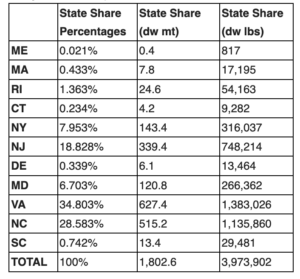
Under Addendum II to the FMP, the Coastal Sharks Board establishes state shares of the base federal coastwide quota for the Atlantic smooth dogfish fishery. At this meeting, the Board approved shares for 2027-2031 based on the base federal quota of 1,802.6 dressed weight (dw) metric tons, or 3,973,902 dw pounds (Table 1). Rollover of unused state shares is not permitted because it could result in overages of the federal coastwide quota.


Under the Coastal Sharks FMP, if a multi-year commercial quota and/or possession limit is implemented, annual review of updated information on the fishery and stock conditions by the Technical Committee and Management Board is required. If scientific review finds that specified measures should be modified based on updates to stock conditions, then the Coastal Sharks Board will be presented with this information and a new specification setting process will be initiated.
For more information, please contact Caitlin Starks, Senior Fishery Management Coordinator, at cstarks@asmfc.org or 703.842.0740.
Table 1. State shares of the coastwide smooth dogfish quota based on the base coastwide quota for the 2027-2031 fishing years (January – December).
###
PR26-18
The press release can also be found at https://asmfc.org/news/press-releases/asmfc-coastal-sharks-board-sets-specifications-for-2026-2031-to-complement-the-federal-default-season-start-date-and-retention-limits/

Retention Limit of Commercial Aggregated Large Coastal Shark and Hammerhead Shark Management Groups: Atlantic Region Increased to 45 Sharks per Trip

July 8, 2016 — The following was released by NOAA:

The National Marine Fisheries Service (NMFS) is increasing the retention limit for the commercial aggregated large coastal shark (LCS) and hammerhead shark management groups for directed shark limited access permit holders in the Atlantic region from 3 to 45 LCS other than sandbar sharks per vessel per trip as of July 15, 2016.  This adjustment is intended to promote equitable fishing opportunities in the Atlantic region, while allowing majority of quota to be harvested later in the year.  All other retention limits and shark fisheries remain unchanged in the Atlantic region.

The retention limit will remain at 45 LCS other than sandbar sharks per vessel per trip in the Atlantic region through the rest of the 2016 fishing season or until NMFS announces via a notice in the Federal Register another adjustment to the retention limit or a fishery closure.   This retention limit adjustment affects anyone with a directed shark limited access permit fishing for LCS in the Atlantic region.


Recent Headlines

  • Second court defeat for Trump’s deep-sea mining ambitions
  • ICCAT fails to agree on yellowfin tuna catch measures, makes progress on other stocks
  • New England researchers hope AI will help decode ‘marine snow’
  • Trump administration proposes new set of tariffs that could hit billions in seafood trade
  • United States Expands Fishing Opportunities for U.S. Fishermen and Secures Historic Win for Shark Conservation
  • Trump administration proposes new set of tariffs that could hit billions in seafood trade
  • Islands confront promises and perils of Pacific deep-sea mining ‘gold rush’
  • US Gulf shrimpers, fishers sue over 2023 oil spill

Most Popular Topics

Alaska Aquaculture ASMFC Atlantic States Marine Fisheries Commission BOEM California China Climate change Coronavirus COVID-19 Donald Trump Florida groundfish Gulf of Maine Gulf of Mexico IUU fishing Lobster Maine Massachusetts Mid-Atlantic National Marine Fisheries Service National Oceanic and Atmospheric Administration NEFMC New Bedford New England New England Fishery Management Council New Jersey New York NMFS NOAA NOAA Fisheries North Carolina North Pacific offshore energy Offshore wind Pacific right whales Salmon South Atlantic Virginia Washington Western Pacific Whales wind energy Wind Farms

Daily Updates & Alerts

Enter your email address to receive daily updates and alerts:

  • This field is for validation purposes and should be left unchanged.
Tweets by @savingseafood

Copyright © 2026 Saving Seafood · WordPress Web Design by Jessee Productions