Saving Seafood

  • Home
  • News
    • Alerts
    • Conservation & Environment
    • Council Actions
    • Economic Impact
    • Enforcement
    • International & Trade
    • Law
    • Management & Regulation
    • Regulations
    • Nutrition
    • Opinion
    • Other News
    • Safety
    • Science
    • State and Local
  • News by Region
    • New England
    • Mid-Atlantic
    • South Atlantic
    • Gulf of Mexico
    • Pacific
    • North Pacific
    • Western Pacific
  • About
    • Contact Us
    • Fishing Terms Glossary

First turbines in federal waters? Va.’s on the way

October 10, 2018 — Dominion Energy Inc.’s request to build a modestly sized — though less modestly priced — wind farm goes before regulators today, as evidentiary hearings begin on the two-turbine, $300 million Coastal Virginia Offshore Wind project.

If all goes as planned, the project would come online in 2020, becoming the nation’s second offshore wind farm and the first to go up in federal waters.

Sited 27 miles off the coast of Virginia Beach, the turbines would add 12 megawatts of capacity to the state’s grid. But Dominion, along with its industry allies and Virginia officials, see the demonstration as a steppingstone to the state’s new goal of developing 2 gigawatts by 2028.

“[T]he project needs to be built and studied to determine how the technology works and performs in the Atlantic Ocean 27 miles off the coast, and in potential hurricane force winds,” said David Botkins, a spokesman for the company, which is partnering with Denmark-based Ørsted Energy A/S on the project.

Andy Geissbuehler, advisory director at renewable consultancy BVG Associates, agreed.

“One of the basics in launching the offshore wind industry in the U.S. is transferring the experience from Europe,” he said. “But there are limitations to how much of that experience can be transferred.”

Signed, sealed, delivered?

This week’s hearings at the State Corporation Commission come after a preliminary session Thursday, when lawyers for environmentalists, Dominion and the attorney general’s office attempted to reassure the SCC’s three commissioners that they still enjoyed some semblance of authority over the project.

Read the full story at E&E News


Virginia Beach wants the same protection from offshore drilling Florida was promised

February 8, 2018 — Leaders want the local coastline taken off a newly expanded list of places open for offshore drilling.

City Council members approved a resolution Tuesday reiterating the city’s opposition to offshore drilling. It also asks for congressional representatives to help secure the same promise from the federal government as Florida, which was assured that it would be “off the table” for drilling.

The White House proposed a five-year offshore leasing program last month that would open most of the East Coast to drilling. The plan isn’t final, and a public hearing will be held in Richmond Feb. 21.

Read the full story at the Virginian-Pilot


Push for 35-mile-long canyon off Virginia coast to become marine sanctuary is suddenly put on hold

December 19, 2016 — For more than a year, the Virginia Aquarium & Marine Science Center built a case for naming a vast canyon in the Atlantic the next national marine sanctuary. There were dozens of meetings held, hundreds of letters written and thousands of signatures gathered from supporters on a petition.

Suddenly and quietly last month, however, an aquarium task force that had been pushing to make the Norfolk Canyon a sanctuary put everything on hold indefinitely.

To make a long story short, what happened was Donald Trump.

The Republican presidential candidate was elected, and the chances for a lot of conservation initiatives suddenly looked much iffier.

“We’re not really sure where this new administration is going to go with environmental protection,” said Mark Swingle, the Virginia Beach aquarium’s director of research and conservation. “The timing just doesn’t look right now. So we just decided to take a pause here to see what’s going to happen.”

Trump has said he favors oil and gas drilling in the Atlantic – something that would be prohibited in and around the 35-mile-long canyon if it were declared a sanctuary. He also has promised to roll back government regulations, particularly those of environmental agencies.

In general, he’s positioned himself to be a president whose administration will be much harder to persuade on environmental initiatives than that of President Barack Obama.

That could make it tougher to build a consensus for widening the government’s protective reach, whether it’s on land or 70 miles out in the Atlantic, where the Norfolk Canyon begins.

“We really did not want to push through this process right now with the uncertainty on whether we’d have the broad type of support we wanted,” Swingle said.

Read the full story at The Virginian-Pilot

Virginia trying to preserve its working waterfronts

December 12, 2016 — Working waterfronts in coastal Virginia are under increasing threats from sea-level rise, subsidence and loss of marine habitat. And the desire to live on the water sometimes clashes with the tradition of working the water.

Earlier this year, Virginia Beach oyster farmers made headlines when they were confronted by waterfront property owners over the number of cages they were putting down in waters used not only commercially but for recreation.

And it’s not an urban problem. Homeowners on the western branch of the Corrotoman River in rural Lancaster County are challenging aquaculture applications there and applying for riparian rights in an effort to block new farms.

“It’s the same as Virginia Beach on a much smaller scale,” said Ben Stagg, who manages shellfish leases for the state. “It’s the same argument: ‘We don’t want somebody right outside our door. We use this area, our kids swim out here, we don’t want a bunch of cages.’ This issue is percolating up statewide.”

Now, after four years of collaboration, working waterfront stakeholders from the Eastern Shore to the Northern Neck have come up with ways to alleviate conflict and to preserve Virginia’s nearly 600 working waterfronts and their commercial fishing heritage.

Of those, 123 are located in the four counties of the Northern Neck. That includes one of Virginia’s oldest and largest industry, Omega Protein Inc.’s menhaden fishing operation in Reedville, which contributes about $88 million to the state’s economy.

Read the full story at the Fredericksburg Free Lance-Star

Warren Elliott elected Mid-Atlantic Fishery Management Council VP

August 22, 2016 — VIRGINIA BEACH, Va. — G. Warren Elliott of Chambersburg has been elected vice-chairman of the Mid Atlantic Fishery Management Council.

The council is responsible for the management of marine fisheries in the United States waters from three to 200 miles offshore from New York to North Carolina.

Elliott was appointed to the council by the U.S. Secretary of Commerce in 2010 and is serving his second term.

Elliott chaired the Ecosystem and Ocean Planning Committee for five years, and led the effort to protect deep sea corals across 39,000 square miles, the single largest protected area in the Atlantic Ocean.

“Warren Elliott has quietly established himself as a leader in ocean issues and policy, and I cannot think of anyone better to succeed me,” said outgoing vice-chairman Dr. Lee Anderson of Delaware.

Anderson was an original member of the council’s Scientific and Statistical Committee organized in 1978. He is a professor in the School of Marine Science and Policy at the University of Delaware.

The 25-member fishery council develops fishery management plans and measures – such as quotas, seasons and closed areas – for 13 species of fish and shellfish, including bluefish, summer flounder, black sea bass, surfclams, ocean quahogs and monkfish.

Read the full story at Public Opinion

Mid-Atlantic Council and ASMFC Maintain Multi-Year Specifications for Black Sea Bass, Bluefish, and Scup and Modify Summer Flounder Specifications

August 15, 2016 — The following was released by NOAA:

Virginia Beach, VA – Last week the Mid-Atlantic Fishery Management Council (Council) and the Atlantic States Marine Fisheries Commission (Commission) reviewed previously implemented specifications for scup, black sea bass and bluefish fisheries and modified specifications for summer flounder. The Commission’s actions are final and apply to state waters. The Council will forward its federal waters recommendations regarding summer flounder specifications to NOAA Fisheries Greater Atlantic Regional Fisheries Administrator for final approval.

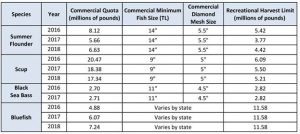
The table below summarizes commercial quotas and recreational harvest limits for summer flounder, scup, black sea bass, and bluefish (2016 values are provided for comparison purposes). Please note specifications for years 2017 and beyond may be adjusted based on changes in the fishery or new scientific information.

image003

For summer flounder, both groups approved a commercial quota of 5.66 million pounds and a recreational harvest limit of 3.77 million pounds for 2017, an approximate 30% decrease from 2016. This decrease in catch and landings limits responds to the findings of the 2016 stock assessment update, which indicates summer flounder has been experiencing overfishing since 2008. In 2015, fishing mortality exceeded its threshold by 26% (i.e., the level beyond which overfishing is occurring). The 2015 estimate of spawning stock biomass (SSB) is at 58% of the biomass target, and only 16% above the threshold. If the stock were to fall below the threshold, it would be considered overfished, requiring the development of a rebuilding plan to reduce fishing mortality and rebuild stock biomass. These results appear to be driven largely by below-average recruitment, an underestimation of the fishing mortality level in the last years of the assessment, and declining biomass indices. The assessment update indicates the stock experienced six below-average year classes from 2010 to 2015. Additionally, indices of abundance from state and federal surveys have indicated declines in abundance ranging from 9 to 97% from their most recent peaks (generally 2009 to 2012). The 2016 assessment update estimated biomass has been trending down since 2010. Summer flounder harvest limits for 2018 may be adjusted in the future based on changes in the fishery or new scientific information.

Scup and Black Sea Bass

For scup and black sea bass, the Commission and Council maintained the previously implemented multi-year specifications set in August and October 2015, respectively. The decline in harvest limits for scup since 2016 is due to a decrease in SSB as projected by the 2015 benchmark stock assessment.

For black sea bass, 2017 harvest limits remain unchanged relative to 2016 levels (in 2016, there was a reduction in the commercial quota due to overages in the previous year). Both the commercial quota and recreational harvest limit may be changed pending the results of next benchmark stock assessment, scheduled for peer review through the Northeast Regional Stock Assessment Workshop/Stock Assessment Review Committee in late 2016. The Commission and Council will consider the results of the benchmark stock assessment in early 2017.

Bluefish

For the bluefish fishery, the final 2016 commercial quota is 4.88 million pounds and the recreational harvest limit is 11.58 million pounds. The final 2016 harvest limits include a 1.58 million pound transfer from the recreational sector to the commercial sector. The Commission and Council did not make any changes to the 2017 and 2018 specifications. The 2017 and 2018 commercial quotas and recreational harvest limits are preliminary and will likely change following release of 2016 and 2017 final Marine Recreational Information Program harvest estimates. These estimates can impact how much is transferred from the recreational sector to the commercial sector.

Mid-Atlantic Council Approves Ecosystem Approach to Fisheries Management (EAFM) Guidance Document

August 11, 2016 — The following was released by the Mid-Atlantic Fishery Management Council:

VIRGINIA BEACH, Va. – Today the Mid-Atlantic Fishery Management Council unanimously approved a guidance document to facilitate the transition to an ecosystem approach to fisheries management (EAFM) in the Mid-Atlantic. The EAFM Guidance Document is designed to serve as an umbrella document that will enable the Council to coordinate ecosystem considerations across fishery management plans (FMPs).

The Council has been considering mechanisms to introduce ecosystem considerations into the fishery management process since the late-1990s. After a review of the various approaches used around the U.S., and extensive input from fisheries stakeholders through its visioning project, the Council decided in 2011 to pursue a transitional approach which would introduce ecosystem considerations into fishery management actions in a step-wise, evolutionary fashion. This approach is intended to allow the Council to meet its current requirements for the management of individual stocks while moving towards an approach that takes into account interactions at multiple dimensions of the environment and ecosystem.

“The EAFM Guidance Document responds to broad public interest in incorporating ecosystem considerations in the management of marine fisheries and will be a critical tool for the Council as it transitions from single-species management to a more comprehensive, ecosystem-based approach,” said Council Chairman Rick Robins. “One of the most important aspects of this approach is that it will allow for the evolution of our EAFM policy at a rate commensurate with the availability of the science to support it.”

The Council’s EAFM approach is organized around four major ecosystem-related issues: forage species, habitat, climate change and variability, and interactions. Development of the document was informed by a series of four workshops which brought together scientists, managers and stakeholders to discuss each issue and associated best management practices.

VIRGINIA: Cobia hearings will play a role in future regulations

August 10, 2016 — The South Atlantic Fishery Management Council is holding public hearings this week and the input from anglers could play a role in the future management of cobia.

The SAFMC is proposing regulations that will further reduce next year’s allowable catch. The council forced closures in federal waters this year to reduce the catch, leaving North Carolina and Virginia to adopt tighter regulations that include a reduced season in state waters.

Opponents of increased closures and tighter regulations are asking that anglers attend as many of this week’s meetings as possible.

Read the full story at The Virginian-Pilot 

Mid-Atlantic Council Approves Amendment to Protect Unmanaged Forage Species

August 9, 2016 — The following was released by the Mid-Atlantic Fishery Management Council:

VIRGINIA BEACH, Va. — The Mid-Atlantic Fishery Management Council has approved an amendment to protect unmanaged forage species in the Mid-Atlantic. If approved by the Secretary of Commerce, the Unmanaged Forage Omnibus Amendment would prohibit the development of new and expansion of existing directed commercial fisheries on a number of unmanaged forage species in Mid-Atlantic Federal waters. The prohibition would continue until the Council has had an opportunity to assess the available scientific information for these species and consider the potential impacts to existing fisheries, fishing communities, and the marine ecosystem.

Forage fish are small, low trophic level fish that play a central role in the marine food chain. These species facilitate the transfer of energy to higher trophic levels by consuming very small prey and then being eaten by larger, predatory fish and other marine animals.

“Forage species play a vital role in maintaining the productivity and structure of marine ecosystems and are currently at risk of unregulated fisheries development in the absence of adequate science to ensure their ecological sustainability,” said the Council’s Chairman, Rick Robins. “With this action, the Mid-Atlantic Council is taking a proactive approach to conserving unmanaged forage species and the ecosystem services they provide in the Mid-Atlantic region.”

The amendment was not intended to address all unmanaged forage species in the Mid-Atlantic but rather to focus on those species that have high ecological importance and those that have high potential for the development of a large-scale targeted commercial fishery.

The Council received more than 21,000 comments during the public comment period, the majority of which focused on the list of species to be included in the amendment. Although the Council initially considered a list of more than 250 forage species, this was narrowed down to a list of 15 taxa (i.e. species, families, orders, and other taxonomic groupings) for inclusion.

After considering input from its advisory panel, Ecosystem and Ocean Planning Committee, and members of the public, the Council voted to remove false albacore due to its large size and high trophic level. These 15 taxa include more than 50 forage species, including anchovies, halfbeaks, herrings, sardines, and sand lances. The complete list is included at the bottom of this announcement.

The Council voted to designate these taxa, with the exception of chub mackerel, as ecosystem components (ECs) in all of the Council’s fishery management plans (FMPs). The amendment would establish an incidental possession limit of 1,700 pounds for all EC species combined. For chub mackerel, the Council approved temporary measures to be implemented while the Council evaluates potentially adding the species as a stock in the Atlantic Mackerel, Squid, Butterfish FMP. These measures would include an annual landings limit of 2.86 million pounds and a 40,000-pound incidental possession limit which would go into effect once this landings limit is met.

The Council also voted to require use of exempted fishing permits (EFPs) prior to allowing any new fisheries or expansion of existing fisheries for unmanaged forage species and to establish a new policy for Council review of EFP applications. The Council also agreed that, prior to allowing any new fisheries or expansion of existing fisheries, the Council would consider whether the species in question should be managed as a stock in the fishery or if other discretionary management measures should be used.

Additional information, updates, and background materials related to this amendment are available on the Unmanaged Forage Omnibus Amendment page here.

South Atlantic Fishery Managment Council Solicits Public Input on Proposed Measures for Atlantic Cobia and Mutton Snapper Plus Options for Allocation of Dolphin and Yellowtail Snapper

July 21, 2016 — The following was released by the South Atlantic Fishery Management Council:

Federal fishery managers are currently soliciting public input on proposed measures that may affect fishermen fishing in federal waters ranging from 3 to 200 miles offshore along the Atlantic coast. A series of public hearings and scoping meetings are scheduled for August including in-person hearings from Virginia Beach to Key West and online webinars. Written comments are also being accepted until August 19, 2016.

Regulation changes are proposed for Atlantic cobia, a species commonly targeted by recreational fishermen as it migrates northward in the late spring and early summer. The Atlantic cobia stock is managed by the South Atlantic Fishery Management Council in cooperation with the Mid-Atlantic Fishery Management Council from Georgia to New York in federal waters. The recreational fishery for Atlantic cobia was closed in federal waters on June 20, 2016. Recreational landings in 2015 exceeded the annual catch limit and accountability measures currently in place were implemented for the following year, resulting in a shorter season. Management measures are being considered to lengthen the recreational season beginning in 2017 and help ensure consistent and stable fishing opportunities.

Changes are also proposed for mutton snapper regulations in South Atlantic federal waters following a recent stock assessment and concerns about fishing pressure during the spring spawning season. The harvest of mutton snapper occurs primarily off the coast of southern Florida. The fish gather in large numbers to spawn during the full moon each spring, making them highly susceptible to fishing efforts. Proposed management measures would reduce fishing pressure during the spawning season and provide further protection to the stock. The Council is coordinating with the Florida Fish and Wildlife Commission to develop compatible regulations.

The South Atlantic Fishery Management Council is also considering options for modifying allocations between commercial and recreational sectors for dolphin (mahi mahi) and yellowtail snapper. The options are being considered based on public input for the need to ensure the longest fishing season for both sectors.

Read the full release at the SAFMC

  • « Previous Page
  • 1
  • 2
  • 3
  • 4
  • Next Page »

Recent Headlines

  • Scientists did not recommend a 54 percent cut to the menhaden TAC
  • Broad coalition promotes Senate aquaculture bill
  • Chesapeake Bay region leaders approve revised agreement, commit to cleanup through 2040
  • ALASKA: Contamination safeguards of transboundary mining questioned
  • Federal government decides it won’t list American eel as species at risk
  • US Congress holds hearing on sea lion removals and salmon predation
  • MASSACHUSETTS: Seventeen months on, Vineyard Wind blade break investigation isn’t done
  • Sea lions keep gorging on endangered salmon despite 2018 law

Most Popular Topics

Alaska Aquaculture ASMFC Atlantic States Marine Fisheries Commission BOEM California China Climate change Coronavirus COVID-19 Donald Trump groundfish Gulf of Maine Gulf of Mexico Illegal fishing IUU fishing Lobster Maine Massachusetts Mid-Atlantic National Marine Fisheries Service National Oceanic and Atmospheric Administration NEFMC New Bedford New England New England Fishery Management Council New Jersey New York NMFS NOAA NOAA Fisheries North Atlantic right whales North Carolina North Pacific offshore energy Offshore wind Pacific right whales Salmon South Atlantic Virginia Western Pacific Whales wind energy Wind Farms

Daily Updates & Alerts

Enter your email address to receive daily updates and alerts:
  • This field is for validation purposes and should be left unchanged.
Tweets by @savingseafood

Copyright © 2025 Saving Seafood · WordPress Web Design by Jessee Productions