Saving Seafood

  • Home
  • News
    • Alerts
    • Conservation & Environment
    • Council Actions
    • Economic Impact
    • Enforcement
    • International & Trade
    • Law
    • Management & Regulation
    • Regulations
    • Nutrition
    • Opinion
    • Other News
    • Safety
    • Science
    • State and Local
  • News by Region
    • New England
    • Mid-Atlantic
    • South Atlantic
    • Gulf of Mexico
    • Pacific
    • North Pacific
    • Western Pacific
  • About
    • Contact Us
    • Fishing Terms Glossary

MASSACHUSETTS: UMass biologist named Vineyard Wind’s liaison to fishing industry

August 2, 2018 –UMass field biologist and New Bedford resident Crista Bank has been named fisheries liaison for Vineyard Wind.

The company announced the full-time appointment Monday. Bank will represent the company to the fishing industry at public meetings and in one-on-one conversations to address fishermen’s concerns with the offshore wind project.

“We can’t solve the problems without their help,” she said in an interview.

Bank has done collaborative research with fishermen on commercially valuable species, including cod, monkfish and halibut, and she is familiar with scallopers, draggers, gillnetters and longliners.

Read the full story at the New Bedford Standard-Times

Vineyard Wind Appoints Crista Bank as Fisheries Liaison

July 30, 2018 — NEW BEDFORD, Mass. — The following was released by Vineyard Wind:

Vineyard Wind today announced the appointment of Crista Bank as Fisheries Liaison. In this role, Bank will lead the project’s regional engagement with fishing industry representatives on Cape and Islands, the South Coast, Rhode Island, and along the East Coast.

A fisheries scientist, Bank brings extensive local, regional, national and international experience and deep knowledge of marine science and fisheries issues to her role at Vineyard Wind.

“We’re pleased to have Crista lead our efforts to address the important questions the fishing industry have raised about the impacts of offshore wind development on the marine environment and on sea life,” said Erich Stephens, Chief Development Officer with Vineyard Wind. “Crista will play a key role in ensuring that the first large-scale offshore wind project in the US helps establish a robust body of knowledge that will benefit the American offshore wind industry and the fishing community for decades to come.”

Most recently, Crista served as a fisheries biologist at the School for Marine Science and Technology (SMAST) at UMass Dartmouth, working on collaborative research projects with commercial fishermen studying cod, monkfish, and halibut. Previously, she served on the Schooner Ernestina, the only surviving 19th century Gloucester-built fishing schooner and one of two remaining examples of the Fredonia-style schooners, where she earned her 100-ton United States Coast Guard Captain’s license. Bank also worked on board traditional sailing vessels across the world, including journeys to the Indian and Atlantic oceans. She started her career teaching marine science at outdoor experiential education programs in New England, Southern California, and the Florida Keys. Crista earned a bachelor’s degree in Marine Biology from UMass Dartmouth and a Master’s degree in Fisheries Oceanography from SMAST.

In May, Vineyard Wind was selected to negotiate long-term contracts with Massachusetts’ electric distribution companies (EDCs) for construction of an 800-megawatt (MW) wind farm 15 miles south of Martha’s Vineyard; the project will provide the amount of clean energy used by over 400,000 homes across Massachusetts Vineyard Wind remains on schedule to begin site construction in 2019 and become operational by 2021.

About Vineyard Wind

Vineyard Wind LLC is an offshore wind development company seeking to build the first large-scale offshore wind energy project in the US, to be located 15 miles south of Martha’s Vineyard. Vineyard Wind, based in New Bedford, Massachusetts, is 50 percent owned by funds of Copenhagen Infrastructure Partners (CIP) and 50 percent by Avangrid Renewables. For more information, visit www.vineyardwind.com.


Vineyard Wind, R.I. fishermen still at odds over turbines

July 30, 2018 — NARRAGANSETT, R.I. — Nearly four months into a review of its proposal by Rhode Island coastal regulators, Vineyard Wind has been unable to allay fears that its proposed offshore wind farm of up to 100 turbines would harm the state’s fishing industry.

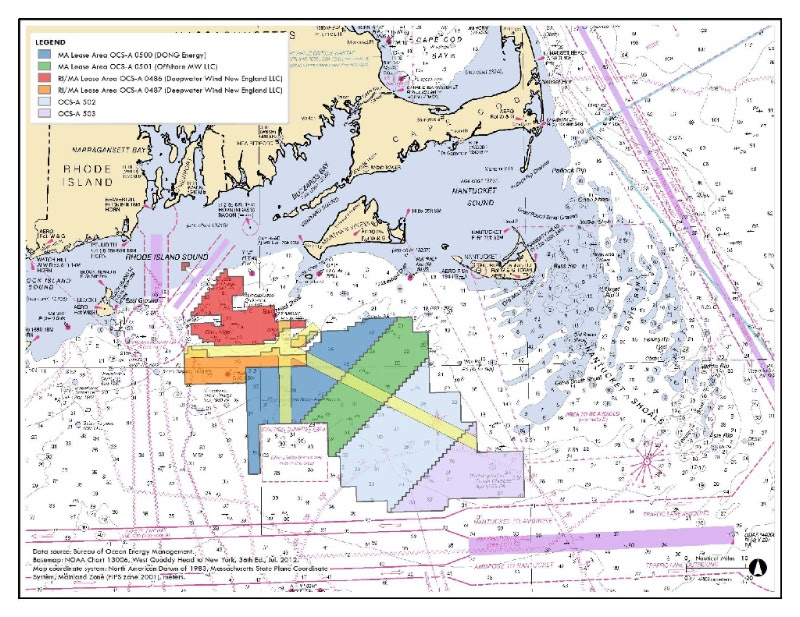
With a key approval from the Coastal Resources Management Council at stake, the New Bedford-based company has agreed to a two-month extension in an attempt to bridge the divide with agency staff and Rhode Island fishermen over the $2-billion project that would be built in 250 square miles of ocean south of Martha’s Vineyard.

At a recent meeting with the company and fishermen, Coastal Resources Management Council executive director Grover Fugate announced the stay, which pushes back a decision by the agency until Dec. 6.

The delay comes after Fugate sent a letter to Vineyard Wind signaling that the agency is unlikely to award a “consistency certification” to the 800-megawatt wind farm as it’s currently configured. Fugate recommended an alternate layout of the turbines to minimize impacts to fishing grounds for squid, lobster and other species that are critical to Rhode Island fishermen.

During the meeting last Thursday of the Fishermen’s Advisory Board, which advises the council on fishing issues related to offshore wind, Rhode Island fishermen complained that Vineyard Wind never took their needs into account when designing the wind farm. Over three hours of back and forth that at points grew heated, they repeatedly said that the orientation of the wind farm and the spacing of the turbines would make it nearly impossible for them to fish within its boundaries.

“You’re talking about gutting an entire industry, the Rhode Island industry,” said Lanny Dellinger, a lobsterman who heads the board. “If you do this, we’re all out of business.”

After the meeting, Fugate was asked if the council could approve the current design of the project.

Read the full story at the Providence Journal


Rhode Island squid fishermen fear wind power

July 2, 2018 — Rhode Island fishermen say a patch of the Atlantic Ocean south of Martha’s Vineyard is among the best places around to catch squid.

They are also the same waters in which a developer selected by Massachusetts plans to install up to 100 giant wind turbines that would supply clean, renewable energy to the state.

Now, Rhode Island coastal regulators and the state’s fishing community are raising concerns that the offshore wind farm that Vineyard Wind wants to build in 250 square miles of federally-owned ocean may affect access to the squid grounds that are critical to the Point Judith fleet.

“They cut out scallop fisheries valued by Massachusetts,” said Grover Fugate, executive director of the Rhode Island Coastal Resources Management Council. “But the grounds left are valued by Rhode Island fishermen, particularly for squid.”

Erich Stephens, chief development officer for Vineyard Wind, said the company has worked hard to accommodate the needs of Rhode Island fishermen — such as working to restrict the prospective schedule for laying a transmission cable to avoid the height of the squid fishing season in the summer — but he also acknowledged the dissatisfaction in some quarters with the proposed 800-megawatt wind farm.

“At the end of the day, there are a lot of different interests,” Stephens said. “It’s not possible to come up with a single design that will keep everyone happy.”

Read the full story at the Providence Journal

Massachusetts wants added review for Vineyard Wind project

June 22, 2018 — With the largest purchase of offshore wind resources in the country on their doorstep, state officials say they want more information to provide proper environmental oversight.

Last Friday a certificate was issued for Vineyard Wind’s April 30 draft environmental impact report, but because the company has now moved ahead to negotiate an 800-megawatt contract with three electric utilities companies, a more comprehensive report is needed, according to Executive Office of Energy and Environmental Affairs Secretary Matthew Beaton.

Massachusetts has an “interest in and obligation to provide a rigorous, robust and transparent environmental review process for the largest single procurement of offshore wind by any state in the nation,” Beaton wrote in the certificate.

The company, an equal partnership of Copenhagen Infrastructure Partners and Avangrid Renewables, plans what is expected to be a $2 billion construction project to install 50 to 100 wind turbines in federal leased waters 15 miles south of Martha’s Vineyard, with three energy export cables to make landfall on Cape Cod.

The sale of offshore wind power from the wind farm to the electric utilities on the mainland is part of a larger initiative by state leaders to reach a capacity of 1,600 megawatts of offshore wind energy by 2027.

As part of the typical review under the state’s environmental policy act, a draft and then a final environmental impact report are explanations by an owner of its project and alternatives to fully adhere to state and local environmental regulations. The state certificates issued on the reports, in turn, are guidance, describing what the company intends and what still needs to be addressed, strengthened or emphasized to ultimately avoid, minimize or mitigate damage to the environment.

In declaring the Vineyard Wind’s 1,380-page draft environmental impact report “inadequate,” Beaton said in Friday’s certificate that he is taking into account the company’s May 23 selection as the offshore wind competitor to move forward with contract negotiations with the utilities. Given the evolving circumstances, Beaton said he is asking for a supplemental draft environmental impact report from Vineyard Wind.

Read the full story at the New Bedford Standard-Times

Offshore wind projects worry Northeast fishermen

June 21, 2018 — A flurry of planned and proposed offshore wind projects in the Northeastern United States is causing anxiety among fishermen, who are worried that the turbines will disrupt marine life, make fishing more difficult, and harm their livelihoods.

The United States’ nascent offshore wind industry is predicted to grow rapidly in the coming years as states create and follow through on requirements to source a greater portion of their energy from clean sources, such as offshore wind.

The first offshore wind project in the U.S. – just five turbines generating 30 megawatts of electricity – came online in December 2016 near Block Island, Rhode Island. In the years to come, many more turbines are expected to crop up on the horizon.

Some fishermen worry the turbines will be too close together, making navigating difficult and possibly dangerous. Others are concerned the turbines will affect ocean currents, and the larvae that are swept up in them. And still others fret about the possibility that undersea electricity transmission will cause behavioral changes in bottom-dwelling creatures.

Earlier this month, a new lobbying group called the Responsible Offshore Development Alliance formed to represent the East Coast fishing industry in discussions over permitting of offshore wind development.

Read the full story at Seafood Source

MASSACHUSETTS: Alliance watchful on cable-laying proposal

June 18, 2018 — Both supporters and opponents of Vineyard Wind’s plan to bring its offshore wind farm cable to land on Cape Cod have emerged in two state decision-making arenas. But at least one well-known advocacy group is remaining noncommittal but watchful.

“We’re not taking a position against the project,” Alliance to Protect Nantucket Sound President Audra Parker said. “We’re preserving our right to participate.”

The alliance, which worked to defeat the never-built Cape Wind project in the Sound, is one of five groups that have been granted intervenor status before the state Energy Facilities Siting Board, along with seven individuals who have limited participation status. The intervenor and limited participation statuses allow groups or individuals to participate in the siting board proceedings beyond simply submitting public comments.

Despite participating in and supporting the designation of federal offshore wind energy areas south of the Islands, where Vineyard Wind plans 50 or more turbines, the alliance remains concerned that some other project could connect to that company’s new cable, leading to new development in the Sound, Parker said.

“We are watching closely,” she said.

The towns of Barnstable and Yarmouth, a resident of Rhode Island and Eversource Energy Service Company are the other intervenors. Among the limited participants are four West Yarmouth residents, a Yarmouth Port resident, one from Barnstable, and Vineyard Wind competitor Bay State Wind.

Read the full story at the Cape Cod Times

Massachusetts and Rhode Island projects have plenty of work ahead of them

May 31, 2018 — An analysis of the offshore wind energy development projects awarded in Massachusetts and Rhode Island last week suggests that, amid the euphoria, the developers of the projects still have a lot to do before they can start work.

As highlighted previously by OWJ, on 23 May 2018 Massachusetts electric distribution companies selected Vineyard Wind, a subsidiary of Avangrid Renewables, as the preferred provider of 800 MW of offshore wind generation for the Massachusetts power market and Rhode Island selected Deepwater Wind as the preferred provider of 400 MW to Rhode Island. Both companies propose to generate the electricity from wind projects they intend to construct on federal leases on the Outer Continental Shelf offshore of Massachusetts and Rhode Island.

Vineyard Wind’s proposal to build an array of about 100 8 MW turbines will see power transmitted via an undersea cable to Cape Cod, where it will tie in with existing transmission and substation infrastructure. The project will also incorporate distributed battery energy storage.

However, as law firm Beveridge & Diamond highlighted recently, even though Vineyard Wind won the request for proposals process, it is not yet over. Final contract negotiations between Vineyard Wind and the Massachusetts utilities are due to conclude by 2 July 2018, and a contract will be submitted to the Department of Public Utilities (DPU) by 31 July 2018. The DPU will have until 31 December 2018 to approve or reject that contract.

Read the full story at the Offshore Wind Journal


Boston Herald: Will wind energy deliver?

May 30, 2018 — Last week, Massachusetts announced the winner of a new offshore wind contract — which means the Bay State is about to get its first offshore wind farm. The Vineyard Wind project will be located at least a dozen miles south of Martha’s Vineyard and is expected to generate 800 megawatts of energy — enough to power 400,000 homes. Vineyard Wind is aiming for 2021 to be up and operational.

There is a lot to like about wind. The rows of wind turbines standing 397 feet tall (that’s 92 feet taller than the Statue of Liberty), rising out of the water are visually striking with their sleek blades turning in concert.

Wind energy is completely green energy, powered by a vast and inexhaustible resource. It does not pollute the water or the air. There is no ugly byproduct to contend with nor does the apparatus itself take up a lot of space. According to its website, “Vineyard Wind will offer $3.7 billion in energy related cost savings over the life of the project while eliminating 1.68 million metric tons of carbon dioxide emissions — the equivalent of taking 325,000 cars off the road.”

It sounds very promising as do a lot of the carefully worded­ highlights on the Vineyard Wind’s “Benefits” page.

Read the full story at the Boston Herald


Massachusetts: ‘Every vote matters:’ democratic candidates for governor visit New Bedford for forum

May 29, 2018 — NEW BEDFORD, Mass. — In a two-hour gubernatorial candidate forum hosted by the New Bedford Democratic City Committee, Jay Gonzalez and Robert Massie covered a wide range of issues including education, fishing, offshore wind, opioids and immigration.

“Every vote matters,” said moderator Shannon Jenkins, chairwoman of the Political Science Department at UMass Dartmouth and Dartmouth School Committee member, explaining the last election for governor was close.

Lisa Lemieux, a New Bedford Democrat was the main organizer of the forum, held at the Zeiterion Theatre Sunday afternoon. Prior to the forum, from 9:30 to 11:30 a.m., was an “open fair” with booths offering voter registration information and candidate advocacy briefing materials, a local farmer’s market and local music.

Gonzalez and Massie were in agreement on many issues, although at times each candidate suggested differing approaches. Both were in support of the proposed millionaires tax and single payer health care, and often criticized current Governor Charlie Baker who’s running for reelection as a Republican.

Fishing / offshore wind

Massie commented on last week’s announcement of Vineyard Wind winning Massachusetts’ first offshore wind contract for an 800-megawatt wind farm, calling it “much too small.”

“I would like to see the governor have agreed to a much larger wind contract so that we really create a whole industry rather than a single project,” he said.

Massie said the government has a responsibility to support people in their role or allow people to “transition out” and suggested a fisherman’s equity act. He said he acknowledges that those who depend on fishing need support to maintain their role or transition to a new role in the economy.

Read the full story at the New Bedford Standard-Times


  • « Previous Page
  • 1
  • …
  • 38
  • 39
  • 40
  • 41
  • 42
  • 43
  • Next Page »

Recent Headlines

  • Scientists did not recommend a 54 percent cut to the menhaden TAC
  • Broad coalition promotes Senate aquaculture bill
  • Chesapeake Bay region leaders approve revised agreement, commit to cleanup through 2040
  • ALASKA: Contamination safeguards of transboundary mining questioned
  • Federal government decides it won’t list American eel as species at risk
  • US Congress holds hearing on sea lion removals and salmon predation
  • MASSACHUSETTS: Seventeen months on, Vineyard Wind blade break investigation isn’t done
  • Sea lions keep gorging on endangered salmon despite 2018 law

Most Popular Topics

Alaska Aquaculture ASMFC Atlantic States Marine Fisheries Commission BOEM California China Climate change Coronavirus COVID-19 Donald Trump groundfish Gulf of Maine Gulf of Mexico Illegal fishing IUU fishing Lobster Maine Massachusetts Mid-Atlantic National Marine Fisheries Service National Oceanic and Atmospheric Administration NEFMC New Bedford New England New England Fishery Management Council New Jersey New York NMFS NOAA NOAA Fisheries North Atlantic right whales North Carolina North Pacific offshore energy Offshore wind Pacific right whales Salmon South Atlantic Virginia Western Pacific Whales wind energy Wind Farms

Daily Updates & Alerts

Enter your email address to receive daily updates and alerts:
  • This field is for validation purposes and should be left unchanged.
Tweets by @savingseafood

Copyright © 2025 Saving Seafood · WordPress Web Design by Jessee Productions