Saving Seafood

  • Home
  • News
    • Alerts
    • Conservation & Environment
    • Council Actions
    • Economic Impact
    • Enforcement
    • International & Trade
    • Law
    • Management & Regulation
    • Regulations
    • Nutrition
    • Opinion
    • Other News
    • Safety
    • Science
    • State and Local
  • News by Region
    • New England
    • Mid-Atlantic
    • South Atlantic
    • Gulf of Mexico
    • Pacific
    • North Pacific
    • Western Pacific
  • About
    • Contact Us
    • Fishing Terms Glossary

Alaska pollock giant American Seafoods lands former top NOAA fisheries official

June 11, 2021 — Alaska pollock supplier American Seafoods has hired Chris Oliver, a former top administrator for the National Oceanic and Atmospheric Administration (NOAA), as special advisor on government affairs in the company’s regulatory division.

Oliver has has a long career in fisheries. In 2017, he was designated by presidential appointment as Assistant Administrator for Fisheries at NOAA, where he was responsible for the management of commercial and recreational marine fisheries and protected species throughout the US Exclusive Economic Zone, which encompasses the Alaska pollock fishing grounds.

Oliver worked at the North Pacific Fishery Management Council — the government agency charged with managing the Alaska pollock fishery and setting its annual catch quotas– for more than 30 years, as a fisheries biologist, a deputy director, and finally as executive director for 16 years.

Read the full story at IntraFish

Oregon fishing families face climate change impacts

June 7, 2021 — For four generations Kevin and Taunette Dixon’s families have followed the rhythm of the sea: Harvesting groundfish, such as cod and pollock, early in the year. Pink shrimp beginning in April, sometimes followed by albacore in the fall. Then, Dungeness crab, Oregon’s biggest and most lucrative fishery, just in time to bring in holiday cash.

It’s been the same for fishing families up and down the Oregon Coast.

But the ocean is changing, and with it, life in tight-knit coastal communities.

For the past six years, Oregon’s traditional Dec. 1 Dungeness opening has been significantly delayed because elevated domoic acid levels make the crab unsafe to eat.

The toxin comes from harmful algal blooms caused by marine heatwaves, which are increasing in frequency and intensity.

The warming planet can actually fill the catch with poison.

And this is only one effect of climate change.

Oregon now has a regular “hypoxia season,” when ocean oxygen levels near the sea floor plummet and some sea life flees the region or dies.

In 2017, a huge hypoxia event occurred off Washington. The next year it extended into Oregon, resulting in almost no halibut caught. Over the next two years, Oregon commercial crabbers reported pulling up pot after pot of dead, suffocated crabs.

Read the full story from the Salem Statesman Journal at USA Today

Russia modernizes its pollock fleet, but struggles to find buyers

June 3, 2021 — Russia’s pollock fishery was faced with an unprecedented season in 2021 as the nation’s products were shut out of Chinese ports – a sudden loss of the destination market for 60 percent of the country’s seafood exports.

The closure forced the fishery to look for new destinations for its products, raising existential questions about the future of Russia’s seafood trade strategy.

Read the full story at Seafood Source

Winners of giant USDA pollock, catfish buys announced

May 27, 2021 — The U.S. Department of Agriculture has awarded nearly USD 20.9 million (EUR 17 million) in contracts as it continues to purchase Alaska pollock for use in federal food and nutrition assistance programs.

Two suppliers nabbed the pollock contracts: Seattle, Washington-based Trident Seafood earned USD 15.1 million (EUR 12.4 million) worth of the contract, while Channel Fish Processing in Braintree, Massachusetts, snared nearly USD 5.8 million (EUR 4.8 million).

Read the full story at Seafood Source

NFI releases new list detailing the top 10 seafood species Americans consume most

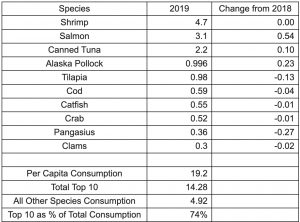
May 26, 2021 — American consumers ate 19.2 pounds of seafood per capita in 2019, an increase of 0.2 pounds over 2018’s figures, according to National Fisheries Institute (NFI) calculations based off of the National Oceanic and Atmospheric Administration’s (NOAA) latest “Fisheries of the United States” report.

For its report released this year, which recounts 2019 figures, NOAA revised its per capita consumption model, “updating weight conversion factors to more accurately reflect efficiencies in processing,” NFI said.

Read the full story at Seafood Source

NFI’s Top 10 List Suggests Consumers Diversifying Seafood Consumption

May 26, 2021 — The following was released by the National Fisheries Institute:

In 2019, Americans ate 19.2 pounds of seafood per capita, an increase of .2 pounds from 2018’s revised figure. In previous years, the Top 10 list has made up an outsized portion of US seafood consumption, nearly 90%. This time the familiar names on the Top 10 make up only 74%.

The 2019 Fisheries of the United States report, released by the National Oceanic Atmospheric Administration (NOAA), revised its Per Capita Consumption model to update edible weight conversion factors to more accurately reflect efficiencies in processing. The revised model resulted in higher consumption levels than previously reported.

Shrimp maintained the top spot, while Salmon, Canned Tuna and Alaska Pollock all saw gains.

It is important to highlight that the featured numbers on this list are all exclusively from 2019 and do not represent any pandemic-impacted market forces.

The U.S. government is buying $40 million worth of pistachios and $70 million of seafood

May 21, 2021 — Pistachios are my favorite nut. I can house a whole bag of those in no time at all. Apparently the American government is into them too, because they’re not buying just a bunch, but a massive amount. During times of crop and product surpluses, the USDA will buy up extra to keep America’s food banks stocked; in 2016, it bought $20 million in cheese. Now, Food & Wine reports, the government is buying up millions of dollars of pistachios, among other delicious bounties.

It’s obvious that COVID-19 has mucked up all sorts of farming supply issues, and plenty of Americans are having a hard time getting by. So the USDA is currently making big buys to help those that produce food and those who need it. Last week the Biden administration announced that the USDA would be purchasing $159.4 million worth of seafood, fruits, legumes, and nuts. Of that, $70.9 million will be spent on seafood, the largest government seafood purchase ever.

“The impacts of COVID-19 reverberated from our farms to our oceans,” said Agriculture Secretary Tom Vilsack. “U.S. fisheries and the American seafood industry were dealt a heavy blow…. These healthy, nutritious food purchases will benefit food banks and non-profits helping those struggling with food hardship as the Biden Administration works to get the economy back on track for American families.”

Read the full story at The Takeout

Analyst says China not meeting US seafood purchase commitments under trade agreement

May 17, 2021 — China is not living up to its commitments to purchase U.S. seafood under the 2020 trade agreement between the two sides, according to a trade analyst at a U.S. fishery trade body.

The U.S. China Economic and Trade Agreement, also known as the “phase one deal,” was signed in early 2020 and bound China to USD 200 billion (EUR 164.5 billion) in purchases from the U.S. through increasing orders of certain commodities, including seafood. The increase was based on figures for 2017 – the last full year before the trade war began.

Read the full story at Seafood Source

USDA spends $70.9 million on domestic seafood

May 14, 2021 — The U.S. Department of Agriculture announced today that it will purchase $70.9 million of domestic wild seafood, registering its largest purchase of U.S. seafood to date.

The purchase, made possible under the Agricultural Adjustment Act, is one of many actions USDA is taking to address food insecurity and disruptions in the food system supply chain exacerbated by the pandemic.

The seafood purchases come from a $159.4 million commitment to buying domestic seafood, fruits, legumes and nuts for distribution to a variety of domestic food assistance programs, including charitable institutions.

“The impacts of covid-19 reverberated from our farms to our oceans,” said Agriculture Secretary Tom Vilsack in a statement. “U.S. fisheries and the American seafood industry were dealt a heavy blow. Today, USDA is pleased to make the largest single seafood purchase in the department’s history. These healthy, nutritious food purchases will benefit food banks and non-profits helping those struggling with food hardship as the Biden administration works to get the economy back on track for American families.”

Read the full story at National Fisherman

USDA to Purchase $159.4 Million in Nutritious Consumer-Ready Seafood and More for Food Assistance Programs

May 14, 2021 — The following was released by the United States Department of Agriculture:

The U.S. Department of Agriculture (USDA) today announced it will purchase up to $159.4 million in domestically produced seafood, fruits, legumes, and nuts for distribution to a variety of domestic food assistance programs, including charitable institutions. These purchases are being made utilizing funds under the authority of Section 32 of the Agricultural Adjustment Act (Pub. L. 74-320), as amended (Section 32). This is one of many actions USDA is taking to address the disruptions in the food system supply chain and worsened food insecurity resulting from the COVID-19 pandemic.

“The impacts of COVID-19 reverberated from our farms to our oceans,” said Agriculture Secretary Tom Vilsack. “U.S. fisheries and the American seafood industry were dealt a heavy blow. Today, USDA is pleased to make the largest single seafood purchase in the Department’s history. These healthy, nutritious food purchases will benefit food banks and non-profits helping those struggling with food hardship as the Biden Administration works to get the economy back on track for American families.”

Selected commodities include: Alaska pollock, apricots (canned, dried, and frozen), chickpeas, dry peas, Gulf of Mexico and South Atlantic wild-caught shrimp, lentils, navy beans, Pacific pink shrimp, Pacific rockfish fillets, Pacific whiting fillets, pistachios, prepared peaches, and sockeye (red) salmon. The inventories of these commodities are in high oversupply due to a decrease in demand because of the COVID-19 pandemic and disruption in the supply chain, as restaurants and other outlets closed during the pandemic. This is the largest purchase of U.S. raised seafood by the USDA to date.

Within a few days of approval, USDA’s Food and Nutrition Service will offer these commodities to their networks. Orders should be received during the first week of June with solicitations being issued mid-June and awards occurring near the end of the month. Deliveries should start to occur by mid-August.

Solicitations will be available electronically through the Web-Based Supply Chain Management (WBSCM) system and on the Agricultural Marketing Service’s website at www.ams.usda.gov/selling-food. To be eligible to submit offers, potential contractors must meet the AMS vendor qualification requirements and be domestic operations.

Read the full release here

  • « Previous Page
  • 1
  • 2
  • 3
  • 4
  • 5
  • 6
  • …
  • 25
  • Next Page »

Recent Headlines

  • Scientists did not recommend a 54 percent cut to the menhaden TAC
  • Broad coalition promotes Senate aquaculture bill
  • Chesapeake Bay region leaders approve revised agreement, commit to cleanup through 2040
  • ALASKA: Contamination safeguards of transboundary mining questioned
  • Federal government decides it won’t list American eel as species at risk
  • US Congress holds hearing on sea lion removals and salmon predation
  • MASSACHUSETTS: Seventeen months on, Vineyard Wind blade break investigation isn’t done
  • Sea lions keep gorging on endangered salmon despite 2018 law

Most Popular Topics

Alaska Aquaculture ASMFC Atlantic States Marine Fisheries Commission BOEM California China Climate change Coronavirus COVID-19 Donald Trump groundfish Gulf of Maine Gulf of Mexico Illegal fishing IUU fishing Lobster Maine Massachusetts Mid-Atlantic National Marine Fisheries Service National Oceanic and Atmospheric Administration NEFMC New Bedford New England New England Fishery Management Council New Jersey New York NMFS NOAA NOAA Fisheries North Atlantic right whales North Carolina North Pacific offshore energy Offshore wind Pacific right whales Salmon South Atlantic Virginia Western Pacific Whales wind energy Wind Farms

Daily Updates & Alerts

Enter your email address to receive daily updates and alerts:
  • This field is for validation purposes and should be left unchanged.
Tweets by @savingseafood

Copyright © 2025 Saving Seafood · WordPress Web Design by Jessee Productions