Saving Seafood

  • Home
  • News
    • Alerts
    • Conservation & Environment
    • Council Actions
    • Economic Impact
    • Enforcement
    • International & Trade
    • Law
    • Management & Regulation
    • Regulations
    • Nutrition
    • Opinion
    • Other News
    • Safety
    • Science
    • State and Local
  • News by Region
    • New England
    • Mid-Atlantic
    • South Atlantic
    • Gulf of Mexico
    • Pacific
    • North Pacific
    • Western Pacific
  • About
    • Contact Us
    • Fishing Terms Glossary

NOAA Fisheries Announces Proposed Management Measures for the 2016-2018 Atlantic Herring Fishery

June 22, 2016 — The following was released by NOAA Fisheries:

NOAA Fisheries announces proposed management measures for the Atlantic Herring fishery for the 2016-2018 fishing years. The proposed catch limits for fishing years 2016 through 2018 are slightly lower than the current catch limits because the most recent assessment shows a slightly lower spawning stock biomass and a slightly higher fishing mortality.

We are also proposing to increase the catch cap limits for river herring and American shad to increase access to the fishery, while still providing sufficient protection for these species.

Read the proposed rule as published in the Federal Register and supplemental documents.

The comment period is open through July 21.

You may submit comments by any one of the following methods:

  • Electronic Submission: Submit all electronic public comments via the Federal eRulemaking Portal. Click the “Comment Now!” icon, complete the required fields, and enter or attach your comments.
  • Mail: Submit written comments to NMFS, Greater Atlantic Regional Office, 55 Great Republic Drive, Gloucester, MA 01930. Mark the outside of the envelope “Comments on 2016-2018 Herring Specifications.”
  • Fax: (978) 281-9135, Attn: Shannah Jaburek.

Questions? Contact Jennifer Goebel at 978-281-9175 or email jennifer.goebel@noaa.gov.

MASSACHUSETTS: Gov. Baker throws oar into lobster fight

June 21, 2016 — Gov. Charlie Baker has tossed his two cents across the Atlantic Ocean and into the Swedish lobster contretemps.

Sweden is attempting to convince the entire European Union — which numbers 28 member states — to ban the import of American lobsters to Europe.

The Massachusetts governor, in a letter dated June 16 to a chief official of the European Union, warned that a proposed ban on the importation of American lobsters into the EU would significantly and negatively impact United States and Canadian fishermen, while also imposing an economic hardship on European consumers and seafood distributors in Europe and the U.S.

The letter to Daniel Calleja Crespo, the EU’s commission’s director general for the environment, closely mirrors similar positions of NOAA Fisheries and its Canadian counterpart.

Read the full story at the Gloucester Times

Rep. Jones, others want red snapper fishery to reopen

June 20, 2016 — More than a dozen congressmen, including U.S. Rep. Walter Jones, wants federal fisheries regulators to reconsider a decision to close the South Atlantic red snapper fishery.

The representatives said data produced by a Florida research institution shows the South Atlantic red snapper stock is healthier than what federal data indicates so the fishery should be reopened to commercial and recreational fishing.

The South Atlantic Fishery Management Council, a division of the National Oceanic and Atmospheric Administration Fisheries program, announced the South Atlantic red snapper season is closed this year because the total number of red snapper removed from the population in 2015 exceeded the allowable level, according to the NOAA Fisheries website.

Read the full story at the Daily Reflector

40 years of change: For fishing industry, the spring of 1976 was the start of a new era

June 20, 2016 — The following is excerpted from a story published Saturday by the New Bedford Standard-Times:

NEW BEDFORD, Mass. — When you talk about fishing here in New Bedford, you have to start with the whaling era — and the lessons learned.

For decades, the pursuit of whaling chugged along without any dramatic changes. The ships, the equipment, the culture remained essentially the same for years, feeding countless families, lining countless pockets … until the bonanza ran out and the industry collapsed in the early part of the 20th century, never to be revived.

The fishing industry, both local and national, might have fallen into that same trap, but 40 years ago the U.S. government changed the game, adopting the most sweeping changes in the laws governing fisheries that reverberates to this day.

On April 13, 1976, the Magnuson-Stevens Fishery Conservation and Management Act was passed and immediately accomplished two major goals.

One, it set into motion a new and unique scheme of regulation to rebuild dwindling fish stocks, a system dramatically different than anything else the government had tried until 1976.

Two, it expelled foreign fishing vessels from fishing inside a 200-mile limit from America’s shoreline.

It isn’t talked about much today, but until 1976 the capacity of the foreign fleet exceeded the Americans, sending huge factory ships into fertile places like Georges Bank to virtually vacuum the fish into the hold and freeze it on the spot, allowing the ships to stay for weeks at a time. “There were West Germans, Poles, Russians, East Germans,” recalled former fisherman James Kendall, now a seafood consultant.

In 1975, the National Marine Fisheries Service reported there were 133 foreign fishing vessels fishing on Georges Bank. The Magnuson-Stevens Act ended that decisively.

Since 1976, much has changed. The unions, which once represented the fishermen and the workers in the fish houses, virtually disappeared from the waterfront. The venerable fish auction at the Wharfinger Building on City Pier 3 is now a museum piece, since the brokers years ago put down their chalkboards and picked up computer screens. Today it has evolved into a computerized display auction elsewhere on the waterfront, with complete transparency and documentation, and bidders located across the nation.

What else has changed?

For lack of a better term, everything.

Where, oh where has our groundfish fleet gone?

At the BASE New Bedford Seafood Display Auction, co-owner Richard Canastra called up data of groundfish sales in recent years that demonstrate a dropoff of more than 30 percent in the last few years alone.

Today there are some days that don’t warrant conducting the auction at all. “Sometimes it’s like a candy store,” he said. “Five pounds of this and three pounds of that.”

Much of the blame for the shrinking of the groundfish fleet, particularly in New Bedford and Gloucester, is laid at the feet of the catch shares and sector management introduced in 2010 by NOAA Administrator Jane Lubchenco. It dispensed with most of the old days-at-sea  system, which had reduced the annual days at sea to 50, down from around 225, that the boats once had available to them.

The term “sectors” was unfamiliar to the industry when NOAA announced their arrival in 2010. Essentially they are cooperatives, in which individual boats are grouped together along with their catch allocations, and the sector manager manages them as efficiently as he or she can.

This was predicted to cause a consolidation of the industry into the bigger players as the smaller ones weren’t getting enough quota to make it profitable to fish.

For some boat owners, the problem was that the catch shares were determined by the history of the boats but the practice of shack left no paper trail, no formal record, so catch shares were reduced in many cases.

Dr. Brian Rothschild, dean emeritus of the UMass Dartmouth School for Marine Science and Technology and a critic of NOAA, noted that many boat owners found that they can “own it and lease it out and obtain money in windfall profits” without even going fishing.

Oh, those pesky environmentalists!

It was “not right from the beginning that NOAA has enforced this,” Rothschild said. “On top of that, NOAA enforcement didn’t come from a desire to make good public policy but because it came under the influence of organizations like the Environmental Defense Fund,” he said.

Catch shares and sector management have, however, withstood legal challenges in federal court, because of a legal doctrine named Chevron, in which government institutions are allowed to interpret laws such as Magnuson any way they wish unless the departures from congressional intent are egregious.

Rothschild is among those who believe that sector management under Magnuson has been ignoring key provisions of the act, notably the socio-economic impact evaluation and the instruction to use the best available science. That has largely excluded scientists outside of NOAA itself.

Outside scientists have occasionally run rings around NOAA. For example, SMAST’s Dr. Kevin  Stokesbury’s invention of a camera apparatus to quite literally count the scallops on the seabed individually has revolutionized scallop management, opened the door to a treasure trove of healthy scallops, and made New Bedford the No. 1 fishing port in the nation.

But NOAA now employs its own camera apparatus. It conducts regular surveys of fish populations and that has been a very sore point at times in recent years.

This is a departure from the days before Magnuson, when fishermen were issued permits for various species and were left largely on their own to discover how many fish were in the ocean, which were already dwindling at the time.

Read the full story at the New Bedford Standard-Times

NOAA Fishery Bulletin: NOAA Fisheries Seeks Public Comment on a Draft Environmental Impact Statement for Hogfish in Federal Waters of the South Atlantic Region

June 20, 2016 — The following was released by NOAA Fisheries:

NOAA Fisheries is seeking public comment on a draft environmental impact statement for Amendment 37 to the Fishery Management Plan for the Snapper-Grouper Fishery of the South Atlantic Region (Amendment 37).

NOAA Fisheries is proposing to manage hogfish in the South Atlantic as two populations: Georgia through North Carolina and Florida Keys/East Florida. A population assessment determined that the Florida Keys/East Florida population is undergoing overfishing and is overfished and, therefore, in need of a rebuilding plan. The overfishing and overfished status of the Georgia/North Carolina population is unknown.

The draft environmental impact statement for Amendment 37 analyzes a range of alternatives for actions, which include:

  • Modifying the management unit for hogfish.
  • Establishing a rebuilding plan for the Florida Keys/East Florida population to increase hogfish biomass to sustainable levels.
  • Specifying commercial and recreational annual catch limits and accountability measures for the Georgia/North Carolina and Florida Keys/East Florida populations of hogfish.
  • Modifying or establishing fishing regulations for both populations of hogfish, including minimum size limits, commercial trip limits, recreational bag limits, and a recreational fishing season.

For more information, please see the frequently asked questions section at:

http://sero.nmfs.noaa.gov/sustainable_fisheries/s_atl/sg/2015/am37/index.html

Request for Comments

The comment period on this draft environmental impact statement ends on August 1, 2016. You may obtain electronic copies of the draft amendment and environmental impact statement from the NOAA Fisheries Web site at http://sero.nmfs.noaa.gov/sustainable_fisheries/s_atl/sg/2015/am37/index.htmlor the e-Rulemaking Portal (see Addresses section).

Addresses

You may submit comments on this document, identified by NOAA-NMFS-2016-0068, by either of the following methods:

ELECTRONIC SUBMISSION: Submit all electronic public comments via the Federal e-Rulemaking Portal.

  1. Go to www.regulations.gov/#!docketDetail;D=NOAA-NMFS-2016-0068.
  2. Click the “Comment Now!” icon, complete the required fields.
  3. Enter or attach your comments.

MAIL: Submit written comments to Nikhil Mehta, Southeast Regional Office, NMFS, 263 13th Avenue South, St. Petersburg, FL 33701.

INSTRUCTIONS: Comments sent by any other method, to any other address or individual, or received after the end of the comment period, may not be considered by NOAA Fisheries.

All comments received are a part of the public record and will generally be posted for public viewing on http://www.regulations.gov without change. All personal identifying information (e.g., name, address, etc.), confidential business information, or otherwise sensitive information submitted voluntarily by the sender will be publicly accessible. NOAA Fisheries will accept anonymous comments (enter “N/A” in the required fields if you wish to remain anonymous).

Controversial Gulf of Mexico red snapper fishery bill advances

June 17, 2016 — The U.S. House of Representatives’ Committee on Natural Resources advanced a bill on Wednesday, 15 June regarding red snapper in the Gulf of Mexico that would extend Southern states’ control over federal waters and establish a new management authority to replace the oversight of the National Oceanographic and Atmospheric Association (NOAA).

The action moves the legislation on to face a potential vote by the full body of the U.S. House of Representatives.

The bill, H.R. 3094, or the Gulf States Red Snapper Management Authority Act, was authored by U.S. Rep. Garret Graves (R-Louisiana). The proposed legislation would remove the red snapper fishery from federal management under the Magnuson-Stevens Act and give management authority of the species to an agency overseen by fishery managers representing five Southern states with borders on the Gulf of Mexico.

Read the full story at Seafood Source

Regulators close scallop fishery southeast of Cape Cod

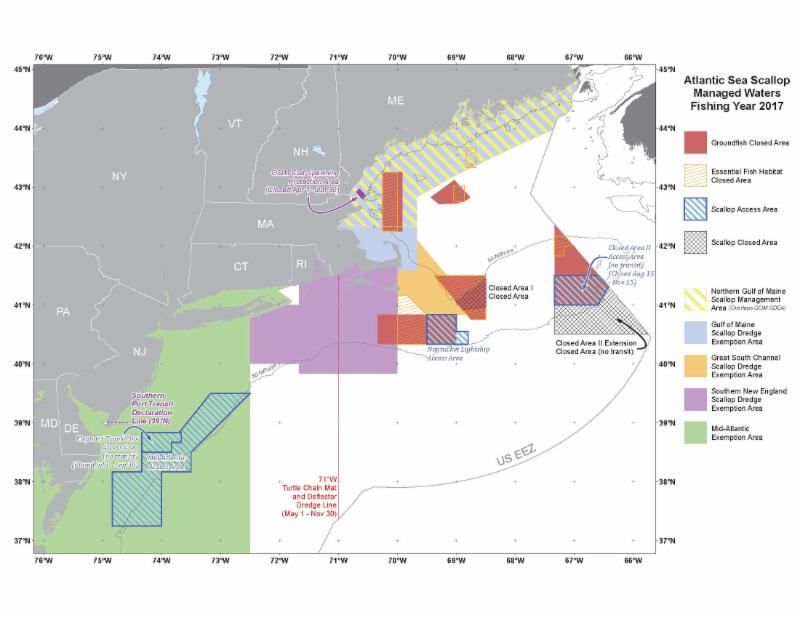
June 16, 2016 — NANTUCKET, Mass. — The National Oceanic and Atmospheric Administration is closing one of the key fishing areas off of New England where fishermen seek scallops.

The administration is closing the Nantucket Lightship North Scallop Access Area to scallop vessels that fish under “limited access general category” rules. The closure goes into effect at 12:01 a.m. on Thursday.

Read the full story from the Associated Press at the Portland Press Herald

Fishermen, scientists to evaluate NOAA stock assessments

June 13, 2016 — The most incendiary divide between groundfishermen and fishing regulators in the past two years has been the discrepancy between what NOAA Fisheries says its stock assessments show and what fishermen are seeing on the water.

The groundfish assessments by the National Oceanic and Atmospheric Administration — particularly for the iconic Gulf of Maine cod stock and certain flounders — have been uniformly dire, leading to the virtual shuttering of cod fishing in the Gulf of Maine and scant quotas for other species.

Fishermen — including commercial groundfishermen, charter captains and even lobstermen — paint a very different portrait of what they are seeing on a daily basis: cod, cod everywhere, and not a one they can catch.

On June 20, the city’s Economic Development and Industrial Corporation and fishing stakeholders will host a presentation by a team of University of Massachusetts scientists on their current findings and methodology for fish population counting in the Gulf of Maine.

Read the full story at the Gloucester Times

NOAA Fisheries Announces Proposed Rules for Northeast Skate Fishery

June 6, 2016 — The following was released by NOAA Fisheries Greater Atlantic Region:

Today, NOAA Fisheries proposes, and opens for public comments, new management measures for the northeast skate fishery.

These were developed through Framework Adjustment 3 to the Northeast Skate Complex Fishery Management Plan at the recommendation of the New England Fishery Management Council.

The proposed measures are:

  • New quotas for the skate wing (8,372 mt) and bait (4,218 mt) fisheries for the 2016 and 2017.
  • All skate trip limits are proposed to remain unchanged from current levels.
  • Splitting the skate wing fishery quota into two seasons (May through August and September through April) to allow the directed fishery to be temporarily closed in-season if the seasonal quota is reached.

Read the proposed rule as filed in the Federal Register.

The comment period is open until 5pm on June 21.

Please submit your comments online or by mailing them to:

John Bullard, Regional Administrator
NOAA Fisheries Greater Atlantic Region
55 Great Republic Drive
Gloucester, MA 01930

Please mark the outside of the envelope “Comments on Northeast Skate Fishery Proposed Rule.”

Federal Legislators Tour New Bedford Fisheries, Discuss At-Sea Monitoring

Bishop 5

Rep. Bill Keating (left) and Rep. Rob Bishop (right) discuss at-sea monitoring in a visit to New Bedford on Thursday, June 2. (Photo: House Natural Resources Committee)

June 3, 2016 — The following is excerpted from a story published yesterday by WBSM:

The City of New Bedford welcomed a possible congressional ally for the fishing industry Thursday to tour fisheries along the harbor.

Congressman Rob Bishop (R-UT) took a tour of the Whaling City Seafood Auction and seafood processing plant Northern Wind along with Congressman Bill Keating (D-MA), New Bedford Mayor Jon Mitchell and representatives of the local seafood industry.

Elected officials and members of the fishing industry have expressed grave concern over the federally mandated costs by NOAA for at-sea monitors aboard select fishing vessels across the east coast.

Keating said it’s difficult for legislators outside maritime districts to fully understand the impact of the at-sea monitoring costs.

“It creates a greater challenge to get the understanding why this is so important,” said Keating. “The cost of monitoring $800 a day could be enough to be the difference between success and failure of a small business.”

Read the full story at WBSM

  • « Previous Page
  • 1
  • …
  • 178
  • 179
  • 180
  • 181
  • 182
  • …
  • 205
  • Next Page »

Recent Headlines

  • Scientists did not recommend a 54 percent cut to the menhaden TAC
  • Broad coalition promotes Senate aquaculture bill
  • Chesapeake Bay region leaders approve revised agreement, commit to cleanup through 2040
  • ALASKA: Contamination safeguards of transboundary mining questioned
  • Federal government decides it won’t list American eel as species at risk
  • US Congress holds hearing on sea lion removals and salmon predation
  • MASSACHUSETTS: Seventeen months on, Vineyard Wind blade break investigation isn’t done
  • Sea lions keep gorging on endangered salmon despite 2018 law

Most Popular Topics

Alaska Aquaculture ASMFC Atlantic States Marine Fisheries Commission BOEM California China Climate change Coronavirus COVID-19 Donald Trump groundfish Gulf of Maine Gulf of Mexico Illegal fishing IUU fishing Lobster Maine Massachusetts Mid-Atlantic National Marine Fisheries Service National Oceanic and Atmospheric Administration NEFMC New Bedford New England New England Fishery Management Council New Jersey New York NMFS NOAA NOAA Fisheries North Atlantic right whales North Carolina North Pacific offshore energy Offshore wind Pacific right whales Salmon South Atlantic Virginia Western Pacific Whales wind energy Wind Farms

Daily Updates & Alerts

Enter your email address to receive daily updates and alerts:
  • This field is for validation purposes and should be left unchanged.
Tweets by @savingseafood

Copyright © 2025 Saving Seafood · WordPress Web Design by Jessee Productions