Saving Seafood

  • Home
  • News
    • Alerts
    • Conservation & Environment
    • Council Actions
    • Economic Impact
    • Enforcement
    • International & Trade
    • Law
    • Management & Regulation
    • Regulations
    • Nutrition
    • Opinion
    • Other News
    • Safety
    • Science
    • State and Local
  • News by Region
    • New England
    • Mid-Atlantic
    • South Atlantic
    • Gulf of Mexico
    • Pacific
    • North Pacific
    • Western Pacific
  • About
    • Contact Us
    • Fishing Terms Glossary

MASSACHUSETTS: New Bedford’s Azorean whaleboats await major spring overhaul

March 13, 2016 — NEW BEDFORD — Major maintenance and repairs are in store this spring for the three proud Azorean whaleboats built in New Bedford between 1997 and 2000.

To pay the $23,000 estimated cost, the Azorean Maritime Heritage Society is hosting two fundraisers — one on Tuesday at Estoril in Fall River, and the other on May 21 at the Sails of Portugal Wine and Food Tasting at the New Bedford Whaling Museum.

One of the three boats, the Bela Vista, now rests on the ground floor of the Whaling Museum’s new education center, in a still unfinished space.

It still looks glorious in its wildly festive pink, blue and yellow paint, colors that don’t signify anything beyond fun and excitement in the Azorean culture.

But as Sara Quintal, society president, pointed out to a visitor, the 40-foot whaleboat suffers many maladies as the result of heavy use and uneven and sometimes harsh storage conditions.

The wetting and drying of the hull “has caused the planks to shrink,” she said. That leaves gaps and so “this boat leaks like a sieve,” she said.

Repair surveys and estimates have been done on the boats, and it seems as if almost every part and every piece will need replacement or repair to get them into shape for the next Azorean regatta, set for 2017.
Read the full story at the New Bedford Standard-Times

How whaling logs from the 1800s might help us solve climate change

December 16, 2015 — NEW BEDFORD, Mass. — Maritime historians, climate scientists and ordinary citizens are coming together on a project to study the logbooks of 19th-century whaling ships to better understand modern-day climate change and Arctic weather patterns.

Whaling ships kept meticulous daily logbooks of weather conditions during their often yearslong voyages searching the globe for whales, valued for their light-giving oil, said Michael Dyer, senior maritime historian at the New Bedford Whaling Museum, which is supplying much of the data.

Some logs include information about life on board, such as sailors falling overboard, or being disciplined for stealing or other transgressions, and of course, notations whenever whales are spotted. More important for this project, they include precise longitude and latitude measurements, weather conditions, the presence of icebergs and the edge of the ice shelf.

“If they’re cruising in the Bering Strait and there’s ice, there will be a notation in the logbook that ice fields are present,” Dyer said.

The project, called Old Weather: Whaling, is led by the National Oceanic and Atmospheric Administration. The whaling museum is transcribing and digitizing its own logbooks, as well as original data sources from the Nantucket Historical Association, Martha’s Vineyard Museum, Mystic Seaport in Connecticut, and the New Bedford Free Public Library.“If they’re cruising in the Bering Strait and there’s ice, there will be a notation in the logbook that ice fields are present,” Dyer said.

Read the full story from the Associated Press at the New York Post


‘Counting Fish’ takes a closer look at UMass Dartmouth team’s fishing industry research

November 16, 2015 — NEW BEDFORD — Gentle persuasion might best describe a new 50-minute documentary on fisheries research going on at the UMass Dartmouth School for Marine Science and Technology.

Don Cuddy, program director for the Center for Sustainable Fisheries and a Mattapoisett resident, provides the narration, taking the viewer aboard the fishing vessel Liberty in May of 2015 to observe fish survey work.

There, one sees footage from eight days at sea, culled from seven hours, of Dr. Kevin Stokesbury of SMAST. He is the researcher who developed the “drop camera” for counting scallops on the sea floor, exposing faulty science, and helped create the highly profitable scallop industry known today.

The New Bedford Whaling Museum is launching the new film, “Counting Fish,” on Harvest of the Sea Day, Nov. 22 at 1:30 p.m. in the museum theater, free to the public.

What viewers will see is a documentary that Cuddy agrees is small, done on a very tight budget.

But without lot of raised voices or a confrontational style, the film depicts SMAST scientists as conducting very serious survey work on fish populations. In between shots of nets being hauled up and fish being hand-counted on deck, Stokesbury and his crew explain carefully and in layman’s terms what they are doing and how they are doing it.

Read the full story at New Bedford Standard Times

Fishing film to premier in New Bedford, Mass.

November 10, 2015 — The following was released by the Center for Sustainable Fisheries:

COUNTING FISH  

A film by Don Cuddy 

November, 22 at 1.30 p.m.

New Bedford Whaling Museum

New England groundfishermen are in trouble, with catch limits set so low that many boats remain tied to the dock. But the industry has little confidence in the NOAA survey that provides the raw data used for the stock assessment. Accurately counting fish populations in the ocean is a daunting task however and everyone agrees on the need for better science. SMAST researcher Kevin Stokesbury may have found a solution. By using underwater cameras to record fish passing through the open cod end of a net, SMAST survey tows can last for as long as two hours while allowing the fish to escape unharmed.

With very limited resources, Stokesbury and his team have been refining this technology on Georges Bank by conducting spring and fall surveys over the past three years; working in collaboration with the fishing industry which generously donates the boat, the grub and the fuel.

Don Cuddy, program director for the Center for Sustainable fisheries in New Bedford, joined the crew for the May 2015 survey and captured the experience on camera. Those eight days at sea produced more than seven hours of video footage that has now been distilled into a fifty-minute film, called, appropriately enough, ‘Counting Fish.’

 For a fascinating look into the world of marine research, join Cuddy, Stokesbury and the crew of the F/V Justice for the premier screening of ‘Counting Fish’ at the New Bedford whaling museum on Sunday, Nov.22 at 1.30 p.m.

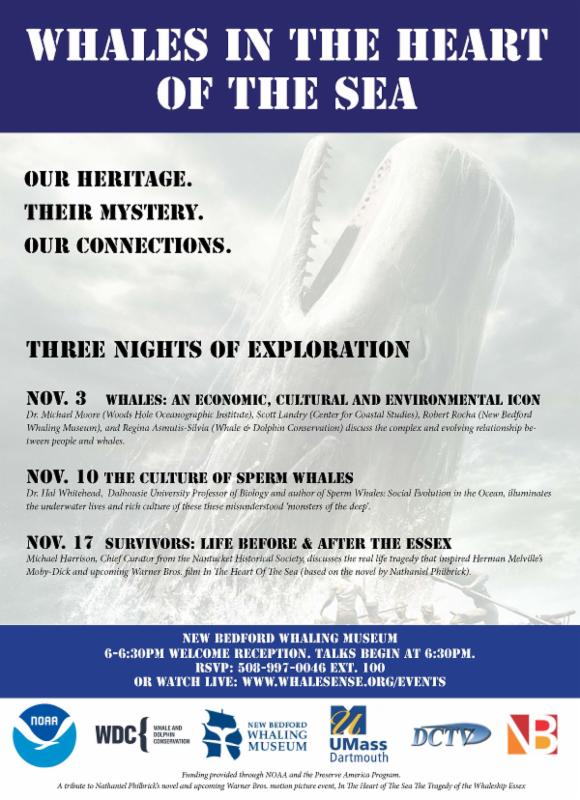
MASSACHUSETTS: Lecture Series: Whales in the Heart of the Sea

October 27, 2015 — The following was released by NOAA Fisheries:

The following free lectures exploring our evolving relationship with whales will take place at the New Bedford Whaling Museum. 

6:00 p.m. Reception  |  6:30 p.m. Lecture

Tuesday, Nov 3

Whales: An Economic, Cultural, and Environmental Icon

Dr. Michael Moore (Woods Hole Oceanographic Institute), Scott Landry (Center for Coastal Studies), Robert Rocha (New Bedford Whaling Museum), and Regina Asmutis-Silvia (Whale & Dolphin Conservation) discuss the complex and evolving relationship between people and whales.

Tuesday, Nov. 10 

The Culture of Sperm Whales 

Dr. Hal Whitehead, Dalhousie University Professor of Biology and author of Sperm Whales: Social Evolution in the Ocean, illuminates the underwater lives and rich culture of these these misunderstood “monsters of the deep.”

Tuesday, Nov. 17 

Survivors: Life Before & After the Essex 

Michael Harrison, Chief Curator from the Nantucket Historical Society, discusses the real life tragedy that inspired Herman Melville’s Moby-Dick and upcoming Warner Bros. film In The Heart of the Sea (based on the novel by Nathaniel Philbrick).

Save your seat by calling 508-997-0046 x 100 or register online.

These events will also be broadcast live online.  

This lecture series is supported by a grant from the NOAA Preserve America Initiative.

Questions? Contact Jennifer Goebel, Regional Office, at 978-281-9175 or Jennifer.Goebel@noaa.gov.


  • « Previous Page
  • 1
  • 2

Recent Headlines

  • Ecosystem shifts, glacial flooding and ‘rusting rivers’ among Alaska impacts in Arctic report
  • Petition urges more protections for whales in Dungeness crab fisheries
  • MASSACHUSETTS: Six decades of change on Cape Cod’s working waterfronts
  • Court Denies Motion for Injunction of BOEM’s Review of Maryland COP
  • Fishing Prohibitions Unfair: Council Pushes for Analysis of Fishing in Marine Monuments
  • Wespac Looks To Expand Commercial Access To Hawaiʻi’s Papahānaumokuākea
  • Arctic Warming Is Turning Alaska’s Rivers Red With Toxic Runoff
  • NOAA Seeks Comment on Bering Sea Chum Salmon Bycatch Proposals

Most Popular Topics

Alaska Aquaculture ASMFC Atlantic States Marine Fisheries Commission BOEM California China Climate change Coronavirus COVID-19 Donald Trump groundfish Gulf of Maine Gulf of Mexico Illegal fishing IUU fishing Lobster Maine Massachusetts Mid-Atlantic National Marine Fisheries Service National Oceanic and Atmospheric Administration NEFMC New Bedford New England New England Fishery Management Council New Jersey New York NMFS NOAA NOAA Fisheries North Atlantic right whales North Carolina North Pacific offshore energy Offshore wind Pacific right whales Salmon South Atlantic Virginia Western Pacific Whales wind energy Wind Farms

Daily Updates & Alerts

Enter your email address to receive daily updates and alerts:
  • This field is for validation purposes and should be left unchanged.
Tweets by @savingseafood

Copyright © 2025 Saving Seafood · WordPress Web Design by Jessee Productions