Saving Seafood

  • Home
  • News
    • Alerts
    • Conservation & Environment
    • Council Actions
    • Economic Impact
    • Enforcement
    • International & Trade
    • Law
    • Management & Regulation
    • Regulations
    • Nutrition
    • Opinion
    • Other News
    • Safety
    • Science
    • State and Local
  • News by Region
    • New England
    • Mid-Atlantic
    • South Atlantic
    • Gulf of Mexico
    • Pacific
    • North Pacific
    • Western Pacific
  • About
    • Contact Us
    • Fishing Terms Glossary

UMass Dartmouth, New Bedford Port Authority to study effects of wind industry on commercial fishing

November 13, 2025 — Researchers from UMass Dartmouth’s School for Marine Science & Technology plan to study how the commercial fishing and wind energy industries coexist off the coast of Massachusetts. The goal is to address one of the major uncertainties in trying to manage offshore fisheries and offshore wind – how to safely fish near a windfarm.

The project will track the behavior and position of fishing vessels and their gear in areas near offshore wind farms. The Massachusetts Clean Energy Center (MassCEC) is funding the research with a $419,000 grant.

Read the full article at Ocean State Media

New Bedford agency, researchers to study commercial fishing within wind farm

November 5, 2025 — In the years leading up to the installation of the first turbine off the coast of Massachusetts, government officials, scientists and fishermen convened in conference rooms and Zoom calls to discuss and debate what the fishing industry’s future could — and would —  look like amid grids of steel towers.

An oft-uttered phrase was “coexistence” — a realistic goal to those backing offshore wind development, but a laughable suggestion to some fishermen. Accepting there would be impacts, other terms like mitigation and financial compensation peppered the conversations — tools to address effects on fishermen who will tow in and around the arrays as they’re erected, and once they’re operational.

Now, with more than 120 towers standing off the New England coast as of this month, the stakeholders involved can finally put their hopes, doubts, and hypotheses to the test.

The New Bedford Port Authority and UMass Dartmouth School of Marine Science & Technology (SMAST) are partnering up for the first of its kind study in the U.S. that will measure how commercial fishing boats and their varied gear — dredges, pots, trawls, and so on — behave and operate within wind farms. The collected data, they say, can answer some unanswered questions, and inform how coexistence between the two industries can be achieved or improved.

“This project gives us the opportunity to address one of the major uncertainties in managing the interaction of offshore wind farms and fisheries,” said Steven Cadrin, professor of fisheries oceanography at SMAST.

The research project is funded by a $420,000 grant from the Massachusetts Clean Energy Center, and comes at a time when other studies that would have examined offshore wind’s impacts on commercially fished species and other marine interests, like whales, have been terminated by the federal government.

The final details have not been ironed out, but the testing may be conducted within Vineyard Wind or Revolution Wind (both projects have 80% to 90% of their turbines installed).

Read the full article at The New Bedford Light

MASSACHUSETTS: New Bedford announces completion of Phase V Dredging Project

August 12, 2025 —  The New Bedford Port Authority announced the completion of Phase V of the New Bedford Harbor Dredging Project on Monday morning.

The project as a whole has been ongoing since 2019.

In Phase V, the port authority said, approximately 380,000 cubic yards of sediment were removed from the water.

Read the full article at ABC 6

MASSACHUSETTS: New Bedford dock collapses on waterfront, the third failure in two years

April 25, 2025 — For the third time in less than two years, a hunk of dock fell into New Bedford Harbor on Wednesday afternoon, again raising red flags about neglected port maintenance. The collapse injured no one but dropped a metal shed into the water.

The asphalt-surface dock and the shed dropped into about 20 feet of water late Wednesday afternoon outside the Sea Watch International processing plant along Antonio Costa Avenue, said Gordon Carr, executive director of the New Bedford Port Authority.

He said it happened when no one was around, at about 3:30 p.m. The sunken storage shed had stood in an area that had been blocked by Jersey barriers since a neighboring section of the dock collapsed a year ago.

Carr said there was a “small sheen” on the water Wednesday, but it was not clear what, if anything, was in the shed and if anything spilled into the water.

“There’s a boom out there now to contain” any possible contamination, he said, referring to a long, floating tube used to corral spills of oil and other substances on the water. He said representatives of Sea Watch, a clam and quahog operation that uses that pier to unload catch, were trying to figure out what was in the shed.

Read the full story at The New Bedford Light

New Bedford Port Authority Expresses “Grave Concerns” Over BOEM’s Proposed Central Atlantic Offshore Wind Development Area

October 23, 2024 — The following was released by the Port of New Bedford:

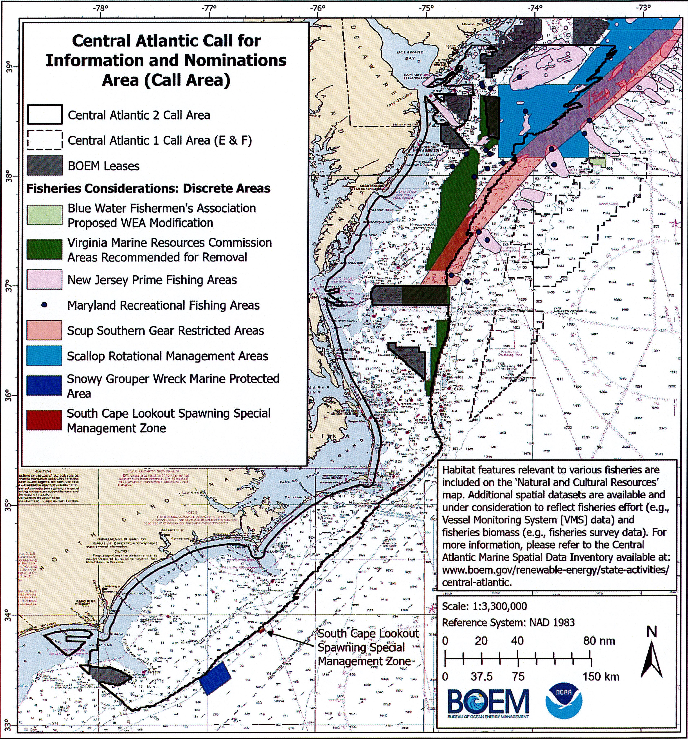
The New Bedford Port Authority (NBPA) has submitted a formal response to the Bureau of Ocean Energy Management (BOEM) regarding the recently proposed Central Atlantic 2 Call Area (Docket No. BOEM-2024-0040), raising significant concerns about its potential impact on the commercial fishing industry. As the nation’s most profitable fishing port and home to the first large-scale offshore wind marshaling port, New Bedford is deeply invested in both renewable energy development and the preservation of vital fishing grounds.

“BOEM has painted with too broad a brush. As the port where the fishing and offshore wind industry intersect more than anywhere else, New Bedford is committed to the successful coexistence of both industries. We believe that the new Mid-Atlantic call areas must be cut back from existing scallop and other fishery access areas, which still would leave ample room for nearby states to achieve their offshore wind capacity goals,” said New Bedford Mayor Jon Mitchell.

While the NBPA supports offshore wind development, it emphasized the importance of balancing this growth with the protection of established industries. In particular, the letter calls attention to the critical scallop fishing areas-Elephant Trunk, Hudson Canyon, and Delmarva-that fall within the boundaries of the proposed Central Atlantic 2 Call Area. The National Marine Fisheries Service (NMFS) estimated the 16-year catch value for the most impacted commercial fisheries in the area of the proposed call is just under $2 billion, with just under $1.5 billion of that amount coming from sea scallops.

“Our grave concern about this CA2 call area is that it unnecessarily includes some of the most critically important scallop fishing areas on the East Coast,” wrote Gordon Carr, NBPA Executive Director. “What is stunning to us is that all that data is and was available to BOEM prior to setting the boundaries of the proposed call area.”

Mr. Carr noted that the call area “could have been set approximately 150 miles to the south, avoiding these critical scallop grounds, while still leaving more than 400 miles and millions of acres of call area down to the South Carolina state line.”

The Port of New Bedford has long been involved in offshore wind planning, providing comments on multiple projects in the region. The NBPA emphasized that “development must only be accomplished in a responsible manner by protecting established industries that share our waters. In particular, ‘responsible manner’ must include learning from mistakes made in failing to avoid and address the interaction and conflicts between offshore wind and commercial fishing in connection with previous BOEM actions.”

“It is long past time for BOEM to take seriously its responsibility towards the other users of the Outer Continental Shelf (“OCS”), some of which, like commercial fishing, have been using the same areas for hundreds of years. BOEM must begin to demonstrate a concerted effort to avoid and minimize the potential impact of a call area, collective lease areas, WEA, and each turbine,” Mr. Carr wrote. “This effort must take place before the potential impact is felt and must be based on more substantive scientific data and information than a hunch. People’s livelihoods are based on these actions.”

The New Bedford Port Authority calls on BOEM to take the concerns of the commercial fishing industry seriously and work toward a more responsible and consistent approach to offshore wind development, one that properly balances the needs of renewable energy with the long-standing commercial fishing industry. BOEM now has the opportunity to scale back the proposed Central Atlantic 2 Call Area to avoid and minimize the effects this area will have on most notably sea scallop, surfclam, and ocean quahog sustainability.

About the New Bedford Port Authority
The New Bedford Port Authority is a state-created agency charged with managing the Port of New Bedford. The Port is the physical center and primary economic engine of Southeastern Massachusetts. It is America’s top commercial fishing port, the staging site for America’s first industrial-scale offshore wind project, and home to hundreds of recreational and commercial vessels and businesses.

For media inquiries, please contact:
John Regan
Director of Policy & External Affairs
John.regan@newbedford-ma.gov
(508) 961-3000

MASSACHUSETTS: Greater New Bedford Sees $2.3 Million in State Seaport Grants

December 15, 2022 — The Greater New Bedford area — including the towns of Dartmouth and Fairhaven — is set to receive more than $2.3 million in state Seaport Economic Council grants for projects relating to coastal access and the maritime industry.

According to an announcement from the outgoing Baker-Polito administration on Tuesday, New Bedford itself will see more than $1.2 million in funding for maritime projects.

These include $880,000 for the New Bedford Port Authority for design, engineering, and permitting to eventually replace Homer’s Wharf, as well as a $320,000 grant for the port authority to split with the town of Fairhaven to update the municipal harbor plan.

It also includes $50,000 in funding for a feasibility study on expanding the Community Boating Center of New Bedford.

Fairhaven is also set to receive a $1 million grant for the final phase of the 10-year effort to reconstruct Union Wharf to modern standards.

Read the full story at WBSM

Mayor Mitchell warns of ‘potentially consequential’ impacts if leasing is approved

May 25, 2022 — Mayor Jon Mitchell is “deeply concerned” about the “potentially consequential” impacts leasing could have in the scallop fishery, according to a letter he submitted to a fishery council ahead of its second and final public meeting in New Bedford Wednesday.

“There is no denying that there will be costs and impacts associated with the leasing program,” Mitchell wrote. “The playing field will be tilted on day one, perhaps irrevocably so, and the transformation of the scallop fishery from a ‘community fishery’ to a ‘corporate fishery’ may become all but inevitable.”

He went on to write, “as the most valuable fishing port in the nation, New Bedford has, without a doubt, more at stake in this matter than any community in the nation.”

At the close of his nearly four-page letter, he echoed local state representatives in requesting the council decline to proceed with drafting an amendment for leasing.

“I am hopeful that the Council will decline to proceed with the proposal before it, based on the vigorous opposition presented by New Bedford stakeholders.”

Included in his letter is an 11-page review, commissioned by the New Bedford Port Authority, on the potential impacts leasing could have.

Read the full story at the New Bedford Light

Expansion Project to Start Soon on North Terminal at Massachusetts’ Port of New Bedford

April 8, 2022 — On March 22, the New Bedford Port Authority (NBPA) awarded a $27.9 million contract to D.W. White Construction of Acushnet, Mass., for the North Terminal Expansion building project in the port located along the south coast of Massachusetts.

In a news release from the city, New Bedford officials view the expansion as “a transformative port infrastructure project” that will spur long-term economic development by meeting the infrastructure needs of commercial fishermen, the offshore wind industry, and other port users, to ensure economic growth and increased efficiency.

New Bedford’s efforts are a culmination of federal, state and private investment that will build a north/south bulkhead at the North Terminal in the city’s upper harbor. The project also should spur significant investment in the Port of New Bedford in the years to come.

Led by the NBPA, the expansion is designed to create a safer and more efficient connection between the New Bedford Harbor and ground transportation systems in town.

Read the full story at Seafood News

‘A big day for the Port of New Bedford’: Development projects could bring hundreds of jobs

March 25, 2022 — Two entities in the Port of New Bedford this week announced they will soon start on major infrastructure projects.

The New Bedford Port Authority announced Tuesday the awarding of a $27,943,800 contract to expand the port’s North Terminal to Acushnet-based D.W. White Construction.

“This project represents a major step in our effort to modernize the Port of New Bedford,” Mayor Jon Mitchell said in a press release. “It will enhance the long-term competitiveness of our maritime industries and help create quality jobs for our residents.”

The new bulkhead will be built near the Environmental Protection Agency’s Deepwatering Facility and create approximately 150,000 square feet of terminal space in the upper harbor.

The project will also build a fourth Contaminated Aquatic Disposal cell in the harbor with a 480,000 cubic yard capacity for dredged contaminated material.

The project is also expected to create more berthing space for vessels, increasing the number of permitted slots now counted at the port as somewhere around 400.

Authorities said that the project is expected to create almost 900 new jobs, approximately $65 million in new wages and consumption, and $11.5 million in state and local tax revenues.

Read the full story at the New Bedford Standard-Times

New England council considers leasing proposal for scallop fishery

February 18, 2022 — Dozens of permit-holders and vessel owners, some of whom manage large-scale commercial fishing operations, have backed amending regulations in New England’s scallop fishery to allow leasing — a proposal that concerns the New Bedford Port Authority, smaller fishing fleets and some shoreside businesses.

Current regulations in the limited access scallop fishery allow one permit per vessel, which entitles a vessel to a certain number of days at sea, as well as a given number of access area fishing trips. A leasing program could enable a permit-holder (and his or her vessel) to lease and fish additional days or trips from another permit.

Supporters of leasing say it will improve efficiency and cut operational costs in the scallop fishery, which brings hundreds of millions of dollars in landings to New Bedford annually. For example, permit-holders could retire old vessels and save on repair costs without losing allocations, or lease in the event a vessel breaks down.

But the New Bedford Port Authority, along with some of the city’s shoreside business and scallop fishermen, according to their attorney, cite concerns that leasing could lead to further consolidation of the fishery to the detriment of smaller fleets and businesses.

Though the Scallopers Campaign, which has recently led the effort behind leasing, has promulgated certain program ideas, the New England Fishery Management Council (NEFMC), would start with a blank slate and develop its own leasing program if it votes to proceed in September.

Read the full story at the New Bedford Light

  • 1
  • 2
  • 3
  • 4
  • Next Page »

Recent Headlines

  • New analysis: No, scientists didn’t “recommend” a 54% menhaden cut
  • The Wild Fish Conservancy’s never-ending lawsuits
  • Delaware judge pauses US Wind appeal in wake of new law
  • Wild Fish Conservancy and The Conservation Angler sue over Columbia River hatcheries
  • NOAA Fisheries Re-Opens Comment Period on Restoring American Seafood Competitiveness
  • USD 12 million awarded for restoring fish habitats, growing oysters in Long Island Sound
  • North Atlantic Right Whale Calving Season 2026
  • BOEM to consider revoking New England Wind 1 approval

Most Popular Topics

Alaska Aquaculture ASMFC Atlantic States Marine Fisheries Commission BOEM California China Climate change Coronavirus COVID-19 Donald Trump groundfish Gulf of Maine Gulf of Mexico Illegal fishing IUU fishing Lobster Maine Massachusetts Mid-Atlantic National Marine Fisheries Service National Oceanic and Atmospheric Administration NEFMC New Bedford New England New England Fishery Management Council New Jersey New York NMFS NOAA NOAA Fisheries North Atlantic right whales North Carolina North Pacific offshore energy Offshore wind Pacific right whales Salmon South Atlantic Virginia Western Pacific Whales wind energy Wind Farms

Daily Updates & Alerts

Enter your email address to receive daily updates and alerts:
  • This field is for validation purposes and should be left unchanged.
Tweets by @savingseafood

Copyright © 2025 Saving Seafood · WordPress Web Design by Jessee Productions