Saving Seafood

  • Home
  • News
    • Alerts
    • Conservation & Environment
    • Council Actions
    • Economic Impact
    • Enforcement
    • International & Trade
    • Law
    • Management & Regulation
    • Regulations
    • Nutrition
    • Opinion
    • Other News
    • Safety
    • Science
    • State and Local
  • News by Region
    • New England
    • Mid-Atlantic
    • South Atlantic
    • Gulf of Mexico
    • Pacific
    • North Pacific
    • Western Pacific
  • About
    • Contact Us
    • Fishing Terms Glossary

NFI Touts Seafood Brain Benefits in New Cognition Kitchen Guide

June 2, 2021 — The following was released by the National Fisheries Institute:

The National Fisheries Institute (NFI) has joined forces with the Wild Blueberry Association of North America and other healthy food commodities to offer a resource about eating a brain-boosting diet at all ages. The organizations created the Cognition Kitchen guide: a free digital brochure that provides simple, science-based information about brain-healthy foods along with 16 delicious recipes.

“The link between the foods we eat and brain health is not always top of mind for people. The Cognition Kitchen guide highlights a variety of foods that boost brain health throughout life,” said Jennifer McGuire, MS RD, NFI dietitian. “Fish and shellfish are among the only foods naturally rich in a healthy type of omega-3 fat called DHA, which actually builds the brain and helps support brain health as we age.”

DHA makes up 97% of the omega-3s in a newborn’s brain and the DHA content of an infant’s brain triples during the first three months of life. Research shows that children of moms who eat seafood 2-3 times each week during pregnancy reach milestones–like climbing stairs, copying sounds and drinking from a cup–more quickly.

“The Dietary Guidelines for Americans encourage people, especially moms-to-be, to eat a variety of seafood—including popular options like salmon, canned tuna, shrimp, tilapia and crab—at least 2-3 times each week.” said Rima Kleiner, MS RD, NFI dietitian and Dish on Fish spokesperson. “The Cognition Kitchen guide brings this recommendation to life with well-rounded recipes and meal suggestions.”

The resource is free and available for download at www.cognition-kitchen.com.

Additional NFI Resources on the health-benefits of seafood:

  • Click here for your copy of the Pregnant Woman’s Guide to Eating Seafood.
  • Learn more about how to include seafood 2-3 times each week in your family’s meal plan by visiting Dish on Fish.

NFI releases new list detailing the top 10 seafood species Americans consume most

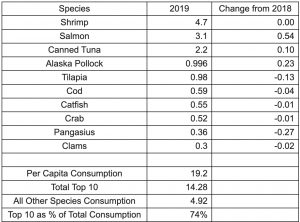
May 26, 2021 — American consumers ate 19.2 pounds of seafood per capita in 2019, an increase of 0.2 pounds over 2018’s figures, according to National Fisheries Institute (NFI) calculations based off of the National Oceanic and Atmospheric Administration’s (NOAA) latest “Fisheries of the United States” report.

For its report released this year, which recounts 2019 figures, NOAA revised its per capita consumption model, “updating weight conversion factors to more accurately reflect efficiencies in processing,” NFI said.

Read the full story at Seafood Source

NFI’s Top 10 List Suggests Consumers Diversifying Seafood Consumption

May 26, 2021 — The following was released by the National Fisheries Institute:

In 2019, Americans ate 19.2 pounds of seafood per capita, an increase of .2 pounds from 2018’s revised figure. In previous years, the Top 10 list has made up an outsized portion of US seafood consumption, nearly 90%. This time the familiar names on the Top 10 make up only 74%.

The 2019 Fisheries of the United States report, released by the National Oceanic Atmospheric Administration (NOAA), revised its Per Capita Consumption model to update edible weight conversion factors to more accurately reflect efficiencies in processing. The revised model resulted in higher consumption levels than previously reported.

Shrimp maintained the top spot, while Salmon, Canned Tuna and Alaska Pollock all saw gains.

It is important to highlight that the featured numbers on this list are all exclusively from 2019 and do not represent any pandemic-impacted market forces.

National Fisheries Institute Statement on NOAA’s Report on Implementation of the Seafood Import Monitoring Program

May 21, 2021 — The following was released by the National Fisheries Institute:

The National Fisheries Institute opposes any illegal, unreported and unregulated (IUU) fishing.  We appreciate NOAA’s focus on ridding the globe of pirate fishing.  We are pleased that today’s report on the Seafood Import Monitoring Program (SIMP) highlights the fact that, “the majority of SIMP audits do not identify noncompliance,” and that of non-conformances “only a small number rise to the level that they warrant enforcement action.” NFI looks forward to working with NOAA to improve any information discrepancies found in entry filings.

We note that NOAA’s report clearly states, “SIMP does not prevent or stop IUU fish and fish products from entering U.S. commerce.”

In fact, NOAA highlights that, “most of the issues that have been found relate to issues apparent from the documents themselves (e.g., vessel permit dates do not match harvest dates, documents are missing).”

In the report NOAA Fisheries emphasizes it remains “focused on maintaining the risk-based nature of SIMP.”  Calls for expanding SIMP to all species undercut this focus on risk.

The seafood community estimates it has spent over $50 million on SIMP regulatory and paperwork compliance for just the 13 species covered by the program, a burden on an industry working to feed Americans during a time of recovery.  SIMP expansion would impose hundreds of millions of dollars of annual expense for a program that “does not prevent or stop IUU fish and fish products from entering U.S. commerce.”

NFI Statement on USDA’s Decision to Purchase Nutritious Consumer-Ready Seafood

May 13, 2021 — The following was released by the National Fisheries Institute:

The United States Department of Agriculture (USDA) announced today that it will purchase up to $159.4 million of seafood and other items as part of its Section 32 food assistance program. This purchase marks “the largest single seafood purchase in the Department’s history,” according to the agency.

It’s good to see USDA recognize the importance of our essential workers as well as provide Americans with healthy seafood. NFI looks forward to working with the Agricultural Marketing Service (AMS) on this as they begin the procurement process.

The seafood community and the 1.7 million Americans jobs along its value chain, has been hit hard by the pandemic from the men and women who work the water to processors, distributors and retailers and restaurants that offer seafood. Most of the links in that vital chain are small businesses that have struggled to survive. Help, like this, will greatly benefit recovery and help get Americans back to work.

World Food Prize Winner Unlocks Benefits of Fish

May 13, 2021 — The following was released by the National Fisheries Institute:

Dr. Shakuntala Haraksingh Thilsted has been named the 2021 World Food Prize Laureate. Often referred to as the Nobel Prize for food research, Dr. Thilsted is the first woman of Asian heritage to receive the award. Her work focuses on unlocking the benefits of fish for diets, health and livelihoods.

“Dr. Thilsted’s work has helped scientists understand just how beneficial fish can be. She’s shown that fish not only provides essential micronutrients and fatty acids, but also improves the absorption of nutrients from traditional agrarian staples,” said Jennifer McGuire, Registered Dietitian from the National Fisheries Institute.

The World Food Prize Foundation says her work is, “reshaping scientific understanding of the benefits of fish in diets” and helping “prioritize increases in fish consumption and production, transforming the diets and incomes of some of the world’s most vulnerable people.”

Her award-winning work includes a focus on expanding small-scale aquaculture systems where small and large fish species are farmed together.

“Dr. Thilsted’s research is unique because it’s holistic,” said National Fisheries Institute Chair Derek Figueroa, President of Seattle Fish Company. “Not only is she looking at the vital dietary side, she’s looking at the jobs, income and the sustainability of whole communities. The transformational power of seafood is truly on display.”

The Foundation calls her work a “trailblazing approach” that “extends throughout the entire chain of producing, processing, transporting, selling and consuming aquatic food.”

“We’re not just talking about generally nourishing people,” said McGuire. “We’re talking about work that helps get the right nutrients to the right people, from nursing mothers to ageing populations. It’s truly remarkable.”

“NFI congratulates Dr. Thilsted on this award and thanks her for her tireless work,” said Figueroa.

World Food Prize granted for research on nutritional importance of seafood

May 13, 2021 — Dr. Shakuntala Haraksingh Thilsted, the global lead for nutrition and public health at WorldFish, has been named the 2021 World Food Prize Laureate for her research into developing nutrition-sensitive approaches to aquatic food systems, including fisheries and aquaculture, and integrated food production from land and water.

Sometimes referred to as “the Nobel Prize for food and agriculture,” Thilsted’s research has been praised by the National Fisheries Institute (NFI) and represents the first time a woman of Asian heritage has been awarded the prize. Her research delved into the nutritional composition of small native fish species that are typically consumed in Bangladesh and Cambodia.

Read the full story at Seafood Source

National Fisheries Institute Statement on Biden Administration’s Climate Taskforce Plan

May 7, 2021 — The following was released by the National Fisheries Institute:

Today’s release of recommendations to the National Climate Taskforce illustrates an understanding that simply walling off parts of the ocean, without a science-based fisheries management goal, is not a sound policy. In fact, the report states that, “many uses of our lands and waters, including of working lands, can be consistent with the long-term health and sustainability of natural systems.”

Further, the report bolsters the fundamental underpinnings of the Magnuson Steven Act, that relies on regional councils to manage fisheries sustainability oversight, when it calls for support of, “locally led conservation and restoration efforts of all kinds and all over America, wherever communities wish to safeguard the lands and waters they know and love.”

Locally led, science based resource management is not a catchy slogan but it is a thorough strategy.

NFI, FMI partner to standardize seafood buying process

April 29, 2021 — FMI – The Food Industry Association and the National Fisheries Institute (NFI) have teamed up to offer forms designed to standardize the seafood buying process.

The two organizations created fillable forms for retailers and wholesalers to use when sending seafood product specifications to suppliers. The fillable forms allow organizations to indicate their product requirements and enable seafood suppliers to consolidate their communication, FMI and NFI said in a press release.

Read the full story at Seafood Source

New Seafood Forms Aim to Improve Buyer Process

April 29, 2021 — The following was released by the National Fisheries Institute:

NFI and FMI – The Food Industry Association launched new resources designed to standardize the seafood buying process and improve efficiency. Retailers and wholesalers can use these fillable forms when sending seafood product specifications to suppliers. The goal is to streamline and standardize the language and specifications for each seafood species to help suppliers comply and fill orders.

Forms currently exist for shrimp, scallop and snow crab, while additional forms are being developed for salmon (farm-raised and wild-caught) and finfish.

You can access the forms below:

  • Shrimp Specification Form
  • Scallop Specification Form
  • Snow Crab Specification Form
  • Snow Crab Glossary

For more information, visit www.AboutSeafood.com.

  • « Previous Page
  • 1
  • …
  • 7
  • 8
  • 9
  • 10
  • 11
  • …
  • 24
  • Next Page »

Recent Headlines

  • Scientists did not recommend a 54 percent cut to the menhaden TAC
  • Broad coalition promotes Senate aquaculture bill
  • Chesapeake Bay region leaders approve revised agreement, commit to cleanup through 2040
  • ALASKA: Contamination safeguards of transboundary mining questioned
  • Federal government decides it won’t list American eel as species at risk
  • US Congress holds hearing on sea lion removals and salmon predation
  • MASSACHUSETTS: Seventeen months on, Vineyard Wind blade break investigation isn’t done
  • Sea lions keep gorging on endangered salmon despite 2018 law

Most Popular Topics

Alaska Aquaculture ASMFC Atlantic States Marine Fisheries Commission BOEM California China Climate change Coronavirus COVID-19 Donald Trump groundfish Gulf of Maine Gulf of Mexico Illegal fishing IUU fishing Lobster Maine Massachusetts Mid-Atlantic National Marine Fisheries Service National Oceanic and Atmospheric Administration NEFMC New Bedford New England New England Fishery Management Council New Jersey New York NMFS NOAA NOAA Fisheries North Atlantic right whales North Carolina North Pacific offshore energy Offshore wind Pacific right whales Salmon South Atlantic Virginia Western Pacific Whales wind energy Wind Farms

Daily Updates & Alerts

Enter your email address to receive daily updates and alerts:
  • This field is for validation purposes and should be left unchanged.
Tweets by @savingseafood

Copyright © 2025 Saving Seafood · WordPress Web Design by Jessee Productions