Saving Seafood

  • Home
  • News
    • Alerts
    • Conservation & Environment
    • Council Actions
    • Economic Impact
    • Enforcement
    • International & Trade
    • Law
    • Management & Regulation
    • Regulations
    • Nutrition
    • Opinion
    • Other News
    • Safety
    • Science
    • State and Local
  • News by Region
    • New England
    • Mid-Atlantic
    • South Atlantic
    • Gulf of Mexico
    • Pacific
    • North Pacific
    • Western Pacific
  • About
    • Contact Us
    • Fishing Terms Glossary

Like a Scallop in the Headlights

October 29, 2015 — Scallops, like deer, freeze in the headlights. A blast of artificial light causes scallops to refuse to swim. It’s an unusual reaction, given that marine creatures generally either flock to the light, like moths, or scurry from the intrusion. Understanding this odd behavior might help governments take better care of scallop fisheries.

Liese Siemann, a research biologist at the Coonamessett Farm Foundation in Massachusetts, discovered the mollusks’ motionlessness by accident while watching videos of Atlantic sea scallops off the east coast of Long Island, New York. Traditionally, scientists survey scallop fishing grounds by dredging—scooping creatures from the seafloor to count them. But Siemann and her team were testing video survey equipment, trawling a camera through the sea. She says video surveys are safer for protected species or in protected areas, and are becoming more common.

Looking at the footage, Siemann noticed that when the camera’s light was off, scallops swam away as the sled approached. But when the camera’s light was switched on, the scallops seemed to stay put. Scallops aren’t the most mobile animals, but they can swim a few meters at a time by opening and closing their shells. They can also spin around, jump, and flip over if they get turned upside down.

Read the full story at Hakai Magazine
 

Feds: Maine beats Massachusetts for fisheries landings value

October 30, 2015 — A 23 percent increase in the value of the country’s 2014 total lobster landings has made Maine the second-most lucrative state for commercial marine fisheries behind Alaska, according to federal officials.

Maine, where 84 percent of all lobster caught nationwide was brought ashore last year, surpassed Massachusetts with help from a 75 cent increase in the national average price lobstermen earned for their catch, according to an annual report released Thursday by the National Marine Fisheries Service. The national average price paid to fishermen for lobster increased from $3.08 in 2013 to $3.83 in 2014, federal officials indicated in the 2014 Fisheries of the United States report.

Read the full story from the Bangor Daily News

New Bedford once again nation’s No. 1 dollar value fishing port

NEW BEDFORD, Mass. — October 29, 2015 — New Bedford remained the No. 1 port in the country for the dollar value of the catch, NOAA Fisheries reported Thursday.

It was far ahead of the second place finisher, Dutch Harbor, Alaska.

In terms of weight, New Bedford improved from 130 million pounds in 2013 to 140 million pounds in 2014, good for ninth place.

The report put the value of New Bedford’s catch at $329 million, thanks largely to scallops. Dutch Harbor reported a catch of 762 million pounds, and came in second for value, at $191 million.

Read the full story from the New Bedford Standard-Times

Scientists: Warming Ocean Factor in Collapse of Cod Fishery

October 29, 2015 — PORTLAND, Maine (AP) — The rapid warming of waters off New England is a key factor in the collapse of the region’s cod fishery, and changes to the species’ management are needed to save one of America’s oldest industries, according to a report published Thursday in Science magazine.

Fishery managers say cod spawning in the Gulf of Maine — a key fishing area between Cape Cod and Canada that touches Massachusetts, Maine and New Hampshire — is only about 3 percent of sustainable levels, and participants in the fishery that dates to the Colonial era face dramatic quota cuts as a result.

The scientists behind the Science report say the warming of the Gulf of Maine, which accelerated from 2004 to 2013, reduced cod’s capacity to rebound from fishing pressure. The report gives credence to the idea — supported by advocacy groups, fishing managers and even some fishermen — that climate change has played a role in cod’s collapse.

The lead author of the study, Andrew Pershing of the Gulf of Maine Research Institute in Portland, said the gulf is warming at a rate 99 percent faster than anywhere else in the world, and as a result, too many of the fish aren’t living past age 4 or 5. Cod can live to be older than 20.

“Every animal has a temperature range that they prefer. The Gulf of Maine, for cod, is really at the warm end of that,” Pershing said. “If you warm it, you push it somewhere that’s really uncomfortable.”

Read the full story from the Associated Press at The New York Times

NEW BEDFORD STANDARD-TIMES: Fishery science will make all the difference

October 29, 2015 — The message coming to New Bedford fishermen from federal regulators isn’t all bad.

On Tuesday, the top administrator of the National Oceanic and Atmospheric Administration, Dr. Kathryn Sullivan, visited New Bedford to meet with local members of the fishing community and spoke in a way that suggests the regulators understand the industry’s perspective.

“We are committed to working with the best science and trying to find the right way forward to sustain the health of the fisheries and the fishing community,” she said following a closed-door meeting, a harbor tour and a discussion at the School for Marine Science and Technology in the South End.

There are short-term crises for the Northeast Multispecies Fishery as well as long-term crises. A brief postponement of industry-funded observers takes some pressure off the fishermen and allows more work to find a compromise that satisfies the requirement of the law without driving boats out of business. In the meantime, while the right folks work out that short-term crisis, there is a necessity to keep working on the long-term issues.

The industry can hardly focus beyond the looming requirement that they pay for the implementation of at-sea monitors on groundfish boats and the immediate economic effect it will have on marginally profitable permit holders.

For too long, the message from the courts, some environmental groups and older NOAA enforcement actions had been concerned with only the resource, not the impacts of trying to sustainably harvest that resource. Administrator Sullivan’s statement of NOAA’s commitment to keeping both strong — and underpinning that work with science — opens great opportunities for collaboration and success.

Read the full editorial at the New Bedford Standard-Times

MASSACHUSETTS: NOAA head visits New Bedford, tours harbor

October 28, 2015 — NEW BEDFORD, Mass. — The commercial fishing community had an opportunity to meet and discuss regulations on Tuesday with Dr. Kathryn Sullivan, the administrator of the National Oceanic and Atmospheric Administration, the first in person meeting between the NOAA administrator and local fishing community since 1993.

The closed-door meeting included a boat tour of the New Bedford Harbor and a discussion at the School for Marine Science and Technology at the University of Massachusetts at Dartmouth with fishermen, city leaders, and other officials.

Sullivan’s visit comes as the ground fishing industry prepares to take another hit with the cost of at-sea monitors shifting to the fishing boats. Estimates are it will cost fishing boats $710 or more each day to employ a person to count the fish that a boat takes in.

The meeting was meant to spark a conversation between the regulators and the commercial fishing community in New Bedford, which is considered the United States’ top fishing port with annual landings valued at $379 million.

Read the full story at the New Bedford Standard-Times

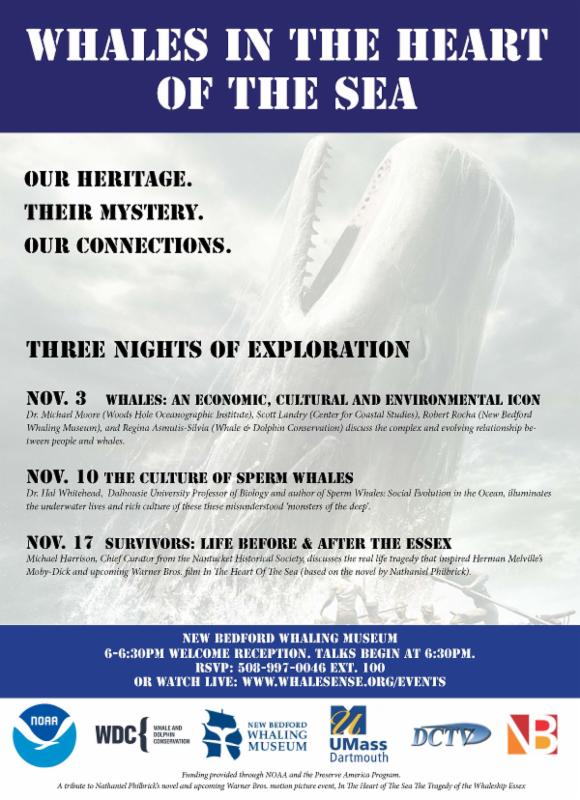
MASSACHUSETTS: Lecture Series: Whales in the Heart of the Sea

October 27, 2015 — The following was released by NOAA Fisheries:

The following free lectures exploring our evolving relationship with whales will take place at the New Bedford Whaling Museum. 

6:00 p.m. Reception  |  6:30 p.m. Lecture

Tuesday, Nov 3

Whales: An Economic, Cultural, and Environmental Icon

Dr. Michael Moore (Woods Hole Oceanographic Institute), Scott Landry (Center for Coastal Studies), Robert Rocha (New Bedford Whaling Museum), and Regina Asmutis-Silvia (Whale & Dolphin Conservation) discuss the complex and evolving relationship between people and whales.

Tuesday, Nov. 10 

The Culture of Sperm Whales 

Dr. Hal Whitehead, Dalhousie University Professor of Biology and author of Sperm Whales: Social Evolution in the Ocean, illuminates the underwater lives and rich culture of these these misunderstood “monsters of the deep.”

Tuesday, Nov. 17 

Survivors: Life Before & After the Essex 

Michael Harrison, Chief Curator from the Nantucket Historical Society, discusses the real life tragedy that inspired Herman Melville’s Moby-Dick and upcoming Warner Bros. film In The Heart of the Sea (based on the novel by Nathaniel Philbrick).

Save your seat by calling 508-997-0046 x 100 or register online.

These events will also be broadcast live online.  

This lecture series is supported by a grant from the NOAA Preserve America Initiative.

Questions? Contact Jennifer Goebel, Regional Office, at 978-281-9175 or Jennifer.Goebel@noaa.gov.


US scallop prices only expected to rise with no supply relief in sight

October 27, 2015 — As landings continue to come in a little shorter than had been predicted for 2015, US sources see no easing in prices for domestic scallops, which are back up near the all-time high levels seen before this fishing season began.

The agreed outlook is for prices to remain where they are now, with limited landings expected between now and Christmas, when demand traditionally picks up from October.

One executive with a scallop catching firm told Undercurrent News that boats landing in Newport News, Virginia, last week, saw U12s earn $15.75 per pound to the boat, and as much as $16 a few days later.

10/20s sold for $12.03 – $12.05. A second source, also operating out of Newport News, confirmed the largest sizes were going in the $16 range. He put 10/20s in the high $11 area, and in the low to mid $12 too. Both sources added these were typical of recent developments, and that they expected prices to remain similar for the rest of 2015.

Meanwhile David Cournoyer, general manager of Marder Trading in New Bedford, Massachusetts, put prices for fresh, dry U10s at $17.50 to the boat, $18- 18.50 sold on the street.

10/20s were $14 sold on the street, give or take 40 cents, he told Undercurrent.

“October demand was down, as it generally is this time of year. Demand tends to increase in November, December, and early January usually.”

Read the full story at Undercurrent News


NOAA Administrator Kathryn Sullivan to Visit New Bedford, Mass.

October 26, 2015 — NEW BEDFORD, Mass. — The following was released by Center for Sustainable Fisheries: 

Mayor Jon Mitchell will host a visit by NOAA Administrator Kathryn Sullivan tomorrow, Tuesday, October 27, 2015. 

Administrator Sullivan and Mayor Mitchell, accompanied by other officials, will meet with local fishing industry leaders as well as tour New Bedford harbor and the SMAST campus (University of Massachusetts Dartmouth School for Marine Science and Technology).

Following a lunch at SMAST, participants will be available to answers questions from the press at 12:45 P.M. (706 South Rodney French Boulevard, New Bedford)

The National Marine Fisheries Service (NMFS) is the federal agency charged with managing the nation’s fisheries; NMFS is an office of the National Oceanic and Atmospheric Administration within the Department of Commerce.

New Bedford is the America’s top fishing port for fourteen consecutive years with annual landings valued at $379 million.

MAINE: Big changes are occurring in one of the fastest-warming spots on Earth

October 25, 2015 — Sandwiched on a narrow sandbar between Yarmouth’s harbor and the open Gulf of Maine, the fishermen of Yarmouth Bar have long struggled to keep the sea at bay.

Nineteenth-century storms threatened to sweep the whole place away, leaving Yarmouth proper’s harbor more open to the elements, prompting the province to build a granite cribwork across the quarter-mile bar, behind which the hamlet’s fishing fleet docks. Global warming has brought rising seas, a two-story-high rock wall to fight them and the hamlet’s designation as one of the communities in the province most threatened by climate change.

Now, snaking around the snout of Nova Scotia and into the Gulf of Maine is a new, unseen threat to Yarmouth Bar and hundreds of coastal communities in Maine, eastern New England and the Maritimes: currents fueling the rapid warming of the sea.

The Gulf of Maine – which extends from Cape Cod in Massachusetts to Cape Sable at the southern tip of Nova Scotia, and includes the Bay of Fundy, the offshore fishing banks, and the entire coast of Maine – has been warming rapidly as the deep-water currents that feed it have shifted. Since 2004 the gulf has warmed faster than anyplace else on the planet, except for an area northeast of Japan, and during the “Northwest Atlantic Ocean heat wave” of 2012 average water temperatures hit the highest level in the 150 years that humans have been recording them.

Read the full story at Portland Press Herald

  • « Previous Page
  • 1
  • …
  • 354
  • 355
  • 356
  • 357
  • 358
  • …
  • 363
  • Next Page »

Recent Headlines

  • WASHINGTON: Coastal commercial season ended with 22.2 million pounds
  • Endangered salmon returned to California’s far north — then the money dried up
  • NEW YORK: New York Governor Kathy Hochul has asked the U.S. Department of Agriculture (USDA) to confirm that a disaster has hit the state’s oyster industry, enabling oystermen to access emergency loans and financial support. Like their counterparts working in Chesapeake Bay, New York oystermen have been beset by extreme cold weather and icy conditions that have kept them from working for much of the season.
  • US government asks industry what to call rockfish
  • Northern Gulf of Maine scallop payday
  • “Remarkable” sea ice conditions in Bering Sea this winter as Arctic-wide sea ice hits record low
  • Scientists and the Fishing Industry Join Forces for Better Data and Management (Part 1)
  • Trump budget proposal targets NOAA

Most Popular Topics

Alaska Aquaculture ASMFC Atlantic States Marine Fisheries Commission BOEM California China Climate change Coronavirus COVID-19 Donald Trump groundfish Gulf of Maine Gulf of Mexico Illegal fishing IUU fishing Lobster Maine Massachusetts Mid-Atlantic National Marine Fisheries Service National Oceanic and Atmospheric Administration NEFMC New Bedford New England New England Fishery Management Council New Jersey New York NMFS NOAA NOAA Fisheries North Atlantic right whales North Carolina North Pacific offshore energy Offshore wind Pacific right whales Salmon South Atlantic Virginia Western Pacific Whales wind energy Wind Farms

Daily Updates & Alerts

Enter your email address to receive daily updates and alerts:
  • This field is for validation purposes and should be left unchanged.
Tweets by @savingseafood

Copyright © 2026 Saving Seafood · WordPress Web Design by Jessee Productions