Saving Seafood

  • Home
  • News
    • Alerts
    • Conservation & Environment
    • Council Actions
    • Economic Impact
    • Enforcement
    • International & Trade
    • Law
    • Management & Regulation
    • Regulations
    • Nutrition
    • Opinion
    • Other News
    • Safety
    • Science
    • State and Local
  • News by Region
    • New England
    • Mid-Atlantic
    • South Atlantic
    • Gulf of Mexico
    • Pacific
    • North Pacific
    • Western Pacific
  • About
    • Contact Us
    • Fishing Terms Glossary

US East Coast could build nearly 9 GW of offshore wind capacity over next decade

September 10, 2018 — The US East Coast is leading the nation’s charge toward developing an offshore wind industry, and while the country only has 30 MW of offshore wind capacity installed currently, if goals are met and announced projects are built, the East Coast could have nearly 9 GW of offshore wind capacity by the 2030s.

The US has a long way to go in closing the gap with Europe in terms of offshore wind capacity, but with several East Coast states committing to achieve aggressive offshore wind development goals, the country could make considerable progress over the next decade.

Europe had nearly 16 GW of total installed offshore wind capacity at the end of 2017, according to trade group Wind Europe, compared with just one operating facility in the US — Deepwater Wind’s 30-MW Block Island Wind Farm in Rhode Island.

New York, New Jersey and Massachusetts are leading the way when it comes to setting offshore wind development goals. New York has a target to receive 2.4 GW of offshore wind power by 2030 and plans to issue requests for proposals for 800 MW in fourth-quarter 2018.

Not to be outdone, New Jersey has a goal of 3.5 GW of offshore wind generation by 2030. The state’s Board of Public Utilities Wednesday accepted an application from EDF Renewables and Fishermen’s Energy for the small-scale 25-MW Nautilus Offshore Wind project that would be located off the Atlantic City coast and could be generating power by 2021. Building a smaller project first has been touted by the companies as a way to kick start New Jersey’s offshore wind industry.

Read the full story at S&P Global

Warming water drawing whales closer to shore

September 10, 2018 — Rising water temperatures have drawn whales closer to shore this year, experts say.

Several humpback whales, and some minke whales, have been seen close to shore, a paddelboarder caught on video just a few feet away from a humpback whale near Salisbury Beach, Mass., a week ago. A humpback was also caught in fishing gear in Rye a couple days before, and footage of close encounters with whales in New England have been posted all over social media and covered in news reports in recent months.

Tony LaCasse, spokesman for the New England Aquarium in Boston, said the higher water temperatures, believed to be brought on by climate change, have led to bait fish called menhaden, locally known as “pogies,” appearing closer to shore.

Pogies, he said, eat plankton that have been growing closer to shore because of the higher water temperatures, and several animals including the whales eat the pogies, following them near land. Drone footage of a whale feeding off the coast of Seabrook over Labor Day weekend went viral this week and made news headlines.

LaCasse said whales have been seen close to shore throughout the region this year with sightings in the mouth of the inner harbor in Boston. New England news stations showed footage recently of a whale in Beverly Harbor in Massachusetts lunge feeding, plowing through a school of fish to gulp a couple hundred pogies in its mouth while sending another hundred or so flying through the air, he said.

“They’re going to be close to shore so long as the menhaden are here,” LaCasse said.

He said the menhaden will migrate from the area when the temperature starts to drop.

Read the full story at Fosters.com

Scientists get break finding elusive beaked whales

September 10, 2018 — Scientists have found a reliable gathering place east of Cape Cod for the elusive and little-known True’s beaked whales, following a month’s effort this summer.

“It was huge for us,” Danielle Cholewiak, research ecologist at the National Oceanic and Atmospheric Administration Northeast Fisheries Science Center in Woods Hole, said. Cholewiak was chief scientist for the trip east of Georges Bank, on the edge of the continental shelf.

Only a dozen sightings of True’s beaked whale had occurred since 1913 when Smithsonian Institution curator Frederick True first identified and named the species from an animal stranded on a North Carolina beach. But the dedicated study in July 200 miles east of Cape Cod yielded dozens of sightings, acoustic recordings, genetic samples and photographs, Cholewiak said.

The repeated sightings of whales during the trip allowed scientists to begin a tracking database. The whales now named Elvis and Trident are the “founding members” of the North Atlantic True’s beaked whale photo identification catalog. With over 300 acoustic detections from a hydrophone towed 24 hours a day across the research area the scientists were able to map out where the animals were living, Cholewiak said. The first-time use on a True’s beaked whale of a suction-cup digital recording tag, for 12 hours, is expected to reveal new information about their movements and acoustic behavior.

“This is a 5- or 6-meter whale that we didn’t know anything about until now,” said Dee Allen, research program officer for the Marine Mammal Commission, who was on the trip. In its oversight role of other federal agencies, the commission wants to make sure that the best available science is used for decision-making. There is great value in new or more information on a species that is little-known, Allen said.

“It shows that it can be done,” Allen said. “We can continue to learn more about beaked whales.”

Read the full story at the Cape Cod Times

Massachusetts: Vineyard Wind Submits Supplemental Draft Environmental Impact Report

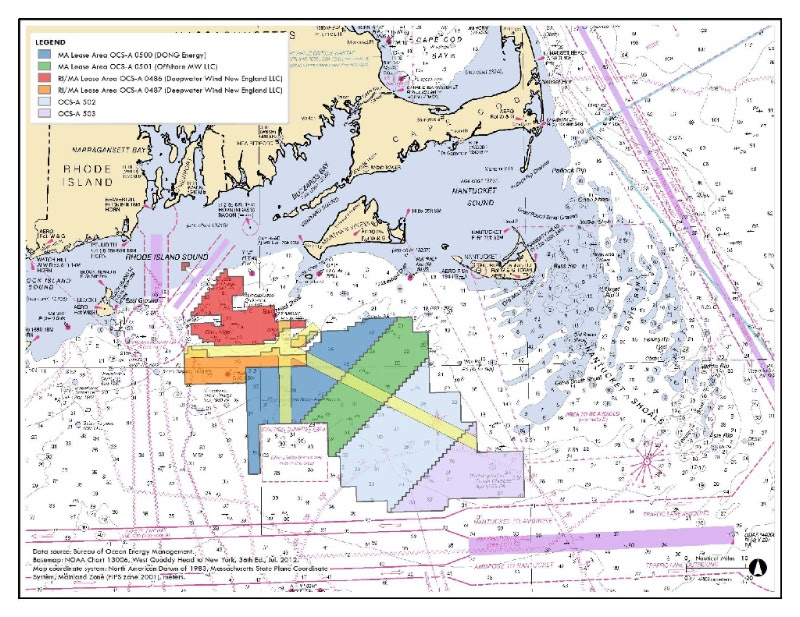
September 5, 2018 — Vineyard Wind announced today that it has submitted the project’s Supplemental Draft Environmental Impact Report (SDEIR) to the Massachusetts Environmental Policy Act Office (MEPA.) The latest report will further ensure that members of public have ample opportunity to provide input about the United States’ first large-scale offshore wind farm.

The SDEIR filing captures additional project refinements following the award and negotiation of long-term contracts with Massachusetts’ electric distribution companies (EDCs) for construction of an 800-megawatt (MW) wind farm 15 miles south of Martha’s Vineyard.

Vineyard Wind remains on schedule to begin site construction in 2019 and become operational by 2021. When Vineyard Wind’s project is completed, it will reduce Massachusetts’ carbon emissions by over 1.6 million tons per year, the equivalent of removing 325,000 cars from state roads.

Read the full story at Cape Cod Today


MASSACHUSETTS: September Dock-U-Mentary Film Series Presents Rodman Sykes: A life in the Fisheries

September 5, 2018 — The following was released by the New Bedford Fishing Heritage Center:

The Dock-U-Mentaries Film Series continues on Friday, September 21st at 7:00 PM with Rodman Sykes: A Life in the Fisheries. This film is part of a series by Markham Starr documenting the commercial fishing port of Point Judith, Rhode Island.

Rodman Sykes is a lifelong commercial fisherman out of Point Judith, Rhode Island. He began fishing with his grandfather as a child and has pursued this career his whole life. He discusses his life in the fisheries, how it has changed over time, and what increasing regulatory pressure is doing to the industry against the backdrop of a day aboard the F/V Virginia Marise, catching both groundfish for food and skate to be used as bait by local lobstermen.

Dock-U-Mentaries is a co-production of New Bedford Whaling National Historical Park and the New Bedford Fishing Heritage Center.  Films about the working waterfront are screened on the third Friday of each month beginning at 7:00 PM in the theater of the Corson Maritime Learning Center, located at 33 William Street in downtown New Bedford. All programs are open to the public and presented free of charge.

The New Bedford Fishing Heritage Center, located at 38 Bethel Street, is a non-profit organization dedicated to preserving and presenting the history and culture of New Bedford’s fishing industry through exhibits, programs, and archives.

New Bedford Whaling National Historical Park was established by Congress in 1996 to help preserve and interpret America’s nineteenth century whaling industry.  The park, which encompasses a 13-block National Historic Landmark District, is the only National Park Service area addressing the history of the whaling industry and its influence on the economic, social, and environmental history of the United States.  The National Park visitor center is located at 33 William Street in downtown New Bedford. It is open seven days a week, from 9 AM-5 PM, and offers information, exhibits, and a free orientation movie every hour on the hour from 10 AM-4 PM.  The visitor center is wheelchair-accessible, and is free of charge.  For more information, call the visitor center at 508-996-4095, go to www.nps.gov/nebe or visit the park’s Facebook page at http://www.facebook.com/NBWNHP. Everyone finds their park in a different way. Discover yours at FindYourPark.com

MASSACHUSETTS: Seafood auction plans to reopen Tuesday

September 5, 2018 — The Cape Ann Seafood Exchange expects to resume landing fish Tuesday, almost two weeks after the U.S. Labor Department effectively shuttered the business by seizing its bank accounts because of unpaid court-ordered damages.

Kristian Kristensen, the owner of the fish auction on 27 Harbor Loop, said Thursday night that he had received final paper work from Labor Department officials that unfroze his business and personal bank accounts.

“Now we can start putting things back in order, pay some people and hopefully start landing fish again on Tuesday, the day after the holiday,” Kristensen said. “That’s the plan.”

Kristensen credited the assistance of U.S. Rep Seth Moulton’s office, state Senate Minority Leader Bruce Tarr and state Rep. Ann-Margaret Ferrante in helping mediate a new consent order and payment schedule with the Labor Department.

“I’d have to say they’re at least 70 percent responsible for getting this done,” Kristensen said. “Without their help, this probably wouldn’t have happened.”

The seizure of the bank accounts stemmed from a 2016 lawsuit filed by the Labor Department against Kristensen and his two businesses, Cape Ann Seafood Exchange and Zeus Packing Inc., both at 27 Harbor Loop. The lawsuit sought $407,996 — $203,998 in unpaid back wages owed about 130 employees and an equal amount in liquidated damages.

Read the full story at the Gloucester Daily Times

NOAA issues clarion call as dead seal numbers hit 599

September 5, 2018 — Seals, some sick and others already dead, continue to wash up on New England shores as fishery managers and marine researchers scramble to identify what is causing the largest unusual seal mortality in this region since 2011.

On Tuesday, NOAA Fisheries updated its preliminary numbers to show that, in the period between July 1 and Aug. 29, 599 harbor and gray seals — 462 dead and 137 alive — were stranded on the coastlines of Maine, New Hampshire and Massachusetts.

Since the previous preliminary count was completed on Aug. 25, 55 newly counted dead seals were among the 67 seals that washed ashore in New England, according to the figures supplied by the National Oceanic and Atmospheric Administration.

The strandings have occurred from Down East Maine to Massachusetts’ North Shore — including at least one in Rockport last week and four on Gloucester’s Coffin Beach two weeks ago — and prompted NOAA last Friday to issue an unusual mortality event for Northeast gray and harbor seals.

The issuance of the unusual mortality event, which NOAA Fisheries has used in the past in efforts to protect Gulf of Maine cod and northern right whale populations, is the regulatory equivalent of a clarion call.

Read the full story at the Gloucester Daily Times

MASSACHUSETTS: Recalling ‘an industry that fed the world’

September 4, 2018 — The Morning Glory Coffee Shop was in its glory Sunday morning. As an unofficial grandstand for the Gloucester Schooner Festival Parade of Sail, the line of spectators waiting for a coveted table stretched clear out into the parking lot.

Most were native Gloucesterites, but there were some first-time tourists, too, and for them the 34th annual Gloucester Schooner Festival was a total surprise, beginning with the first big boom! of the water cannon sounding across the Outer Harbor.

“We wondered what was happening,” said Martha Goldberg, in Gloucester from Lowell for the day with her friend Connie Parker. When that first boom sounded, they watched, transfixed, as the great sails gathered. “It looks beautiful,” said Goldberg, “just awesome.”

“Beautiful’ and “awesome” are words heard a lot along Stacy Boulevard as the sails “schoon” by to pay their respects to the Fisherman’s Memorial in this harbor where the very word “schoon” is said to have been born in 1713. They’re words Paul Clancy, waiting for a table with his wife Ellen, used to describe what they think of this, their first schooner festival. Though they’ve lived in Gloucester several years and always wanted to come, this was the first time they actually made it to Stacy Boulevard, and, if truth be known, it was just for breakfast. But then came the boom! “And we were like, ‘Whoa! What’s going on?'”

Read the full story at the Gloucester Daily Times

SEAN HORGAN: Of whale poop and lobster claws

September 4, 2018 — Well, Happy Labor Day. We hope you are celebrating by lying in a hammock, dozing in the sun while listening to a ballgame on the radio, taking a swim and any and all activities completely separated from the concept of work. Take the day. You’ve earned it. Even if you haven’t, we won’t spill.

As an homage to the chill, we’re going to abridge the top of the column, providing another piece to your day that doesn’t require much intellectual or emotional heavy lifting. I’m telling you, this Labor Day thing is the cat’s whiskers.

To the items:

Whale of a story

It feels as if any time we write about whales, it’s with a certain hand-wringing about their imperiled status. But there is another side to the coin and that is that the great beasts have been a constant and immensely pleasurable presence near the Cape Ann coastline all summer.

Our waters have been filled with the largest mammals of the sea from mid-spring. There was an early appearance of a dozen or so northern right whales, followed by humpbacks, minke and fin whales. We even heard from one Rockport lobsterman, whose name is being withheld because of his continued ties to the radical Weather Underground, of pilot whales feeding on schools of pogeys in as little as 9 feet of water hereabouts.

Perhaps you saw the story in the pages of the Gloucester Daily Times and online at gloucestertimes.com, where our intrepid correspondent, along with photographer Paul Bilodeau, journeyed out aboard a whale watch boat to check out all the hubbub.

Now comes a different type of whale story: how the scientific community is mustering even more arguments for protecting whales because of the benefits of their, well, poop.

According to the piece in Scientific American, a 2010 study showed whale feces injects about 23,000 metric tons of nitrogen into Gulf of Maine waters each year and conceivably could help with climate change.

Read the full story at the Gloucester Daily Times

Will Congress reel in regulations on America’s fishermen?

September 4, 2018 — The fishing industry says the U.S. government is crushing them with regulations.

Watch the video at Fox News


  • « Previous Page
  • 1
  • …
  • 210
  • 211
  • 212
  • 213
  • 214
  • …
  • 363
  • Next Page »

Recent Headlines

  • Another offshore wind firm is seeking a payout as Trump stifles sector
  • Western Atlantic acts as refuge for recovering bluefin tuna
  • New Jersey ratepayers are on the hook for canceled projects amid Trump’s war on wind
  • How climate change threatens the economic backbone of the Pacific
  • Putting the Fishing Industry First at the Cooperative Research Summit
  • The Longsoaker promises to bait your pots automatically
  • NEW JERSEY: Missing New Jersey oysterman found in Delaware Bay
  • WASHINGTON: Washington state reclassifying golden mussels as a banned invasive species

Most Popular Topics

Alaska Aquaculture ASMFC Atlantic States Marine Fisheries Commission BOEM California China Climate change Coronavirus COVID-19 Donald Trump groundfish Gulf of Maine Gulf of Mexico Illegal fishing IUU fishing Lobster Maine Massachusetts Mid-Atlantic National Marine Fisheries Service National Oceanic and Atmospheric Administration NEFMC New Bedford New England New England Fishery Management Council New Jersey New York NMFS NOAA NOAA Fisheries North Atlantic right whales North Carolina North Pacific offshore energy Offshore wind Pacific right whales Salmon South Atlantic Virginia Western Pacific Whales wind energy Wind Farms

Daily Updates & Alerts

Enter your email address to receive daily updates and alerts:
  • This field is for validation purposes and should be left unchanged.
Tweets by @savingseafood

Copyright © 2026 Saving Seafood · WordPress Web Design by Jessee Productions