Saving Seafood

  • Home
  • News
    • Alerts
    • Conservation & Environment
    • Council Actions
    • Economic Impact
    • Enforcement
    • International & Trade
    • Law
    • Management & Regulation
    • Regulations
    • Nutrition
    • Opinion
    • Other News
    • Safety
    • Science
    • State and Local
  • News by Region
    • New England
    • Mid-Atlantic
    • South Atlantic
    • Gulf of Mexico
    • Pacific
    • North Pacific
    • Western Pacific
  • About
    • Contact Us
    • Fishing Terms Glossary

Wind energy efforts in Gulf of Maine pick up steam

February 10, 2023 — Stakeholders across Maine, Massachusetts and New Hampshire, in partnership with the U.S. Department of the Interior’s Bureau of Ocean Energy Management (BOEM), are inching closer to developing offshore wind energy in the Gulf of Maine.

In a series of public meetings last month, including one in Portsmouth, BOEM detailed its progress on bringing the renewable energy source to a portion of the 36,000-square-mile gulf area.

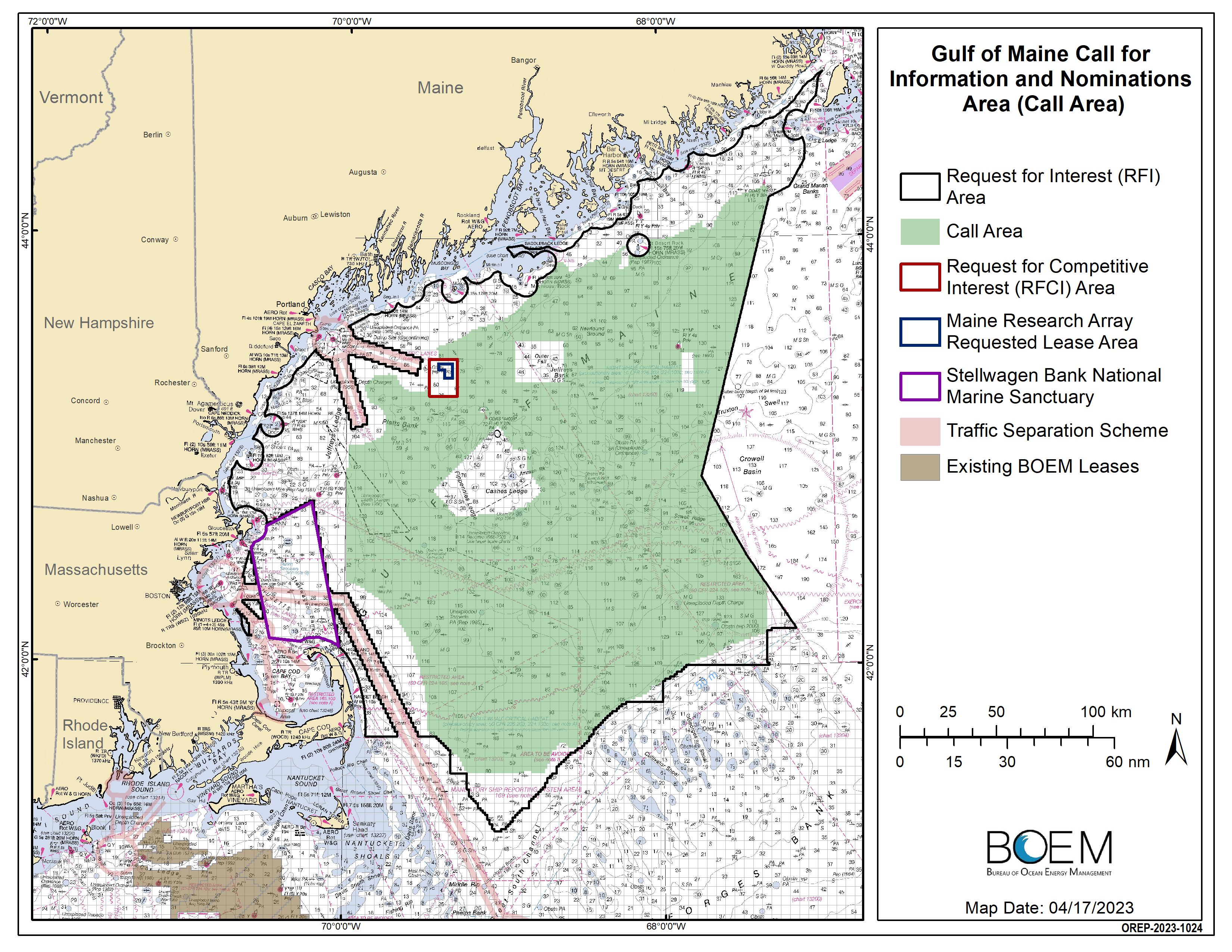
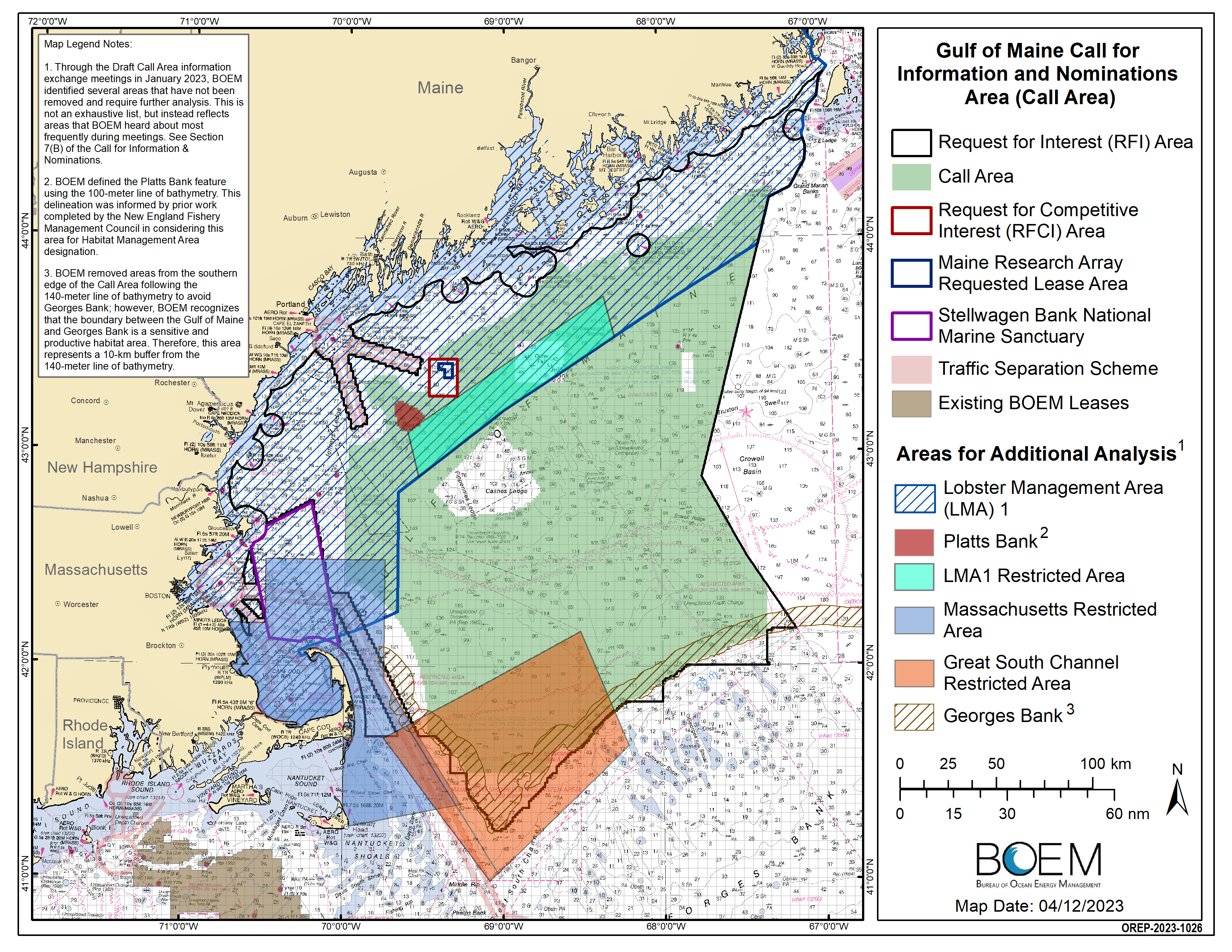
Last August, the Department of the Interior released a request seeking “commercial interest in obtaining wind energy leases in the Gulf of Maine consisting of about 13.7 million acres.” Based on input from the request, BOEM joined with the National Oceanic and Atmospheric Administration’s National Center for Coastal and Ocean Science to produce a spatial analysis. This led to reducing the potential offshore wind gulf acreage to 9.9 million acres.

Read the full article at NH Business Review

CONSTANCE GEE: ‘Strategy’ to protect right whales from offshore wind development is recipe for extinction

January 25, 2023 — The Bureau of Ocean Energy Management (BOEM) and the National Oceanic and Atmospheric Administration (NOAA) published a draft of their strategy to protect the critically endangered North Atlantic right whale (NARW) from the hazards of offshore wind development this past fall.

The report is a heartbreaking portrayal of the plight of the 336 remaining right whales. Approximately 230 animals have died over the past decade. Autopsies and photo documentation conclude that fishing gear entanglement and vessel strikes have caused the deaths. “Stressors” of industrialized ocean noise and dwindling food sources have contributed to reduced health and compromised body condition in 42% of the remaining population.

“Human-caused mortality is so high,” BOEM scientists state, “that no adult NARW has been confirmed to have died from natural causes in several decades; for a species that might live a century, most animals have a low probability of surviving past 40.”

Read the full article at The New Bedford Light

Portland Press Herald: Gulf of Maine swath mulled as potential site for commercial wind turbines

January 20, 2023 — The potential use of wind turbines off the coast of Maine to generate electricity has drawn scientific and commercial interest for at least a decade – and now the federal government is taking a next step to determine where those turbines might go.

The U.S. Department of the Interior last August issued a formal request-of-interest to gauge the potential market for wind-energy leases within about 13.7 million acres of the Gulf of Maine. The department’s Bureau of Ocean Energy Management has scaled this site down to a “draft call area” of 9.9 million acres, and now is looking to obtain public feedback on leasing the waters for commercial wind-power production.

The bureau will hold a meeting in Portland on Thursday to receive input from marine businesses, fishermen and other ocean users about the location and size of the area. The meeting is scheduled for 5-8 p.m. at the Holiday Inn By the Bay, 88 Spring St., and the agenda and more information can be found here.

Read the full article at Spectrum News

BOEM holding public sessions on offshore wind energy in Gulf of Maine

January 13, 2023 — The Bureau of Ocean Energy Management is holding a series of in-person and online public sessions on its planning for potential offshore wind energy development in the Gulf of Maine from Jan. 17 through Jan. 30.

In August 2022 the U.S. Department of Interior announced a “request for interest” from wind energy developers in potentially offering 13.7 million acres in the gulf for energy leasing. In response to public input after that announcement, BOEM has worked with the National Oceanic and Atmospheric Administration’s National Center for Coastal and Ocean Science (NCCOS) to conduct a spatial analysis of the RFI area.

That process has led BOEM to reduce the RFI area by about 27 percent to 9.9 million acres.

“BOEM would like your feedback on the reduced RFI area, as well as input on the model being developed in partnership with NCCOS,” according to a BOEM announcement Jan. 10. “This model will be used in the next phase of the planning process to aid in the identification of offshore areas that are the most suitable for commercial wind energy activities, while minimizing potential conflicts with marine life and all ocean users.

Read the full article at the National Fisherman

Soaring Costs Threaten U.S. Offshore-Wind Buildout

January 3, 2023 — Offshore wind developers are facing financial challenges that threaten to derail several East Coast projects critical to reaching the Biden administration’s near-term clean-energy targets.

Supply-chain snarls, rising interest rates and inflationary pressures are making projects far more expensive to build. Now, some developers are looking to renegotiate financing agreements to keep their projects under way.

The Biden administration has set a target for the U.S. to develop 30 gigawatts of offshore wind power by 2030—enough to supply electricity to roughly 10 million homes. Analysts say that target will be difficult, if not impossible, to achieve if cost and supply issues persist.

“We’re seeing unexpected and unprecedented macroeconomic challenges,” said David Hardy, chief executive of the Americas for Danish power company Ørsted A/S, which is developing about five gigawatts of offshore wind projects off the coast between Rhode Island and Maryland.

Avangrid, a subsidiary of Spanish power company Iberdrola SA, is developing a 1.2-gigawatt project called Commonwealth Wind off the coast of Massachusetts. The company in December asked the Massachusetts Department of Public Utilities to terminate its review of contracts the company negotiated with utilities serving the state. The company said it now intends to scrap the contracts and rebid the project next year to account for higher costs. 

Read the full story at the Wall Street Journal

US Ignored Own Scientists’ Warning in Backing Atlantic Wind Farm

December 30, 2022 — US government scientists warned federal regulators the South Fork offshore wind farm near the Rhode Island coast threatened the Southern New England Cod, a species so ingrained in regional lore that a wooden carving of it hangs in the Massachusetts state house.

The Interior Department approved the project anyway.

The warnings were delivered in unpublished correspondence weeks before Interior’s Bureau of Ocean Energy Management authorized the 12-turbine South Fork plan in November 2021. And they serve to underscore the potential ecological consequences and environmental tradeoff of a coming offshore wind boom along the US East Coast. President Joe Biden wants the US to deploy 30 gigawatts of offshore wind by the end of the decade.

Concerns about South Fork, the 132-megawatt project being developed by Orsted AS and Eversource Energy, focused on its overlap with Cox Ledge, a major spawning ground for cod and “sensitive ecological area that provides valuable habitat for a number of federally managed fish species,” a National Oceanic and Atmospheric Administration assistant regional administrator said in an October 2021 letter to Interior Department officials. Based on in-house expertise and peer-reviewed science, the agency said “this project has a high risk of population-level impacts on Southern New England Atlantic cod.”

The Interior Department took some steps to blunt impacts on Atlantic cod, including by carving out some areas of Cox Ledge from leasing. Developers, who are required to monitor cod activity at the site from November through the end of March, plan to adjust work plans to avoid any spotted spawning areas. And the final South Fork plan was scaled down from 15 turbines to 12 after warnings from NOAA.

Still, the oceanic agency faulted the Interior Department for shrugging off other recommendations to protect cod, saying the bureau had based some decisions on flawed assumptions not supported by science. That includes a decision to not block pile driving at the very start of the spawning season in November, even though NOAA said the noise could deter the activity and force some cod to abandon the area.

Read the full story at Yahoo Finance

Offshore wind in 2022: Billions in bids and new confidence

December 28, 2022 — Offshore wind advanced at a dizzying pace in 2022, from billion-dollar bids in New York to turbine installation vessels arriving in New England waters.

The landmark year buoyed confidence in investment in the U.S. market and saw the expansion of federal tax benefits — along with an increased government workforce — to support wind growth. Insiders continued to express confidence in the industry despite looming economic headwinds that threaten to slow the pace of President Joe Biden’s wind boom in the years ahead.

The White House’s commitment to raising turbines in the ocean, to reach a 30-gigawatt target by 2030, enough to power 10 million homes, fueled much of the growth seen over the last 12 months.

In February, energy companies pledged $4.4 billion for wind leases off the coasts of New York and New Jersey, the largest offshore energy sale in U.S. history.

The Biden administration would go on to hold its first auction in the Pacific Ocean and commit to raising 15 GW of floating offshore wind, a developing technology that’s needed to build wind farms in deep water.

“The momentum continues for the offshore wind sector,” said Erik Milito, president of the National Ocean Industries Association. “The government has done a good job of keeping things moving at a reasonable pace.”

New financial certainty also came from Congress, which expanded incentives to underwrite offshore wind investments and provided benefits for manufacturers of components like turbines and blades, and turbine installation vessels. As the year neared its close, turbine installation vessels arrived in northern waters to begin construction on the first large-scale projects in the country off the coast of Rhode Island and Massachusetts.

It’s a growth story only dampened by the specter of inflationary costs from the Covid-19 pandemic and the Russian war against Ukraine that have begun to bleed into development forecasts. The high price of steel and supply chain problems could pose threats as companies scramble to quickly launch projects.

Inflationary costs are not a unique problem for offshore wind. They are mirrored across the energy industries, noted Michelle Solomon, who tracks electricity trends for Energy Innovation Policy & Technology LLC, a nonpartisan think tank that supports the energy transition.

But there is a “concerning” possibility that inflation and supply chain issues can slow down the offshore wind build-out in the United States at a time when climate targets demand an even faster pace of renewable deployment, she said.

This month an offshore wind developer asked Massachusetts if it could bow out of contracts with utilities, citing higher costs that have put the project underwater without a different deal, while other large developers like Ørsted A/S and the Public Service Enterprise Group Inc. have been frank about their concerns about prices undermining project timelines (Energywire, Nov. 15).

The pressure is also at an all-time high for the Biden administration’s offshore wind bureau, the Bureau of Ocean Energy Management, to meet lofty clean energy targets. Despite a breakneck speed, the bureau needs to approve more than a dozen offshore wind arrays in under two years (Energywire, Dec. 1).

Still, these pressing challenges follow a pivotal year in offshore wind that’s increased confidence that the industry has cemented its position in the U.S. Here are four takeaways of how the sector shifted in 2022 that shed light on where it’s going.

Read the full article at E&E News

US lawmakers pursuing national compensation plan for offshore wind impacts

December 23, 2022 — Two federal lawmakers from the U.S. state of Massachusetts have announced an effort to create a national policy that ensures fishermen are compensated for the impact offshore wind developments will have on their livelihoods.

U.S. Senator Ed Markey and U.S. Representative Seth Moulton, both Democrats, said Thursday, 22 December, they’re working on a discussion draft of legislation that would ensure just compensation for fishermen, with funding distributed based on wind farm projects in their regions. In doing this, they plan to bring together officials from NOAA, the U.S. Bureau of Ocean Energy Management, and stakeholders from involved industries and academia to determine the best process to determine and distribute funding.

Read the full article at SeafoodSource

Markey, Moulton push for national fund to compensate fishermen for losses due to offshore wind

December 22, 2022 — With both offshore wind development and dissent from fishing groups ramping up along the East Coast, Senator Ed Markey and Congressman Seth Moulton announced a plan Wednesday to establish a national fund to compensate potential economic loss suffered by the fishing industry.

Currently there is no federal framework that requires offshore wind developers to compensate fishermen for potential damages. Those include gear loss, habitat degradation, loss of historic fishing grounds and new fishing restrictions in areas leased for wind farms — all of which compound, fishermen say, to spell serious economic challenges to their industry.

In the absence of such compensation requirements, some developers have established their own funds, with their own oversight panels. Other developers have not yet established a compensation plan. Fishing groups have been critical of this approach, saying the government’s lack of clear requirements gives the offshore wind industry the upper hand in compensation negotiations, leaving it up to the fishermen to prove the impact on their livelihoods and up to developers to decide the extent to which they are responsible.

“Any ability left to the wind developers to choose their own procedures will always result in their taking the least expensive path most favorable to them, not commercial fishing,” the New Bedford Port Authority wrote in a letter to the director of the Bureau of Ocean Energy Management (BOEM) in August.

Read the full article at the New Bedford Light

Wind industry group says turbine restrictions for whales could threaten commercial viability of projects

December 21, 2022 — An organization that represents and lobbies for the wind industry has warned that a recommendation from federal scientists to limit turbines in offshore lease areas to protect the endangered North Atlantic right whale could threaten the commercial viability, efficiency and utilities contracts for some projects.

Climate change is affecting the whale and its prey, according to researchers. And offshore wind, which the Biden administration has called on to address the climate crisis, might add to existing stressors from the noise created during construction and operation, to the turbine impacts on currents and prey distribution.

In a letter first published by The Light last month, NOAA scientist Sean Hayes proposed establishing a “conservation buffer” zone or turbine-free area overlapping with wind development planned in Southern New England. But the American Clean Power Association (ACP), which represents the wind industry, said such a buffer would cause the removal of a “significant number” of turbines from several projects.

Read the full article at the New Bedford Light

  • « Previous Page
  • 1
  • …
  • 23
  • 24
  • 25
  • 26
  • 27
  • …
  • 83
  • Next Page »

Recent Headlines

  • LOUISIANA: Science vs. Spin: The Truth About Menhaden Fishing in Louisiana Waters
  • MARYLAND: Maryland Calls for Offshore Wind Proposals Days After Court Victory
  • SSC Calls for Day One Monument Monitoring and Clearer False Killer Whale Analysis Ahead of Council Meeting
  • Oceana appeals court ruling over Gulf of Alaska environment
  • MAINE: Maine shrimp fishery closed for three more years
  • NEFMC projects continued low landings for scallop fishery, adopts new strategic plan
  • MAINE: Northern shrimp fishery closed for at least 3 more years, following unsuccessful pilot
  • Healey-Driscoll Administration Awards Nearly $1.2 Million to Support Fishing Industry

Most Popular Topics

Alaska Aquaculture ASMFC Atlantic States Marine Fisheries Commission BOEM California China Climate change Coronavirus COVID-19 Donald Trump groundfish Gulf of Maine Gulf of Mexico Illegal fishing IUU fishing Lobster Maine Massachusetts Mid-Atlantic National Marine Fisheries Service National Oceanic and Atmospheric Administration NEFMC New Bedford New England New England Fishery Management Council New Jersey New York NMFS NOAA NOAA Fisheries North Atlantic right whales North Carolina North Pacific offshore energy Offshore wind Pacific right whales Salmon South Atlantic Virginia Western Pacific Whales wind energy Wind Farms

Daily Updates & Alerts

Enter your email address to receive daily updates and alerts:
  • This field is for validation purposes and should be left unchanged.
Tweets by @savingseafood

Copyright © 2025 Saving Seafood · WordPress Web Design by Jessee Productions