Saving Seafood

  • Home
  • News
    • Alerts
    • Conservation & Environment
    • Council Actions
    • Economic Impact
    • Enforcement
    • International & Trade
    • Law
    • Management & Regulation
    • Regulations
    • Nutrition
    • Opinion
    • Other News
    • Safety
    • Science
    • State and Local
  • News by Region
    • New England
    • Mid-Atlantic
    • South Atlantic
    • Gulf of Mexico
    • Pacific
    • North Pacific
    • Western Pacific
  • About
    • Contact Us
    • Fishing Terms Glossary

NEW JERSEY/DELAWARE BLACK SEA BASS REOPENS SATURDAY

October 18th, 2016 — This Saturday, October 22, the New Jersey and Delaware black sea bass fishery will officially reopen for the rest of 2016. For wreck fishermen in both states, the bag limit increases to 15 fish bag through December 31, with the minimum size of 12-1/2 inches in Delaware and 13 inches in New Jersey.

By all accounts, this should be a banner opener for the fishery as inshore waters have been loaded with smaller black sea bass on the move eastbound, with local wrecks and reefs practically blanketed by the tasty, hard-fighting fish.

“Sea bass are a menace on the reefs but that should be taken care of starting this Saturday,” noted Alex from the Reel Seat in this week’s report for The Fisherman Magazine’s Central Jersey report, explaining that folks dropping clam for the porgies on the Axel Carlson and Sea Girt spreads as well as the inshore lumps and wrecks.

“Can’t wait for Saturday,” added Capt. Joe Bogan of the Jamaica II who said getting jigs down to monster bluefish has even been tough because of the sea bass numbers of late. “Giant sea bass were slamming the jigs meant for the blues,” Bogan said.

Read the full story at The Fisherman 

New Effort Underway To Study Black Sea Bass In Southern New England

September 21, 2016 — The Commercial Fisheries Research Foundation is kicking off a new project to collect data on black sea bass, a species that has moved north in search of cooler water.

Catch limits for black sea bass in New England are a small compared to the Mid-Atlantic states, where the fish are typically found, according to Anna Malek Mercer, the foundation’s executive director. That means New England fishermen are throwing back very large quantities of black sea bass, she said. And it’s a highly valuable species.

“So this will fetch at the dock between $4 and $7 a pound,” said Malek Mercer. “It’s super important in that way. Really could begin to fill some of this economic void caused by the downturns in things like ground fish and southern New England lobsters. ”

The project will enlist Rhode Island fishermen to collect data on black sea bass.

“So we’ll have eight fishing vessels of a variety of gear types to collect biological data from their catch, as well as bycatch, of black sea bass so that we can begin to assess the characterization of the catch,” including size and sex, said Malek Mercer.

She said black sea bass are an interesting study because they’re born as females then switch to males. Malek Mercer said understanding their biology will help improve managing the species and she hopes that will eventually lead to updated catch limits for New England fishermen.

Read the full story at RI NPR

Above the waves, Connecticut fishermen struggle to hang on

August 30, 2016 — STONINGTON, Conn. — Gambardella Wholesale Fish on the docks here is all but empty on an early afternoon, eerily quiet save for the rhythmic clack, clack of cardboard boxes being stapled together.

“We used to start at seven in the morning,” said Mike Gambardella, whose grandfather started the family’s original fish market more than a century ago. “And when we used to have the whiting boats coming in here, sometimes we wouldn’t get out of here ‘til two o’clock in the morning. Now if I open one day a week, I’ll be happy.”

The problem isn’t the fish. There are plenty of fish – but they’re the wrong fish.

Warming water and other shifting ocean conditions, probably caused by climate change and its cascading impact on the entire marine ecosystem, have pushed the longtime mainstays of Connecticut fishing, like winter flounder and most notably lobster, north to deeper and colder waters.

In their places are species that had been more common further south, also moving north in search of more hospitable conditions. But the way the fish management and quota systems work on the East Coast, fishermen in New England can’t catch many of those fish.

Instead, trawlers from North Carolina are traveling all the way to the ocean waters in Connecticut’s backyard and catching what used to be off their own coast – summer flounder, scup and the very valuable black sea bass – while Connecticut fishermen can only watch; throwback tons of fish – most of which will die; or risk a costly, difficult and long trip to where the fish they are allowed to catch in larger numbers are now.

The situation has resulted in an emotional dispute over how the U.S. fishing system operates, with Connecticut fishermen and politicians calling, if not downright begging, for immediate changes to fish allocations to save the state’s fishing industry from what many believe is its inevitable ruin. But others in the scientific and environmental communities are saying – maybe not so fast.

Read the full story at the Connecticut Mirror

CFRF Black Sea Bass Research Fleet

August 24, 2016 — The following was released by the Commercial Fisheries Research Foundation:

On September 1st., the Commercial Fisheries Research Foundation (CFRF), in partnership with the Rhode Island Department of Environmental Management (RI DEM), will launch a one-year pilot project to develop a cost-effective method to collect critically needed fishery dependent data on black sea bass (Centropristis striata) in the Southern New England and Mid-Atlantic Bight region. The project will be approached collaboratively by a team of commercial and recreational fishermen and fisheries scientists and managers, and will involve eight months of black sea bass catch and discard characterization from Cape Cod to Cape Hatteras. The Black Sea Bass Research Fleet will involve eight fishing vessels from a variety of gear types, including trawl, lobster/crab trap, gillnet, and hook and line, in collecting biological black sea bass data as part of routine fishing practices. Participant fishermen will use a specialized tablet app to efficiently and accurately record biological information about black sea bass catch and bycatch throughout the year. The results from the proposed project will help to fill existing data gaps for the northern Atlantic black sea bass, which is an essential first step in developing a management plan that reflects the current state of the black sea bass resource.

The CFRF will be soliciting applications from fishing vessels based in Rhode Island to participate in the Black Sea Bass Research Fleet in September 2016. More information about the project, including application materials, will be available on the CFRF website here.

The CFRF looks forward to getting the Black Sea Bass Research Fleet up and running!

Mid-Atlantic Council and ASMFC Maintain Multi-Year Specifications for Black Sea Bass, Bluefish, and Scup and Modify Summer Flounder Specifications

August 15, 2016 — The following was released by NOAA:

Virginia Beach, VA – Last week the Mid-Atlantic Fishery Management Council (Council) and the Atlantic States Marine Fisheries Commission (Commission) reviewed previously implemented specifications for scup, black sea bass and bluefish fisheries and modified specifications for summer flounder. The Commission’s actions are final and apply to state waters. The Council will forward its federal waters recommendations regarding summer flounder specifications to NOAA Fisheries Greater Atlantic Regional Fisheries Administrator for final approval.

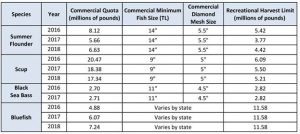
The table below summarizes commercial quotas and recreational harvest limits for summer flounder, scup, black sea bass, and bluefish (2016 values are provided for comparison purposes). Please note specifications for years 2017 and beyond may be adjusted based on changes in the fishery or new scientific information.

image003

For summer flounder, both groups approved a commercial quota of 5.66 million pounds and a recreational harvest limit of 3.77 million pounds for 2017, an approximate 30% decrease from 2016. This decrease in catch and landings limits responds to the findings of the 2016 stock assessment update, which indicates summer flounder has been experiencing overfishing since 2008. In 2015, fishing mortality exceeded its threshold by 26% (i.e., the level beyond which overfishing is occurring). The 2015 estimate of spawning stock biomass (SSB) is at 58% of the biomass target, and only 16% above the threshold. If the stock were to fall below the threshold, it would be considered overfished, requiring the development of a rebuilding plan to reduce fishing mortality and rebuild stock biomass. These results appear to be driven largely by below-average recruitment, an underestimation of the fishing mortality level in the last years of the assessment, and declining biomass indices. The assessment update indicates the stock experienced six below-average year classes from 2010 to 2015. Additionally, indices of abundance from state and federal surveys have indicated declines in abundance ranging from 9 to 97% from their most recent peaks (generally 2009 to 2012). The 2016 assessment update estimated biomass has been trending down since 2010. Summer flounder harvest limits for 2018 may be adjusted in the future based on changes in the fishery or new scientific information.

Scup and Black Sea Bass

For scup and black sea bass, the Commission and Council maintained the previously implemented multi-year specifications set in August and October 2015, respectively. The decline in harvest limits for scup since 2016 is due to a decrease in SSB as projected by the 2015 benchmark stock assessment.

For black sea bass, 2017 harvest limits remain unchanged relative to 2016 levels (in 2016, there was a reduction in the commercial quota due to overages in the previous year). Both the commercial quota and recreational harvest limit may be changed pending the results of next benchmark stock assessment, scheduled for peer review through the Northeast Regional Stock Assessment Workshop/Stock Assessment Review Committee in late 2016. The Commission and Council will consider the results of the benchmark stock assessment in early 2017.

Bluefish

For the bluefish fishery, the final 2016 commercial quota is 4.88 million pounds and the recreational harvest limit is 11.58 million pounds. The final 2016 harvest limits include a 1.58 million pound transfer from the recreational sector to the commercial sector. The Commission and Council did not make any changes to the 2017 and 2018 specifications. The 2017 and 2018 commercial quotas and recreational harvest limits are preliminary and will likely change following release of 2016 and 2017 final Marine Recreational Information Program harvest estimates. These estimates can impact how much is transferred from the recreational sector to the commercial sector.

Scientist Studies Black Sea Bass as New England Catch Climbs

August 15, 2016 — A Maryland scientist is working on a study of black sea bass, a fish that has been turning up in New England fishermen’s nets more often in recent years.

Brad Stevens of University of Maryland Eastern Shore plans to help regulators better understand the importance of habitat for black sea bass. The Atlantic Coastal Fish Habitat Partnership is giving Stevens and a student of his more than $200,000 for the work.

Read the full story from the Associated Press at the Boston Herald

NOAA Fisheries Seeks Comments on Proposed Rule to Modify the Current Seasonal Prohibition on Fishing with Black Sea Bass Pots and Enhance Gear Marking

August 12, 2016 — The following was released by the South Atlantic Fishery Management Council:

NOAA Fisheries is seeking public comment on the proposed rule for Regulatory Amendment 16 to the Fishery Management Plan for the Snapper-Grouper Fishery of the South Atlantic Region (Regulatory Amendment 16). The proposed rule for Regulatory Amendment 16 published in the Federal Register on August 11, 2016 (81 FR 53109). The comment period ends on September 12, 2016.

Currently, fishermen may not fish with black sea bass pots from November 1 through April 30, each year, in the entire management area for black sea bass in the South Atlantic. The seasonal prohibition was established in 2013 as a precautionary measure to prevent interactions between black sea bass pot gear and whales during periods of large whale migrations, and during the right whale calving season off the U.S. southeastern coast. Regulatory Amendment 16 would retain a November 1 through April 30 seasonal prohibition but would reduce the size of the prohibited area. The goal is to reduce the adverse socioeconomic impacts to fishermen resulting from the current seasonal prohibition while continuing to provide the necessary protection to large whales in the South Atlantic region.

Regulatory Amendment 16 would also require an additional 12-inch wide purple band in three locations on black sea bass pot lines. The goal is to enhance current gear marking requirements for black sea bass pots to distinguish black sea bass pot lines from other fishing lines.

More information, including Frequently Asked Questions for Regulatory Amendment 16, can be found online here.

Request for Comments

Comments on the regulatory amendment must be received no later than September 12, 2016, to be considered by NOAA Fisheries. See the Addresses section for information on where and how to submit comments.

Electronic copies of Regulatory Amendment 16 may be obtained from the NOAA Fisheries website here, the Federal e-Rulemaking Portal here, the Council’s Web site here.

Addresses

You may submit comments by the following methods:

Electronic Submission: Submit all electronic public comments via the Federal e-Rulemaking Portal. Go here, click the “Comment Now!” icon, complete the required fields, and enter or attach your comments.

Mail:

NOAA Fisheries

Southeast Regional Office

Sustainable Fisheries Division

c/o Nikhil Mehta

263 13th Avenue South

St. Petersburg, Florida 33701

All personal identifying information (for example, name, address, etc.) voluntarily submitted by the commenter may be publicly accessible. Do not submit confidential business information or otherwise sensitive or protected information. NOAA Fisheries will accept anonymous comments. Attachments to electronic comments will be accepted in Microsoft Word, Excel, WordPerfect, or Adobe PDF file formats only. Comments received through means not specified in this bulletin (such as e-mail), may not be considered.

NOAA Fisheries Southeast is pleased to announce the introduction of our Text Message Alert Program.  The program will allow you to sign up to receive important fishery related alerts via text message.

Text alerts you may receive include:

Immediate fishery openings and closures

Any significant changes to fishing regulations that happen quickly

How to opt-in

Sign up for one or more of the following groups:

South Atlantic Recreational Fisheries Related Alerts

Text SATLRECFISH to 888777

South Atlantic Commercial Fisheries Related Alerts

Text SATLCOMMFISH to 888777

Atlantic Coastal Fish Habitat Partners Initiate Black Sea Bass Habitat Research Project in the Mid-Atlantic

August 4, 2016 — The following was released by the ASMFC:

The Atlantic Coastal Fish Habitat Partnership (ACFHP) has established a new collaborative project with the University of Maryland Eastern Shore (UMES), Mid-Atlantic Fishery Management Council (Council), and National Fish Habitat Fund (Fund) to study black sea bass habitat characteristics, fish abundance, and fish diets in the Mid-Atlantic. The project, led by Dr. Brad Stevens of UMES, is titled ‘Hab in the MAB: Characterizing black sea bass habitat in the Mid-Atlantic Bight.’ The new study will combine SCUBA, photography, videography, controlled angling, and stable isotope analysis techniques to better understand the importance of habitat and prey community structure on black sea bass feeding ecology.

“ACFHP and our collaborative partners are excited about the unique opportunity to work together over the next few years to collect data that will inform both science and management, and support healthy fisheries in the Mid-Atlantic region,” stated Kent Smith, ACFHP Steering Committee Chair.

In the summer of 2015, ACFHP applied for and received funding from the Council to manage a short-term research project focusing on Mid-Atlantic habitat (natural and/or artificial reef) and fisheries productivity. Black sea bass was chosen as a focal species because it is managed by both the Council and the Atlantic States Marine Fisheries Commission (ASMFC), and because the species is structure oriented. ACFHP formed a subcommittee of representatives from the ACFHP Steering Committee, Council, and ASMFC Artificial Reef Committee to develop a request for proposals dedicated to black sea bass habitat research and/or restoration in the Mid-Atlantic region.

After careful review of several strong proposals, the ACFHP subcommittee chose to provide a $216,000 award to Dr. Stevens and his PhD student, Cara Schweitzer. Their study will determine if there are differences resulting in the use of artificial vs. natural habitats.

In particular, study objectives include:

1. Determining the preference of black sea bass for particular habitats by assessing their abundance, size structure, and feeding ecology within natural and artificial reefs;

2. Improving the understanding of benthic habitat structure by quantitatively assessing biodiversity, rugosity (e.g., surface roughness measurements routinely used by reef biologists), and other habitat characteristics of natural and artificial reefs; and

3. Determining if increased connectivity of habitat type increases fish recruitment, by experimentally manipulating connecting areas between isolated habitat patches.

“I’m glad that the Mid-Atlantic Council was able to work with the NFHP Board to support this important research,” said Chris Moore, Executive Director of the Council. “The outcomes of this project will significantly improve our understanding of black sea bass habitat and productivity.”

ACFHP is the first of the 19 Fish Habitat Partnerships (FHPs) throughout the U.S. to support a habitat research project using the NFHP Beyond the Pond Fund. The Fund is a 501(c)3 entity created in 2015 to provide the FHPs an opportunity to connect with the private sector and maximize funding and collaboration opportunities. It supports the leveraging of resources and grassroots actions to achieve maximum impact in protecting and restoring fish habitat from the local to national levels.

August 2016 Mid Atlantic Fishery Management Council Meeting Agenda​

July 20, 2016 — The Mid Atlantic Fishery Managment Council released the agenda for their August 2016 Council meeting today. The meeting will take place from August 8-August 11 in Virginia Beach, Virginia.

See the agenda for the meeting here

NOAA Fisheries Announces New Regulations for Blueline Tilefish, Black Sea Bass, and Yellowtail Snapper in Federal Waters of the South Atlantic

July 12, 2016 — The following was released by the South Atlantic Fishery Management Council:

The final rule for Regulatory Amendment 25 to the Fishery Management Plan for the Snapper-Grouper Fishery of the South Atlantic Region (Regulatory Amendment 25) will publish on July 13, 2016.

The final rule for Regulatory Amendment 25 will implement the following changes:

Blueline Tilefish

Regulations for blueline tilefish will be effective on July 13, 2016.

  • Increase the annual catch limits for blueline tilefish from 26,766 to 87,521 pounds whole weight (commercial sector) and 26,691 to 87,277 pounds whole weight (recreational sector).
  • Reopen commercial harvest for blueline tilefish on July 13, 2016. Commercial harvest will close in 2016 if the commercial annual catch limit is met.
  • Increase the commercial trip limit from 100 to 300 pounds gutted weight.
  • Increase the recreational bag limit from one fish per vessel to three fish per person per day for the months of May through August within the aggregate bag limit. There will continue to be no recreational retention of blueline tilefish during the months of January through April and September through December, each year.
  • The increases in the commercial trip limit and the recreational bag limit are in response to the increase in the annual catch limit.

Black sea bass

Regulations for black sea bass will be effective on August 12, 2016.

  • Increase the recreational bag limit for black sea bass from five to seven fish per person per day.

Yellowtail Snapper

Regulations for yellowtail snapper will be effective on August 12, 2016.

  • Change the yellowtail snapper fishing year start date for both the commercial and recreational sectors from January 1 to August 1, each year. Changing the start of the fishing year to August 1 will benefit both sectors because it will ensure harvest is open during the winter months when yellowtail snapper obtains a higher price per pound commercially, and during peak tourist season in south Florida where the majority of yellowtail snapper harvest takes place.

More Information

For more information, including electronic copies of Amendment 25 and Frequently Asked Questions may be obtained from the NOAA Fisheries Web site.

  • « Previous Page
  • 1
  • …
  • 18
  • 19
  • 20
  • 21
  • 22
  • …
  • 25
  • Next Page »

Recent Headlines

  • Scientists did not recommend a 54 percent cut to the menhaden TAC
  • Broad coalition promotes Senate aquaculture bill
  • Chesapeake Bay region leaders approve revised agreement, commit to cleanup through 2040
  • ALASKA: Contamination safeguards of transboundary mining questioned
  • Federal government decides it won’t list American eel as species at risk
  • US Congress holds hearing on sea lion removals and salmon predation
  • MASSACHUSETTS: Seventeen months on, Vineyard Wind blade break investigation isn’t done
  • Sea lions keep gorging on endangered salmon despite 2018 law

Most Popular Topics

Alaska Aquaculture ASMFC Atlantic States Marine Fisheries Commission BOEM California China Climate change Coronavirus COVID-19 Donald Trump groundfish Gulf of Maine Gulf of Mexico Illegal fishing IUU fishing Lobster Maine Massachusetts Mid-Atlantic National Marine Fisheries Service National Oceanic and Atmospheric Administration NEFMC New Bedford New England New England Fishery Management Council New Jersey New York NMFS NOAA NOAA Fisheries North Atlantic right whales North Carolina North Pacific offshore energy Offshore wind Pacific right whales Salmon South Atlantic Virginia Western Pacific Whales wind energy Wind Farms

Daily Updates & Alerts

Enter your email address to receive daily updates and alerts:
  • This field is for validation purposes and should be left unchanged.
Tweets by @savingseafood

Copyright © 2025 Saving Seafood · WordPress Web Design by Jessee Productions