Saving Seafood

  • Home
  • News
    • Alerts
    • Conservation & Environment
    • Council Actions
    • Economic Impact
    • Enforcement
    • International & Trade
    • Law
    • Management & Regulation
    • Regulations
    • Nutrition
    • Opinion
    • Other News
    • Safety
    • Science
    • State and Local
  • News by Region
    • New England
    • Mid-Atlantic
    • South Atlantic
    • Gulf of Mexico
    • Pacific
    • North Pacific
    • Western Pacific
  • About
    • Contact Us
    • Fishing Terms Glossary

Vote coming on rules about removal of dogfish fins

July 28, 2016 — OLD LYME, Conn. — Interstate fishing regulators will vote on changes to rules that govern removal of fins from some coastal sharks by fishermen.

The Atlantic States Marine Fisheries Commission is considering an amendment that would allow fishermen to bring smooth dogfish to land with fins removed as long as their total retained catch is at least 25 percent smooth dogfish.

Current rules say fishermen can bring ashore as many dogfish with fins removed as they choose. The vote is scheduled for Tuesday.

Read the full story from the Associated Press at the New Jersey Herald

Regulators to revisit saving southern New England’s lobsters

July 28, 2016 — LITTLE COMPTON, R.I. — Regulators are taking another look at potential strategies to revitalize southern New England’s lobster population, which scientists say has sunk to its lowest levels on record.

The lobster management board of the Atlantic States Marine Fisheries Commission is planning to discuss possible solutions to the problem Aug. 4 in Alexandria, Virginia, near where the commission is based.

The commission’s members have expressed a desire to find new management options to increase egg production in southern New England lobsters by 20 to 60 percent.

Among the options being considered are reducing traps and shortening the fishing season so lobsters have time to reproduce. The population has declined in the face of warming oceans.

Read the full story from the Associated Press at WMDT

NEW YORK: Commercial bluefish season could come to early end

July 25, 2016 — The commercial season for Atlantic bluefish in New York State could end prematurely following a pending decision from the National Oceanic and Atmospheric Administration. 

The potential closure would come about three months earlier than usual and have a negative economic impact on commercial fisheries throughout New York, according to the state Department of Environmental Conservation.

The decision, which could be made any day now, is based on data from the Marine Recreation Information Program, which is the program NOAA uses to record all of its recreational fishing data. Recent data shows a high number of bluefish were caught last year by recreational fishers.

The DEC, however, has argued in a letter sent to NOAA that it finds the data “troubling” and is urging officials to reevaluate the findings.

On Monday, Senator Charles Schumer (D-NY) also called on NOAA to take a second look, writing in a letter to the organization that “any decision on bluefish fishing season must be based on up-to-date science, period.”

Mr. Schumer’s request follows a letter sent to NOAA last Tuesday by DEC commissioner Basil Seggos, who expressed concern that a mid-season closure would be a “devastating blow to our commercial fisheries.”

On the North Fork, several business owners have also expressed worry about how such a closure might impact them. Charlie Manwaring of Southold Fish Market said he sells a considerable number of bluefish this time of year.

“I’m not very happy because it’s one less fish I can sell,” Mr. Manwaring said, adding that bluefish season sometimes extends until November.

NOAA sets a quota each year for East Coast states regarding how many fish can be caught. The quota is divided between commercial and recreational fisheries. For Atlantic bluefish, about 80 percent of the quota relates to recreational fishing. Data from the Atlantic States Marine Fisheries Commission shows that recent yearly averages for recreational bluefish fishing are around 13 million pounds.

DEC officials said recreational fisheries almost never hit the 80 percent quota. When commercial fishermen want to harvest more fish, they said, the government can transfer a percentage of the remaining recreational quota.

Read the full story at The Suffolk Times

Massachusetts fishing restricted amid lobster bait crunch

July 22, 2016 — GLOUCESTER, Mass. — The Massachusetts herring fishery will be restricted in an attempt to mitigate a shortage of bait fish that threatens the lobster fishery.

The interstate Atlantic States Marine Fisheries Commission has voted to cut the number of days that herring boats can bring the fish ashore from five to two. The changes are in effect from Sunday to Sept. 30.

Maine cut its herring days down to two earlier in the season. Regulators say that reducing the number of days will prevent the fishery from catching its entire quota too quickly.

The problem is that fishermen aren’t catching herring far out at sea, which has increased pressure in inshore waters.

Read the full story from the Associated Press at The Boston Globe

Herring limits expanded to prolong catch of lobster bait

July 21, 2016 — An interstate fishing council has extended some of Maine’s emergency Atlantic herring restrictions to Massachusetts to try to close a loophole that threatened to derail the summer supply of lobster bait.

On Wednesday, the Atlantic States Marine Fisheries Commission voted 2-1 to cut the number of days that herring boats can land fish each week within its jurisdiction from five to two, with Maine and New Hampshire representatives voting in favor of the landing day reduction and Massachusetts voting against it. Under its emergency rules, Maine had already cut its landing days down to two in an attempt to prolong the availability of fresh herring throughout the lobster season, but boats that fished that area could still land for five days if they sailed to a Massachusetts port such as Gloucester.

Maine regulators are trying to balance the lobster industry’s demand for fresh bait now, when season is just beginning but offshore herring is in short supply, with its need for fresh bait through the end of summer, when the inshore summer herring quota is in danger of running out. While lobstermen don’t like a bait shortage at any time, the industry is supporting Maine’s herring restrictions to make sure there will still be fresh bait available when they need it most.

Maine regulators who lobbied on behalf of the regional rule change say one large boat that usually fished for menhaden has begun to fish heavily for herring and bring it to Gloucester. They argued that boat, which fishermen described as 160 feet long with a 50-foot seine, could undermine Maine’s efforts to stretch the 19,400 metric ton quota of herring that can be taken from Maine’s coastal waters through September, and punish Maine’s herring fleet, which has supported the state’s effort to balance the need to prolong the quota and still keep at least some herring coming in for lobstermen to bait their traps.

“Without constraints on the landing (in Massachusetts) we would not make it into August, much less September,” said Terry Stockwell of Maine Department of Marine Resources.

Read the full story at the Portland Press Herald

Atlantic Herring Area 1A Days Out Conference Call Scheduled for Wednesday, July 20 at 3:00 PM

July 18, 2016 — The following was released by the Atlantic States Marine Fisheries Commission:

Atlantic Herring Section members from Maine, New Hampshire and Massachusetts will meet via conference call on Wednesday July 20, 2016 at 3:00 p.m. to discuss Area 1A (inshore Gulf of Maine) days out measures for Trimester 2 (June 1 to September 30). The states are concerned the current rate of landings will result in the trimester quota being reached before September 30th. Fishermen and other interested parties are welcome to listen in and participate at the Chair’s discretion.

Current days out measure:

July 15 – September 30: Vessels may land herring 5 consecutive days a week until further notice. All other days are designated as days out of the fishery.

Join the conference call by dialing 1.888.394.8197 and entering the passcode 499811 when prompted.

Please contact Ashton Harp, Fishery Management Plan Coordinator, at 703.842.0740 or aharp@asmfc.org for more information

July 11 ASMFC Atlantic Herring Days Out Call Cancelled; Information on Maine Emergency Rule

July 11, 2016 — The following was released by the Atlantic States Marine Fisheries Commission:

As of June 6, 2016, 25% of the Trimester 2 quota (June 1 – September 30) for Area 1A (inshore Gulf of Maine) has been harvested. The Maine Department of Marine Resources (DMR) has issued a herring emergency rule, effective July 9, 2016, in an attempt to distribute the Trimester 2 quota (72.8% of the Area 1A sub-ACL) as far into Trimester 2 as possible. This action also provides for fishing opportunities to account for
weather and safe operations.

As described in the emergency rule, vessels landing herring caught in Area 1A in any Maine port will be limited to the following provisions. See the DMR regulations for specific definitions and more information:https://content.govdelivery.com/accounts/MEDMR/bulletins/154c337

  • 3 fishing days (Saturday 6 p.m. to Tuesday 6 p.m.)
  • 2 landing days (Sunday 6 p.m. to Tuesday 6 p.m.)
  • Weekly landing limit of no more than 600,000 lbs (15 trucks)
  • Harvester vessels can make at-sea transfers to only one carrier vessel per week
  • Harvester vessels are limited to making one landing per 24-hour period (6 p.m. to 6 p.m.)
  • Harvester and carrier vessels shall send an email hail to DMR three hours prior to landing. See DMR website for specific reporting requirements.

Given the above measures, action on behalf of the Atlantic Herring Section is not warranted at this time; therefore, the ‘days out’ call on July 11 is cancelled. Staff will continue to monitor landings and will schedule ‘days out’ calls on an as needed basis, while providing 48 hours notice to interested parties. Vessels (except those landing in Maine) should adhere to the following ‘days out’ schedule that was released by the Commission in April.

  • July 1 – 14: Vessels may land 4 consecutive days a week. All other days are designated as ‘days out’ of the fishery (e.g., vessels may not land herring).
  • July 15 – September 30: Vessels may land herring 5 consecutive days a week until further notice. All other days are designated as ‘days out’ of the fishery.

Fishermen Concerned by Marine Monument Proposals

July 11, 2016 — As the Obama administration enters its final months, federal officials are considering the use of the Antiquities Act to designate one or more new areas as marine monuments – a streamlined process permitting the president to create a permanent, protected zone without the review procedures required for other legal designations.

On the Atlantic seaboard, the Atlantic States Marine Fisheries Commission says that it has been informed the administration may create a marine monument to protect deep-sea coral. To date, details of such a plan have not been made publicly available, but a group of scientists and conservationists have called for the administration to use its authority to designate several areas off Maine and Massachussetts for purposes of preserving high-biodiversity marine habitats. The Commission, along with industry representatives, has asked the president to leave the regulation of these areas to regional bodies like the Northeast Fisheries Management Council, which is already working on coral protection measures.

In California, a group of fishing industry representatives have released what they claim is a copy of an environmental proposal for a new set of areas for marine monument designation; they object to the what they describe as an opaque process, and to the prospect of having these areas withdrawn from fishing. “We’re trying to head it off before the president considers nominating these as national monuments,” said Mike Conroy of West Coast Fisheries Consultants, the group which released a copy of the proposal. The five page document has no authors listed, and its authenticity could not immediately be confirmed. The consultants group suggested in a letter to the Pacific Fishery Management Council that some commercial and recreational fishing interests felt that they were “kept in the dark” as the proposal took shape. “We are very alarmed that this action is being promoted behind closed doors, without any involvement of those who will be most impacted,” the group wrote.

See the full story at The Maritime Executive

Summary of ASMFC Summer Flounder, Scup, and Black Sea Bass & Bluefish Management Boards

July 7, 2016 — The following was released by the Atlantic States Marine Fisheries Commission:

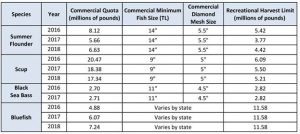
The Commission’s Summer Flounder, Scup and Black Sea Bass and Bluefish Management Boards met via conference call to review the latest recreational harvest estimates from the Marine Recreational Information Program. Most notably for both bluefish and black sea bass, the final 2015 recreational harvest estimates were uncharacteristically larger than the preliminary estimates. Based on this information, the Board discussed the need to change state recreational measures for the 2016 fishing season. While no management action was taken for bluefish since the 2016 annual catch limit had not been exceeded, the Board briefly discussed the possibility of transferring unused recreational quota to the commercial fishery (as allowed under the FMP). However, based on final 2015 bluefish harvest estimates, NOAA Fisheries anticipates the 2016 recreational quota will be fully utilized, prohibiting any transfer to the commercial sector. NOAA Fisheries will be releasing a final rule on 2016 bluefish fishery later this month. The Board and Mid‐Atlantic Fishery Management Council will discuss the final rule at their joint meeting in August.

Taking several factors into consideration, the Board chose to not take any management action for the recreational black sea bass fishery. Its decision was based on (1) the validity of the harvest estimates given the significant change from preliminary to final numbers; (2) concern about changing recently promulgated state regulations; (3) concern regarding socioeconomic impacts to the for‐hire industry; (4) difficultly in enforcing mid‐season regulatory adjustments; and (5) the potential for increases in discard mortality under more restrictive measures. The Board discussed a number of ways NOAA Fisheries could improve the annual specification process for these species. These include providing a more timely delivery of final recreational harvest numbers from the previous season, which would allow the states to more precisely tailor their regulations; incorporating vessel trip reports in its preliminary harvest estimates; and seeking ways to increase sample sizes in the for‐hire fishery to more accurately represent catch and effort in this sector.

See the full summary at the ASMFC

Atlantic States Marine Fisheries Commission eyes menhaden

July 6, 2016 — DOVER, Del. — Delaware officials are hosting an Atlantic States Marine Fisheries Commission public hearing on proposed changes to the interstate management plan for Atlantic Menhaden.

Wednesday evening’s hearing in Dover involves a proposal to allow two licensed commercial fishermen to harvest up to 12,000 pounds of menhaden bycatch when working from the same vessel and fishing with stationary, multi-species gear, limited to one vessel trip per day.

Currently, the bycatch limit is 6,000 pounds per vessel per day.

Read the full story from the Associated Press at the Washington Times

  • « Previous Page
  • 1
  • …
  • 118
  • 119
  • 120
  • 121
  • 122
  • …
  • 127
  • Next Page »

Recent Headlines

  • Ecosystem shifts, glacial flooding and ‘rusting rivers’ among Alaska impacts in Arctic report
  • Seafood prices soar, but US retail sales still see some gains in November
  • Western Pacific Council Moves EM Implementation Forward, Backs Satellite Connectivity for Safety and Data
  • Ecosystem shifts, glacial flooding and ‘rusting rivers’ among Alaska impacts in Arctic report
  • Petition urges more protections for whales in Dungeness crab fisheries
  • MASSACHUSETTS: Six decades of change on Cape Cod’s working waterfronts
  • Judge denies US Wind request to halt Trump administration attacks
  • Low scallop quota will likely continue string of lean years for industry in Northeast US

Most Popular Topics

Alaska Aquaculture ASMFC Atlantic States Marine Fisheries Commission BOEM California China Climate change Coronavirus COVID-19 Donald Trump groundfish Gulf of Maine Gulf of Mexico Illegal fishing IUU fishing Lobster Maine Massachusetts Mid-Atlantic National Marine Fisheries Service National Oceanic and Atmospheric Administration NEFMC New Bedford New England New England Fishery Management Council New Jersey New York NMFS NOAA NOAA Fisheries North Atlantic right whales North Carolina North Pacific offshore energy Offshore wind Pacific right whales Salmon South Atlantic Virginia Western Pacific Whales wind energy Wind Farms

Daily Updates & Alerts

Enter your email address to receive daily updates and alerts:
  • This field is for validation purposes and should be left unchanged.
Tweets by @savingseafood

Copyright © 2025 Saving Seafood · WordPress Web Design by Jessee Productions