Saving Seafood

  • Home
  • News
    • Alerts
    • Conservation & Environment
    • Council Actions
    • Economic Impact
    • Enforcement
    • International & Trade
    • Law
    • Management & Regulation
    • Regulations
    • Nutrition
    • Opinion
    • Other News
    • Safety
    • Science
    • State and Local
  • News by Region
    • New England
    • Mid-Atlantic
    • South Atlantic
    • Gulf of Mexico
    • Pacific
    • North Pacific
    • Western Pacific
  • About
    • Contact Us
    • Fishing Terms Glossary

Lund’s Fisheries Offering Fair Trade Certified Scallops

March 12, 2018 — SEAFOOD NEWS — Lund’s Fisheries has announced that they are now offering Fair Trade Certified scallops, a first in the United States for an Atlantic sea scallop fishery.

“Ethically and sustainably harvested seafood is increasingly demanded by consumers. It is the right thing for the environment and the right thing for people,” said Wayne Reichle, President of Lund’s Fisheries. “We are proud to sell a product that’s as good for our fishermen as it is for the consumer.”

Lund’s Fisheries received approval from an independent certification group to be able to sell their scallops using the Fair Trade label. The label was designed to show consumers that the product meets the highest standards for environmental sustainability, social responsibility and fair labor practices.

“We are excited to welcome Lund’s fisheries to the Fair Trade family of certified suppliers as they expand their commitment to sustainability by bringing the benefits of Fair Trade certification to the fishermen and processing workers who are an integral part of their success,” added Julie Kuchepatocv, Seafood Director at Fair Trade USA.

This story originally appeared on Seafoodnews.com, a subscription site. It is reprinted with permission.


NE Council Receives 2017 Scallop Survey Overview and Progress Report on 2018 Management Measures in Framework 29

October 2, 2017 — The following was released by the New England Fishery Management Council:

During its late-September meeting in Gloucester, MA, the New England Fishery Management Council received a comprehensive overview of the “very successful” 2017 scallop survey season. The Council then reviewed the range of measures under development for Framework Adjustment 29 to the Atlantic Sea Scallop Fishery Management Plan. These measures, once fully developed and approved, will apply to the 2018 scallop fishing year, which will begin on April 1 instead of March 1 as in previous years.

Five separate groups contributed to the 2017 scallop surveys:

  • The Virginia Institute of Marine Science (VIMS) conducted dredge surveys in the Mid-Atlantic, Nantucket Lightship Area, and Closed Area II.
  • UMass Dartmouth School for Marine Science and Technology (SMAST) conducted intensive surveys of Closed Area I, Closed Area II, and the Elephant Trunk Area, along with broadscale surveys of Georges Bank and the Mid-Atlantic and a drop camera survey of Stellwagen Bank in the Gulf of Maine.
  • The Woods Hole Oceanographic Institution (WHOI), in partnership with Lund’s Fisheries, conducted a Habitat Camera Mapping System (HabCam) version 5 (v5) survey of the Northern Edge on Georges Bank.
  • Coonamessett Farm Foundation (CFF) conducted a HabCam v3 survey of the Nantucket Lightship Area, as well as a HabCam v3 survey on Stellwagen Bank and Jeffreys Ledge in the Gulf of Maine, along with six dredge tows on Stellwagen. And,
  • The Northeast Fisheries Science Center (NEFSC) conducted a dredge survey on Georges Bank and a HabCam v4 survey of the Mid-Atlantic and Georges Bank.

Read the full release at the New England Fishery Management Council

Scallop RSA Program: 2018-2019 research proposals wanted

September 12, 2017 — The following was released by the New England Fishery Management Council:

The National Marine Fisheries Service, in coordination with the New England Fishery Management Council, is soliciting proposals for the 2018-2019 Atlantic Sea Scallop Research Set-Aside (RSA) Program.  The application deadline is November 6, 2017.

HOW DOES THE PROGRAM WORK:  The Scallop RSA Program was established through the Atlantic Sea Scallop Fishery Management Plan to address scallop research priorities identified by the New England Council.  The Council adopted 2018-2019 research priorities at its June meeting in Portland, ME.

HOW IS THE RSA PROGRAM FUNDED:  Each year, 1.25 million pounds of scallops are “set aside” during the specification-setting process to carry out the program.  Awards are made in pounds, not dollars, and no federal funding is provided to conduct the research.  Proceeds generated from the sale of set-aside scallops are used to fund research activities and compensate vessels that participate in research activities and/or harvest set-aside quota.

2018-2019 PRIORITIES:  Projects funded under the Scallop RSA Program must: (a) enhance understanding of the scallop resource; or (b) contribute to scallop fishery management decisions.  For the current federal funding opportunity, priority will be given to proposals that address the New England Council’s list of 2018 and 2019 research priorities.  The complete list is spelled out in detail in the 2018-2019 Atlantic Sea Scallop Federal Funding Opportunity  notice, which also contains instructions for how to submit proposals.  In very general terms, the research priority categories include:

  • HIGHEST: (#1) Survey-related research
  • HIGH: (#2) Scallop meat quality research; and (#3) bycatch research
  • MEDIUM: (#4) Turtle behavior investigations and potential impact on the Mid-Atlantic/Georges Bank scallop fishery; (#5) scallop biology projects
  • OTHER: (#6) Dredge efficiency investigations; (#7) habitat characterization research; (#8a) projects related to water quality and environmental stressors; (#8b) spat collection and seeding projects; (#9) research to identify sources of management uncertainty and potential effects on projected landings; (#10) expanded survey coverage into new or minimally sampled areas; (#11) social and economic impacts and consequences of area rotation; and (#12) investigations of non-harvest scallop mortality.

REVIEW PROCESS:  All submitted proposals will be evaluated by: (1) technical reviewers for technical merit; and (2) a management panel comprised of scallop fishermen, fishery managers, fishing industry representatives, and others closely involved with scallop fishery management issues.

RSA BACKGROUNDERS:  Learn more at RSA and everything you ever wanted to know.

QUESTIONS:  For more information about the 2018-2019 solicitation and the Scallop RSA Program in general, contact Cheryl Corbett at (508) 495-2070, cheryl.corbett@noaa.gov.

NOAA Fisheries Announces 2018/2019 Atlantic Sea Scallop Research Set-Aside Program Funding Opportunity

September 11, 2017 — The following was released by NOAA Fisheries:

NOAA Fisheries, in coordination with the New England Fishery Management Council, is soliciting Atlantic Sea Scallop research proposals under the 2018/2019 Atlantic Sea Scallop Research Set-Aside Program.

Under this program, proceeds generated from the sale of set-aside scallops will be used to fund research activities and compensate vessels that participate in research activities and/or harvest set-aside quota.

Projects funded under the Atlantic Sea Scallop Research Set-Aside Program must enhance the understanding of the scallop resource or contribute to scallop fishery management decisions. Priority is given to funding research proposals addressing the list of 2018 and 2019 Atlantic Sea Scallop Research Priorities listed in the Funding Opportunity.

Read the complete 2018/2019 Atlantic Sea Scallop Federal Funding Opportunity.

To apply for this NOAA Federal Funding Opportunity, go to Grants.gov, and use the following code: NOAA-NMFS-NEFSC-2018-2005322.

Complete proposals/applications must be received on or before 5 p.m. EDT on November 6, 2017.

For proposals submitted through Grants.gov, a date and time receipt will be the basis of determining timeliness. The proposal must be validated by Grants.gov in order to be considered timely. PLEASE NOTE: It may take Grants.gov up to two (2) business days to validate or reject the application. Please keep this in mind in developing your submission timeline.

If you prefer to mail your application, please send one signed original and two hard copy applications postmarked by November 6, 2017 to Cheryl A. Corbett, Northeast Fisheries Science Center, 166 Water Street, Woods Hole, MA 02543, ATTN: 2018/2019 Atlantic Scallop Research Set-Aside Program.

Find out more about Northeast Research Set-Aside Programs.

Questions? Contact Cheryl Corbett at 508-495-2070 or Cheryl.Corbett@noaa.gov.

Reminder to Scallop Fishermen: Closed Area II Access Area Closes August 15

August 10, 2017 — The following was released by NOAA Fisheries:

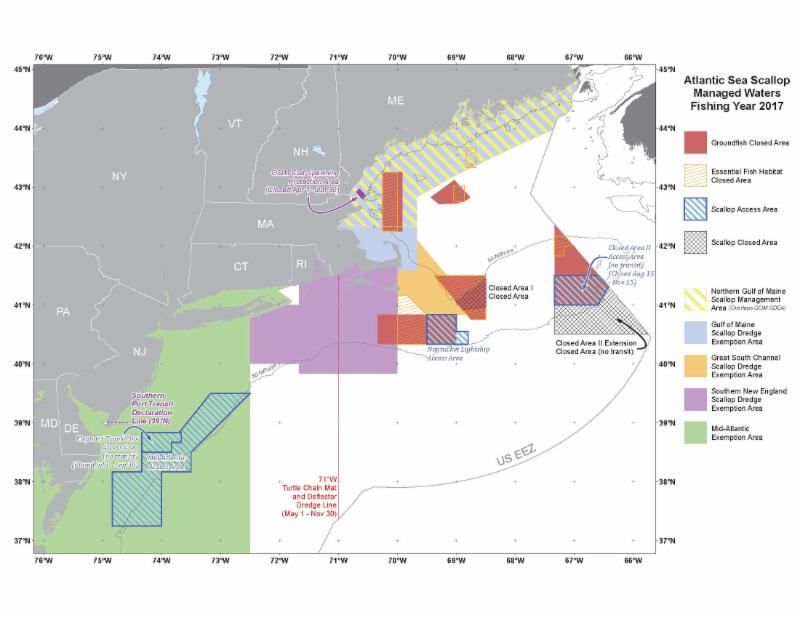
The Scallop Closed Area II Access Area will close at 12:01 am on August 15 and will remain closed through November 15. All vessels must be out of the area prior to the time of the closure.

Any unharvested Closed Area II pounds can be harvested once the area reopens on November 16.

For more information, see our new story map that describes the scallop fishery regulations for 2017, or see our large map of the scallop management areas (also below).

Fisheries Survival Fund Corrects the Record on Gulf of Maine Scallops

WASHINGTON — March 22, 2017 — The following was released by the Fisheries Survival Fund:

Atlantic sea scallops remain one of the most sustainably harvested stocks in the United States. With recent media attention on scallops in the northern Gulf of Maine (NGOM), the Fisheries Survival Fund, which represents the majority of the full-time Limited Access scallop fleet, has produced a fact sheet clarifying the true status of scallops in the region.

Recent data from the New England Fishery Management Council, which is responsible for sustainably managing the region’s scallop population, shows that Atlantic sea scallops in the NGOM are not overfished, nor are they experiencing overfishing. The Limited Access fleet is operating within its allocated federal quota, and the Atlantic sea scallop fishery remains certified as sustainable by the Marine Stewardship Council. It also shows that most fishing in the area does not actually take place in the geographical NGOM, but rather in southwestern Stellwagen Bank, off the coast of Massachusetts. There are currently 36 active NGOM scallop fishing vessels in the NGOM, only 18 of which are home-ported in Maine.

We have provided a fact sheet below using the official documents in order to clarify these claims.

Fact Sheet on Scallops in the Northern Gulf of Maine

  • There is no overfishing of the Northern Gulf of Maine (NGOM) scallop stock, nor is it rebuilding, as scallops in the NGOM are not considered a separate, unique stock. There are not separate reference points for NGOM scallops, nor are there separate Annual Catch Limits. For all management and scientific purposes, NGOM scallops are part of the overall scallop stock, and are included in the full scallop assessment. According to that assessment, scallops are not overfished and are not experiencing overfishing.
  • The catch limit for the general category scallop boats in NGOM, currently set at 70,000 pounds, is based upon historical catch. The NGOM scallopers were given these allocations because they did not qualify for the limited access scallop fleet. More information can be found in Amendment 11 to the scallop Fishery Management Plan on the NEFMC website: http://www.nefmc.org/library/amendment-11
  • There are 81 NGOM permits and only 36 active NGOM scallop vessels fishing in NGOM. Out of those, only 18 are home-ported in Maine. This can be verified in Table 4 below, which was obtained from the New England Fishery Management Council website, from the March 1 meeting of the Scallop Plan Development Team. The table can also be found in section 3.2.1 of Draft Discussions Document on NGOM management.
  • Most of the scallop fishing activity in the NGOM does not occur near Maine, but offshore Massachusetts, in the southwest corner of Stellwagen Bank. Some of this activity is outside the actual NGOM management area. A table illustrating this can be found below, and can also be found in the Draft Discussions Document on NGOM management in section 3.1.
  • The fishing activity of the limited access scallop fleet in the NGOM does not count towards the quota of the NGOM. The limited access fleet operates on a federal quota, in federal waters, under an entirely separate management system. This is not new: the limited access scallop fleet has been fishing in this area under this management program for many years.
  • The Atlantic Sea Scallop fishery is certified as sustainable by the Marine Stewardship Council. The scallop fishery’s commitment to sustainability is also reflected in their participation in the Research Set Aside program. Every year, a portion of revenue from the scallop catch is redirected towards research, which allows the scallop fishery to be managed by the most up-to-date science.
  • All points made have been confirmed with the most up to date NEFMC findings. These links are provided below:
  • http://www.nefmc.org/calendar/mar-1-2017-scallop-plan-development-team-meeting
  • http://www.nefmc.org/library/amendment-11
  • http://s3.amazonaws.com/nefmc.org/Doc4-170224_NGOM-Discussion-Draftv.2.pdf
  • http://s3.amazonaws.com/nefmc.org/Doc4a-NGOM-PDT_DataRequest_Feb2017_V2.pdf


Read the release here 

Scallop RSA proposals now being solicited for 2017 and 2018

August 9, 2016 — The following was released by the New England Fishery Managment Council:

Scallop industry members and partners have until 5 p.m. on Oct. 7, 2016 to submit applications for the latest round of funding available through the Scallop Research Set-Aside (RSA) Program.

The program was established through the Scallop Fishery Management Plan (FMP) to address scallop research priorities identified by the New England Fishery Management Council. The National Marine Fisheries Service (NMFS), in coordination with the Council, is now soliciting proposals for the 2017 and 2018 Atlantic Sea Scallop Federal Funding Opportunity (FFO).

To apply, go to www.grants.gov and use the following funding opportunity number: NOAA-NMFS-NEFSC-2017- 2004963.

NMFS emphasized, “Projects funded under the Scallop RSA Program must enhance the understanding of the scallop resource or contribute to scallop fishery management decisions. Priority is given to funding research proposals addressing the list of 2017 and 2018 Atlantic Sea Scallop Research Priorities listed in the FFO.”

Read the full release from the New England Fishery Management Council

  • « Previous Page
  • 1
  • …
  • 4
  • 5
  • 6

Recent Headlines

  • Scientists did not recommend a 54 percent cut to the menhaden TAC
  • Broad coalition promotes Senate aquaculture bill
  • Chesapeake Bay region leaders approve revised agreement, commit to cleanup through 2040
  • ALASKA: Contamination safeguards of transboundary mining questioned
  • Federal government decides it won’t list American eel as species at risk
  • US Congress holds hearing on sea lion removals and salmon predation
  • MASSACHUSETTS: Seventeen months on, Vineyard Wind blade break investigation isn’t done
  • Sea lions keep gorging on endangered salmon despite 2018 law

Most Popular Topics

Alaska Aquaculture ASMFC Atlantic States Marine Fisheries Commission BOEM California China Climate change Coronavirus COVID-19 Donald Trump groundfish Gulf of Maine Gulf of Mexico Illegal fishing IUU fishing Lobster Maine Massachusetts Mid-Atlantic National Marine Fisheries Service National Oceanic and Atmospheric Administration NEFMC New Bedford New England New England Fishery Management Council New Jersey New York NMFS NOAA NOAA Fisheries North Atlantic right whales North Carolina North Pacific offshore energy Offshore wind Pacific right whales Salmon South Atlantic Virginia Western Pacific Whales wind energy Wind Farms

Daily Updates & Alerts

Enter your email address to receive daily updates and alerts:
  • This field is for validation purposes and should be left unchanged.
Tweets by @savingseafood

Copyright © 2025 Saving Seafood · WordPress Web Design by Jessee Productions