Saving Seafood

  • Home
  • News
    • Alerts
    • Conservation & Environment
    • Council Actions
    • Economic Impact
    • Enforcement
    • International & Trade
    • Law
    • Management & Regulation
    • Regulations
    • Nutrition
    • Opinion
    • Other News
    • Safety
    • Science
    • State and Local
  • News by Region
    • New England
    • Mid-Atlantic
    • South Atlantic
    • Gulf of Mexico
    • Pacific
    • North Pacific
    • Western Pacific
  • About
    • Contact Us
    • Fishing Terms Glossary

VIRGINIA: Cost of Virginia Beach wind farm jumps almost $1 billion, with increase passed onto customers

February 4, 2025 — The estimated cost of Dominion Energy’s 2.6-gigawatt Virginia Beach offshore wind farm has increased about 9%, which will mean a 43-cent increase on an average monthly residential power bill.

In a Monday announcement, Dominion said the total cost estimate of its wind farm had increased from $9.8 billion to $10.7 billion. The cost increase is due to higher network upgrade costs assigned by PJM, the regional electric grid operator, as well as higher onshore electrical interconnection costs, according to the statement.

“Higher network upgrade cost estimates by PJM reflect the significant increase in demand growth that require incremental generation and transmission resources across the system,” Dominion said in the statement.

Read the full article at The Virginian-Pilot

VIRGINIA: Virginia Beach wind farm spared from Trump order, but future projects could be slowed, experts say

January 27, 2025 — President Donald Trump used his first day in office to slam the brakes on the renewable energy industry, issuing an executive order to temporarily halt federal leasing, permitting and approval of both onshore and offshore wind energy projects.

But a Virginia Beach wind farm already under construction will be spared the immediate effects of the order, said environmental experts and Dominion Energy officials. Still, the experts say other Dominion projects could be delayed.

“It will have an effect on any future leases,” said Eileen Woll, offshore energy program director for the Sierra Club’s Virginia chapter.

Under the Monday executive order, the Trump administration will pause all offshore wind leases in federal waters, in addition to halting permitting and approvals for any wind project, both offshore or onshore. The order notes that, “Nothing in this withdrawal affects rights under existing leases in the withdrawn areas.” That includes the 2.6-gigawatt Coastal Virginia Offshore Wind project, which began construction off the coast of Virginia Beach last year.

Read the full article at The Daily Progress

VIRGINIA: What does Trump’s pause on offshore wind mean for Virginia?

January 23, 2025 — One of President Trump’s first executive orders halted all new federal leases and permits for offshore wind projects.

Hampton Roads has bet big on the offshore wind industry.

Dominion Energy is building the nation’s largest offshore wind farm 27 miles off the Virginia Beach Oceanfront, and has two more leases waiting in the wings.

Local economic development officials have also worked hard to attract related businesses to make southeastern Virginia an offshore wind hub, including a South Korean manufacturer of undersea electrical cables.

President Donald Trump’s administration now threatens to put up a roadblock to further growing Virginia’s industry.

“We are going to have a policy where no windmills are being built,” Trump said recently.

On his first day in office this week, Trump signed an executive order that temporarily halts all new federal leases and permits for wind energy.

Read the full article at WHRO

VIRGINIA: Dominion says offshore wind farm moving forward, despite executive order

January 22, 2025 — President Donald Trump started his second term Monday with a flurry of executive orders, including one that temporarily ceases all federal wind leases under consideration and calls for an “immediate review” of the policies before resuming.

So, what does that mean for Virginia and Dominion Power, which is midway through constructing its $9.8 billion Coastal Virginia Offshore Wind farm off the coast of Virginia Beach and has purchased two other wind farm leases in the Atlantic Ocean?

The Richmond-based Fortune 500 utility said in a statement Tuesday that it is “confident CVOW will be completed on time, and that Virginia’s clean energy transition will continue with bipartisan support for many years to come.”

Read the full article at Virginia Business

VIRGINIA: VA Marine Scientists Leads National Program Cleaning up Discarded Fishing Gear, Awarding New Grants

January 16, 2025 — The Virginia Institute of Marine Science (VIMS) and William and Mary’s Coastal Sciences school are leading the charge nationwide to clean up discarded fishing gear and “ghost pots” from U.S. waterways.

William & Mary’s Batten School and VIMS, administrators of the National Fishing Trap Removal, Assessment, and Prevention (TRAP) Program, has awarded $1.4 million to fund 11 projects to retrieve derelict lobster and crab traps in 2025. This initial round supports projects in California, Connecticut, Delaware, Florida, Louisiana, Maine, Maryland, New York, Washington and the Pacific Island State of Palau, as well as ongoing efforts by the Virginia Marine Debris Program.

In 2023, using funds from the Bipartisan Infrastructure Law, the National Oceanic and Atmospheric Administration’s (NOAA) Marine Debris Program awarded an $8 million, four-year competitive grant to the Batten School & VIMS to administer the TRAP program. One important feature of the project will be standardizing data collection practices and establishing a national database to evaluate the environmental and economic impacts of these projects.

Read the full article at Chesapeake Bay Magazine

Monty Deihl: Let’s set the record straight about menhaden fishing

December 18, 2024 — The following is an excerpt from an opinion piece published by The Virginian-Pilot and the Daily Press. It was written by Monty Deihl, the CEO of Ocean Harvesters, Inc. He is a native of Reedville, where he and his wife raised their family, and a retired Air Force officer.

A guest column published on Dec. 11 (“Menhaden harvesting has an impact on local fisheries”) contained several inaccuracies regarding the menhaden fishery — including Reedville-based companies Ocean Harvesters and Omega Protein — and the state of the Atlantic menhaden population.

Omega Protein neither “farms” fish nor engages in aquaculture. Menhaden used in Omega Protein’s products are harvested by Ocean Harvesters, an independent company that operates a fleet of nine vessels out of Reedville. Omega Protein processes the menhaden harvested by Ocean Harvesters into products that improve the nutritional integrity of foods, dietary supplements, and animal feeds.

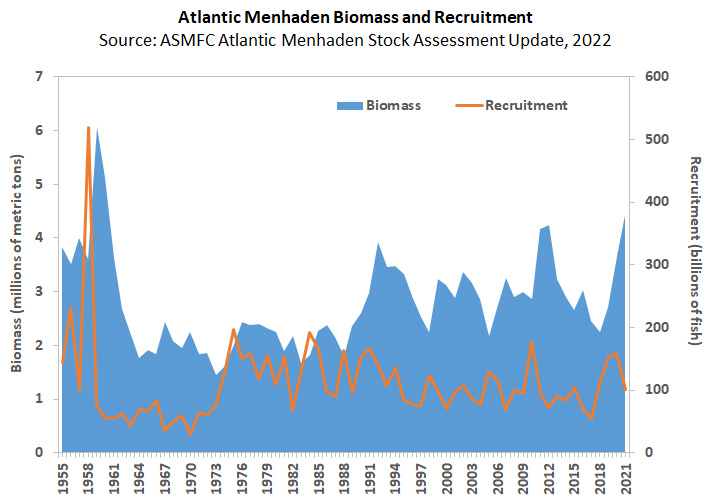
The menhaden population is not “dwindling.” The Atlantic States Marine Fisheries Commission (ASMFC) reports menhaden populations are abundant and sustainably managed. Menhaden are not overfished and are not experiencing overfishing. The biomass exceeded 4.5 million metric tons in 2022, while total commercial landings amounted to just 195,387 metric tons. The ASMFC says menhaden biomass has been stable since the 1960s.

At the August ASMFC meeting, both the representative from the Maryland Department of Natural Resources (DNR) and the Maryland governor’s appointee stated there are “no menhaden” in Maryland. Ironically, in October, the Maryland DNR juvenile striped bass survey found that juvenile menhaden abundance in the Chesapeake Bay over the past two years is at the highest level measured since 1990.

The menhaden fishery is certified sustainable by the Marine Stewardship Council. This required a rigorous, independent evaluation by third-party auditors confirming a healthy biomass, minimal environmental impact and a robust management system.

Atlantic menhaden is the first U.S. species managed to account for predator forage needs. In 2020, after a decade of work, the ASMFC implemented “ecological reference points.” This was applauded by numerous environmental advocates and the Chesapeake Bay Foundation.

Although some critics in the recreational fishing community claim a distinction between the coast-wide and Chesapeake Bay menhaden populations, no evidence supports this. Menhaden are migratory, naturally moving in and out of the Bay. At a Dec. 6, 2022, meeting, Virginia Institute of Marine Science (VIMS) scientists called “localized depletion” claims speculative and unsupported by evidence.

In recent months, the Chesapeake Bay Foundation and other groups publicized a controversial study allegedly linking menhaden harvesting and negative osprey reproductive success. At the August ASMFC meeting, the Chesapeake Bay Foundation’s Maryland executive director offered a motion creating a workgroup to consider more precautionary management of menhaden based on the study. But an article in the current Bay Journal highlights criticism from three VIMS fisheries scientists, who questioned the study’s data, methods and conclusion linking osprey nesting issues to menhaden fishing.

Antagonism between commercial menhaden and recreational fishing interests is nothing new. It was first reported in The New York Times in 1895. But recently, threats on social media and physical attacks on commercial vessels escalated to the point that Virginia amended its laws in 2024 to increase penalties for such dangerous actions. We are thankful to the governor, delegates and commercial watermen from other fisheries who worked hard to change the law to increase public safety.

Today, Ocean Harvesters and Omega Protein are the largest providers of union jobs with full benefits, and the largest minority employers in Northumberland County, serving as key economic drivers. My family has worked in the menhaden industry in Reedville for more than 100 years; it clothed and fed me, put me through school, and today employs my children and supports my grandchildren.

For more than a century, those in the Northern Neck’s menhaden fishing industry have defended their livelihoods against unfounded claims that menhaden purse-seine fishing harms recreational fishing. The debate will continue, but it must be based on fact. And the regulation of this job-creating industry must also be based on fact — not politics and unsubstantiated conjecture.

Read the op-ed at The Virginian-Pilot

Maryland county takes on international offshore wind company to save commercial fishing jobs

December 18, 2024 — On the largely undeveloped Delmarva peninsula – which is surrounded by the Chesapeake Bay to the west, the Atlantic Ocean to the east and includes portions of Delaware, Maryland and Virginia – local lawmakers are getting ready to take on a major international wind power company in an effort to save its crucial commercial fishing industry.

The Worcester County Commissioners in Maryland approved a resolution on Tuesday to acquire two properties in West Ocean City Harbor through eminent domain, which US Wind plans to develop into an operations and maintenance facility as it constructs a wind farm off the coast of Ocean City, Maryland. The action was taken in an effort to protect the county’s historic commercial and sport fishing industries.

The commissioners passed the resolution as US Wind, a subsidiary of Italian-based Renexia SpA, plans to construct a 353-foot-long-by-30-foot-wide concrete pier at the harbor to service vessels used to construct a proposed wind farm consisting of up to 118 turbines at least 15 miles off the coast of Ocean City. Along with the pier, the company plans to install 383 feet of bulkhead.

The two properties the county plans to acquire are currently being used by Southern Connection Seafood and the Martin Fish Company, which are the only two commercial seafood wholesalers in the area where watermen can offload and sell their catches.

The county’s plans for the two properties include developing a long-term lease with the existing owners, allowing them to continue serving the needs of the commercial fishing industry, according to the resolution that was passed.

“The commercial fishing industry is an integral and essential part of Worcester County’s economy,” the resolution reads, adding that it, along with the sport fishing industry, are dependent on commercial marine support in and around West Ocean City Harbor.

Read the full story at FOX Business

Osprey troubles not tied to menhaden, some fisheries scientists say

December 13, 2024 — A widely publicized study pointing to a shortage of Atlantic menhaden as the cause of osprey nest failures in the Chesapeake Bay has come under fire from a trio of Virginia fisheries scientists.

The study, published in January by researchers with the College of William & Mary’s Center for Conservation Biology, linked a drastic decline in osprey reproduction in Virginia’s Mobjack Bay with a drop in the availability of menhaden, the migratory fish that once made up the bulk of the birds’ diet. They said ospreys are having fewer young and more chicks are dying in the nest for lack of food than in decades past. They  suggested that the commercial menhaden harvest be limited to sustain ospreys, also known as fish hawks.

That research report, written by center director Bryan Watts and five co-authors, gave credence to complaints by conservationists and sports anglers about large-scale commercial menhaden harvests in the Bay. Those groups have long contended that a Virginia-based fishing fleet operated by Omega Protein has been depleting menhaden stocks in the Chesapeake, depriving Atlantic striped bass and other fish of a vital source of forage.

Read the full article at the Bay Journal

VIMS scientists critique research linking osprey declines to menhaden industry

November 29, 2024 — There is a long-running battle in Virginia over how to manage the menhaden fishery – and the lack of data about the species continues to be front and center.

Research that touches on menhaden in the Chesapeake Bay has long been contentious, because it helps inform how officials choose to regulate the controversial fishery.

The latest disagreement is playing out in scientific literature. Three scientists at William & Mary’s Virginia Institute of Marine Science, which conducts research for state regulators, recently published a formal critique of a study linking declines in the local osprey population to the menhaden industry.

The study they critiqued came from another arm of William & Mary: the Center for Conservation Biology, which studies birds.

The center has monitored ospreys for years. Director Bryan Watts said they’ve now seen the birds struggling to reproduce for more than a decade.

His team published a study earlier this year recording the lowest number of osprey chicks since the 1970s. They said the baby birds are dying of starvation, and posit that’s because there aren’t enough menhaden for them to eat.

Read the full article at WHRO

VIRGINIA: Offshore wind project to cause traffic headaches in Virginia Beach through May

November 25, 2024 — Work related to Dominion Energy’s Coastal Virginia offshore wind project will be the source of travel headaches through May.

Lane closures and delays started Monday on South Birdneck Road near Bells Road in Virginia Beach and run from 7 a.m. to 7 p.m. Monday – Saturday

Read the full article at the Augusta Free Press

  • « Previous Page
  • 1
  • …
  • 5
  • 6
  • 7
  • 8
  • 9
  • …
  • 66
  • Next Page »

Recent Headlines

  • MARYLAND: Gov. Moore sends federal disaster funding request on current state of fishery
  • US lawmakers introduce marine carbon dioxide removal bill
  • BEN LANDRY: Call to shut down menhaden fishery is unwarranted
  • MARYLAND: Maryland requests disaster declaration for Chesapeake oyster fishery
  • MASSACHUSETTS: Two Local Banks Step Up to Manage Lily Jean Charitable Fund
  • Immigration, trade policies, rising operational costs among top pressures affecting US restaurants in 2026
  • MASSACHUSETTS: Lily Jean loss sparks formal investigation as fishing community rallies
  • Tariff lawsuits begin moving forward as US federal court issues mandate

Most Popular Topics

Alaska Aquaculture ASMFC Atlantic States Marine Fisheries Commission BOEM California China Climate change Coronavirus COVID-19 Donald Trump groundfish Gulf of Maine Gulf of Mexico Illegal fishing IUU fishing Lobster Maine Massachusetts Mid-Atlantic National Marine Fisheries Service National Oceanic and Atmospheric Administration NEFMC New Bedford New England New England Fishery Management Council New Jersey New York NMFS NOAA NOAA Fisheries North Atlantic right whales North Carolina North Pacific offshore energy Offshore wind Pacific right whales Salmon South Atlantic Virginia Western Pacific Whales wind energy Wind Farms

Daily Updates & Alerts

Enter your email address to receive daily updates and alerts:
  • This field is for validation purposes and should be left unchanged.
Tweets by @savingseafood

Copyright © 2026 Saving Seafood · WordPress Web Design by Jessee Productions