Saving Seafood

  • Home
  • News
    • Alerts
    • Conservation & Environment
    • Council Actions
    • Economic Impact
    • Enforcement
    • International & Trade
    • Law
    • Management & Regulation
    • Regulations
    • Nutrition
    • Opinion
    • Other News
    • Safety
    • Science
    • State and Local
  • News by Region
    • New England
    • Mid-Atlantic
    • South Atlantic
    • Gulf of Mexico
    • Pacific
    • North Pacific
    • Western Pacific
  • About
    • Contact Us
    • Fishing Terms Glossary

Mid-Atlantic Council and ASMFC Maintain Multi-Year Specifications for Black Sea Bass, Bluefish, and Scup and Modify Summer Flounder Specifications

August 15, 2016 — The following was released by NOAA:

Virginia Beach, VA – Last week the Mid-Atlantic Fishery Management Council (Council) and the Atlantic States Marine Fisheries Commission (Commission) reviewed previously implemented specifications for scup, black sea bass and bluefish fisheries and modified specifications for summer flounder. The Commission’s actions are final and apply to state waters. The Council will forward its federal waters recommendations regarding summer flounder specifications to NOAA Fisheries Greater Atlantic Regional Fisheries Administrator for final approval.

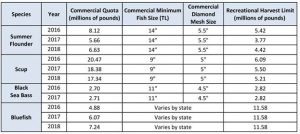
The table below summarizes commercial quotas and recreational harvest limits for summer flounder, scup, black sea bass, and bluefish (2016 values are provided for comparison purposes). Please note specifications for years 2017 and beyond may be adjusted based on changes in the fishery or new scientific information.

image003

For summer flounder, both groups approved a commercial quota of 5.66 million pounds and a recreational harvest limit of 3.77 million pounds for 2017, an approximate 30% decrease from 2016. This decrease in catch and landings limits responds to the findings of the 2016 stock assessment update, which indicates summer flounder has been experiencing overfishing since 2008. In 2015, fishing mortality exceeded its threshold by 26% (i.e., the level beyond which overfishing is occurring). The 2015 estimate of spawning stock biomass (SSB) is at 58% of the biomass target, and only 16% above the threshold. If the stock were to fall below the threshold, it would be considered overfished, requiring the development of a rebuilding plan to reduce fishing mortality and rebuild stock biomass. These results appear to be driven largely by below-average recruitment, an underestimation of the fishing mortality level in the last years of the assessment, and declining biomass indices. The assessment update indicates the stock experienced six below-average year classes from 2010 to 2015. Additionally, indices of abundance from state and federal surveys have indicated declines in abundance ranging from 9 to 97% from their most recent peaks (generally 2009 to 2012). The 2016 assessment update estimated biomass has been trending down since 2010. Summer flounder harvest limits for 2018 may be adjusted in the future based on changes in the fishery or new scientific information.

Scup and Black Sea Bass

For scup and black sea bass, the Commission and Council maintained the previously implemented multi-year specifications set in August and October 2015, respectively. The decline in harvest limits for scup since 2016 is due to a decrease in SSB as projected by the 2015 benchmark stock assessment.

For black sea bass, 2017 harvest limits remain unchanged relative to 2016 levels (in 2016, there was a reduction in the commercial quota due to overages in the previous year). Both the commercial quota and recreational harvest limit may be changed pending the results of next benchmark stock assessment, scheduled for peer review through the Northeast Regional Stock Assessment Workshop/Stock Assessment Review Committee in late 2016. The Commission and Council will consider the results of the benchmark stock assessment in early 2017.

Bluefish

For the bluefish fishery, the final 2016 commercial quota is 4.88 million pounds and the recreational harvest limit is 11.58 million pounds. The final 2016 harvest limits include a 1.58 million pound transfer from the recreational sector to the commercial sector. The Commission and Council did not make any changes to the 2017 and 2018 specifications. The 2017 and 2018 commercial quotas and recreational harvest limits are preliminary and will likely change following release of 2016 and 2017 final Marine Recreational Information Program harvest estimates. These estimates can impact how much is transferred from the recreational sector to the commercial sector.

August 2016 Mid Atlantic Fishery Management Council Meeting Agenda​

July 20, 2016 — The Mid Atlantic Fishery Managment Council released the agenda for their August 2016 Council meeting today. The meeting will take place from August 8-August 11 in Virginia Beach, Virginia.

See the agenda for the meeting here

Summary of ASMFC Summer Flounder, Scup, and Black Sea Bass & Bluefish Management Boards

July 7, 2016 — The following was released by the Atlantic States Marine Fisheries Commission:

The Commission’s Summer Flounder, Scup and Black Sea Bass and Bluefish Management Boards met via conference call to review the latest recreational harvest estimates from the Marine Recreational Information Program. Most notably for both bluefish and black sea bass, the final 2015 recreational harvest estimates were uncharacteristically larger than the preliminary estimates. Based on this information, the Board discussed the need to change state recreational measures for the 2016 fishing season. While no management action was taken for bluefish since the 2016 annual catch limit had not been exceeded, the Board briefly discussed the possibility of transferring unused recreational quota to the commercial fishery (as allowed under the FMP). However, based on final 2015 bluefish harvest estimates, NOAA Fisheries anticipates the 2016 recreational quota will be fully utilized, prohibiting any transfer to the commercial sector. NOAA Fisheries will be releasing a final rule on 2016 bluefish fishery later this month. The Board and Mid‐Atlantic Fishery Management Council will discuss the final rule at their joint meeting in August.

Taking several factors into consideration, the Board chose to not take any management action for the recreational black sea bass fishery. Its decision was based on (1) the validity of the harvest estimates given the significant change from preliminary to final numbers; (2) concern about changing recently promulgated state regulations; (3) concern regarding socioeconomic impacts to the for‐hire industry; (4) difficultly in enforcing mid‐season regulatory adjustments; and (5) the potential for increases in discard mortality under more restrictive measures. The Board discussed a number of ways NOAA Fisheries could improve the annual specification process for these species. These include providing a more timely delivery of final recreational harvest numbers from the previous season, which would allow the states to more precisely tailor their regulations; incorporating vessel trip reports in its preliminary harvest estimates; and seeking ways to increase sample sizes in the for‐hire fishery to more accurately represent catch and effort in this sector.

See the full summary at the ASMFC

ASMFC To Review Harvest Estimates

July 1, 2016 — The following was released by the Atlantic States Marine Fisheries Commission:

The Atlantic States Marine Fisheries Commission’s Summer Flounder, Scup and Black Sea Bass and Bluefish Management Boards will meet via conference call on Wednesday, July 6 at 10:00 a.m. to review the latest recreational harvest estimates from the Marine Recreational Information Program. These data indicate that preliminary estimates of 2015 recreational harvest were underestimated for both bluefish and black sea bass. While the uptick in harvest will have no impact to 2016 bluefish recreational management measures since the annual catch limit was not exceeded, it will likely have implications for 2016 black sea bass recreational management measures. On the conference call, the Summer Flounder, Scup, and Black Sea Bass Management Board will consider possible changes to state regulations for 2016.

The public is welcome to listen in on the discussion by phone (888.394.8197; passcode 815277) and view the WEBINAR. The meeting agenda is posted to the Commission website. Meeting materials will be posted shortly. Time permitting, there will be a limited opportunity to provide comments at the end of the agenda. The Board Chair will provide additional information on the procedures for accepting public comment at the beginning of the conference call. We ask the public and other nonparticipating attendees to please mute their phones in order to minimize distractions to the Board’s deliberations.

Read the release at The Fisherman

NC commercial, recreational fishermen saw record harvests in 2015

June 22, 2o16 — North Carolina commercial and recreational fisherman reeled in record harvests last year.

Milder weather allowed fishermen to work longer, harvesting more shrimp and hard blue crab in the latter months, according to the N.C. Division of Marine Fisheries.

Shrimp landings increased by 94 percent — the highest since 2008. November 2015 shrimp landings increased by 307 percent from November 2014. Hard blue crabs also increased by 23 percent to 31 million pounds.

“We had the best spring shrimp we’ve ever had,” said Phil Guyer, owner of Coastal Seafood and Propane in Leland. “In fact, we saw shrimp in March and our hometown shrimper said that they’ve never caught shrimp in March. We had a really good year.”

While shrimp and crab harvest flourished, other species in the top five — spiny dogfish, summer flounder, Atlantic croaker — plummeted.

Recreational fishermen caught an estimated 10.2 million fish in 2015, 6.8 percent more seafood than in 2014. Fishermen also released 6 percent more fish in 2015 than in 2014.

Similarly, coastal recreational fishing in 2015 also increased substantially. Dolphin, yellowfin tuna, cobia and wahoo were the top five recreational species harvested. Dolphin catches increased by 132 percent, while wahoo rose by 66 percent and cobia rose 62 percent.The increase in dolphin, wahoo and cobia is likely due to the decline of yellowfin tuna harvests, which was down 10.7 percent last year, Marine Fisheries stated in a news release.

Read the full story at the StarNews Online

ASMFC Summer Flounder, Scup, and Black Sea Bass and Bluefish Management Boards to Meet Via Conference Call to Review Recent Recreational Harvest Estimates

June 24, 2016 — The following was released by the Atlantic States Marine Fisheries Commission:

ARLINGTON, Va. — The Atlantic States Marine Fisheries Commission’s Summer Flounder, Scup and Black Sea Bass and Bluefish Management Boards will meet via conference call on Wednesday, July 6 at 10:00 a.m. to review the latest recreational harvest estimates from the Marine Recreational Information Program. These data indicate that preliminary estimates of 2015 recreational harvest were underestimated for both bluefish and black sea bass.  While the uptick in harvest will have no impact to 2016 bluefish recreational management measures since the annual catch limit was not exceeded, it will likely have implications for 2016 black sea bass recreational management measures. On the conference call, the Summer Flounder, Scup, and Black Sea Bass Management Board will consider possible changes to state regulations for 2016.

The public is welcome to listen in on the discussion by phone (888.394.8197; passcode 815277) and view the webinar using this link. The meeting agenda is posted to the Commission website here.  Meeting materials will be posted next week. Time permitting, there will be a limited opportunity to provide comments at the end of the agenda. The Board Chair will provide additional information on the procedures for accepting public comment at the beginning of the conference call. We ask the public and other nonparticipating attendees to please mute their phones in order to minimize distractions to the Board’s deliberations.

Congressmen complain that New England fishermen are being shortchanged

May 24, 2016 — Fishing quotas on black sea bass, summer flounder and scup are unfairly limiting the catch of New England fishermen, U.S. congressmen from the region said in a letter Monday to the U.S. Department of Commerce that complained about the current “out-of-date allocation formula.”

U.S. Rep. Joe Courtney, D-2nd District, was joined by Connecticut’s two Democratic U.S. senators, Richard Blumenthal and Chris Murphy, in the letter that was also signed by 13 other members of the Connecticut and Massachusetts congressional delegations. They noted that these fish species are heading north, looking for cooler water, yet New England states have been thwarted in cashing in on the bounty.

Read the full story at The Day

Changing Migration Patterns Upend East Coast Fishing Industry

May 11, 2016 — Summer flounder that once amassed in North Carolina have gradually shifted about 140 miles to New Jersey—one facet of the northward migration of fish species that is upending traditional fishing patterns.

The move north has sparked debate among regulators over how to respond to changing natural resources that could affect commercial fisheries across the eastern seaboard.

For the first time, a group of researchers backed by the federal government is trying to ascertain what the northward movement means for fishermen’s income and way of life.

“Some fisherman will end up losing out and some will win big,” said Malin Pinsky, an assistant professor of ecology and evolution at Rutgers University, who is part of a team of scientists from Rutgers, Princeton University and Yale University studying the phenomenon.

Funded through a piece of a $1.4 million National Science Foundation grant, the team of scientists is examining how shifting patterns of where fish congregate is affecting commercial anglers and how they are changing their practices. They are also studying what kind of regulations may be needed to adapt to these changing realities.

For Lund’s Fisheries, for example, the northward creep has forced the company’s boats to catch the flounder in New Jersey and then spend time traveling to North Carolina, where regulations allow them to bring them on shore in more abundant quantities. When the boats travel south, the fishery can’t catch sea bass, scup and other species they may have reeled in at the same time in waters off New Jersey.

“It does cause us to drive fish around the ocean longer than we have historically. That gets factored into the cost of doing business,” said Jeff Kaelin, an executive at the company, which has facilities in Cape May, N.J., and North Carolina.

Read the full story at the Wall Street Journal

Populations of salmon, flounder added to overfishing list

April 21, 2016 — PORTLAND, Maine — The federal government has added several populations of economically important food fish, including stocks of salmon and flounder, to its list of fish stocks that are being subjected to overfishing.

The National Oceanic and Atmospheric Administration said Wednesday that three regional populations of Chinook salmon and one regional population each of Coho salmon, summer flounder, yellowtail flounder and winter flounder are suffering from overfishing.

NOAA produces an annual update of its list of fish that are either subject to overfishing or have been overfished to the point where populations are too low. The report informs conservation and management efforts.

Overall, the number of fish on the “overfishing” list climbed from 26 to 28, and the number on the “overfished” list rose from 37 to 38.

Read the full story from the Associated Press at the New Bedford Standard-Times

Council Approves Changes to Scup Gear-Restricted Areas

April 21, 2016 — The following was released by the Mid-Atlantic Fishery Management Council:

During a meeting last week in Montauk, New York the Mid-Atlantic Fishery Management Council approved a framework action to modify the boundary of one of the region’s two Scup Gear Restricted Areas (GRAs). The proposed change to the Southern Scup GRA boundary is expected to increase the availability of longfin squid to small-mesh fisheries.

The GRAs were implemented in 2000 and are intended to reduce discard mortality of juvenile scup. The current GRA regulations include a Northern GRA, which is effective from November 1 through December 31, and a Southern GRA, which is effective from January 1 through March 15. Trawl vessels which fish for or possess longfin squid, black sea bass, or silver hake (also known as whiting) are required to use mesh 5 inches or larger in the GRAs during those times of the year. The scup stock has expanded substantially since the GRAs were first implemented, and analysis conducted by scientists at the Northeast Fisheries Science Center indicate that the GRAs were partially responsible for this rebuilding.

The GRAs have been modified several times in response to requests from commercial fishermen. In recent years, advisors have recommended further modification of the GRAs to restore access to certain areas for longfin squid fishing, arguing that modifications to the GRA boundaries would not harm the scup stock

In response to an industry request, the Council initiated a framework action in 2014 to address potential changes to the scup GRAs. The framework considered a range of alternatives, including modifications to the GRA boundaries and elimination of one or both GRAs.

After a lengthy discussion of the impacts of the proposed alternatives, the Council voted to modify the boundary of the Southern Scup GRA. The proposed change, shown in Figure 1, is based on a proposal developed by members of the Council’s Summer Flounder, Scup, and Black Sea Bass Advisory Panel.

“By increasing access to important fishing grounds, the Council balanced the concerns of the squid industry with the possible impacts on the scup stock,” said the Council’s Executive Director, Chris Moore. “If the modification is approved by NMFS, the Council will be working closely with NMFS to monitor scup discards to make sure that mortality of juvenile scup does not increase as a result.”

Read the release and see the chart at the Mid-Atlantic Fishery Management Council

  • « Previous Page
  • 1
  • …
  • 18
  • 19
  • 20
  • 21
  • 22
  • Next Page »

Recent Headlines

  • Scientists did not recommend a 54 percent cut to the menhaden TAC
  • Broad coalition promotes Senate aquaculture bill
  • Chesapeake Bay region leaders approve revised agreement, commit to cleanup through 2040
  • ALASKA: Contamination safeguards of transboundary mining questioned
  • Federal government decides it won’t list American eel as species at risk
  • US Congress holds hearing on sea lion removals and salmon predation
  • MASSACHUSETTS: Seventeen months on, Vineyard Wind blade break investigation isn’t done
  • Sea lions keep gorging on endangered salmon despite 2018 law

Most Popular Topics

Alaska Aquaculture ASMFC Atlantic States Marine Fisheries Commission BOEM California China Climate change Coronavirus COVID-19 Donald Trump groundfish Gulf of Maine Gulf of Mexico Illegal fishing IUU fishing Lobster Maine Massachusetts Mid-Atlantic National Marine Fisheries Service National Oceanic and Atmospheric Administration NEFMC New Bedford New England New England Fishery Management Council New Jersey New York NMFS NOAA NOAA Fisheries North Atlantic right whales North Carolina North Pacific offshore energy Offshore wind Pacific right whales Salmon South Atlantic Virginia Western Pacific Whales wind energy Wind Farms

Daily Updates & Alerts

Enter your email address to receive daily updates and alerts:
  • This field is for validation purposes and should be left unchanged.
Tweets by @savingseafood

Copyright © 2025 Saving Seafood · WordPress Web Design by Jessee Productions