Saving Seafood

  • Home
  • News
    • Alerts
    • Conservation & Environment
    • Council Actions
    • Economic Impact
    • Enforcement
    • International & Trade
    • Law
    • Management & Regulation
    • Regulations
    • Nutrition
    • Opinion
    • Other News
    • Safety
    • Science
    • State and Local
  • News by Region
    • New England
    • Mid-Atlantic
    • South Atlantic
    • Gulf of Mexico
    • Pacific
    • North Pacific
    • Western Pacific
  • About
    • Contact Us
    • Fishing Terms Glossary

Misplaced NOAA footnote blamed for shark fin miscue

October 27, 2017 — US senator Cory Booker and others have been exaggerating the number of shark fin incidents in efforts to get legislation passed that would ban the practice, but it’s really a misplaced footnote that’s to blame, a fishing industry trade group says.

Booker, who has been suggested as a future possible presidential candidate, reported at a hearing of the Senate Commerce, Science and Transportation Subcommittee on Oceans, Atmosphere, Fisheries, & Coast Guard, in early August, that he was “shocked to find out that, since 2010, [the National Oceanic and Atmospheric Administration (NOAA)] has investigated over 500 incidences of alleged shark fining.”

But the New Jersey Democrat is wrong, according to a press release issued by Saving Seafood on Thursday, bringing the matter to light.

“While the information NOAA provided in response to senator Booker’s staff was not entirely inaccurate, a footnote was attached to the wrong sentence, making it possible for a reader to misinterpret the over-inclusive information provided,” the group said.“So, in the past 7.5 years, with an annual average of 2.6 million pounds landed sustainably from federally managed shark fisheries, there has been on average just 3.5 incidents per year resulting in charges,” Saving Seafood said.

“Shark finning is a reprehensible activity that has been outlawed in the U.S. and is opposed by participants in the sustainable U.S. shark fishery,” said Robert Vanasse, executive director of the group. “Members of our coalition do not believe there is any need for Booker’s bill.”

Read the full story at Undercurrent News
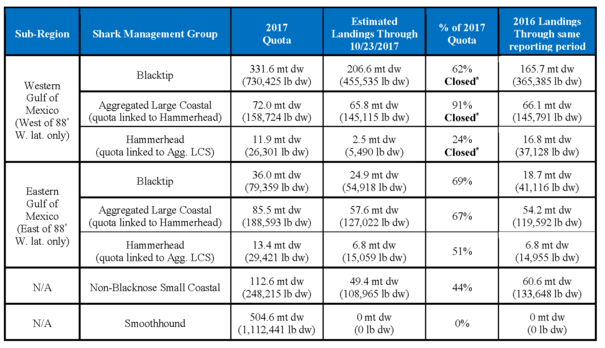
 

Shark Landings Update Through October 23, 2017

October 27, 2017 — The following was released by NOAA Fisheries:

The following are preliminary landings estimates in metric tons (mt) and pounds (lb) dressed weight (dw) for the Atlantic shark commercial fisheries; 1 mt is equal to 2,204.6 pounds.  These preliminary estimates are based on dealer reports and other information received from January 1 through October 23, 2017.  The estimates include landings by state-only permitted vessels, federally permitted vessels, and the 2017 shark research fishery participants.  We provide percentages of landings instead of estimated landings where needed to continue ensuring participant confidentiality.  The fishing seasons for all shark management groups opened on January 1, 2017, except for the aggregated LCS, blacktip shark, and hammerhead shark management groups in the western Gulf of Mexico sub-region which opened on February 1, 2017.

Gulf of Mexico Region

  • Includes any landings south and west 25° 20.4’ N. long.
  • As of 10/23/2017, the retention limit for directed permit holders is 45 large coastal sharks other than sandbar sharks per vessel per trip in the eastern Gulf of Mexico sub-region and no retention of large coastal sharks in the western Gulf of Mexico sub-region*.
  • The retention limit for directed permit holders can change throughout the season.

GOM

* Fishery closed at 11:30 p.m. local time on May 2, 2017 (82 FR 20447).

NMFS will announce closures of management groups when landings reach or are projected to reach 80 percent of the quota.  Management groups that are quota linked close when landings of either of the linked management groups reach or are projected to reach 80 percent of the quota.

For the full list of shark landings by region visit NOAA Fisheries

Atlantic Highly Migratory Species Advisory Panel Meeting September 7-8, 2016

August 4, 2016 — The following was released by NOAA:

The National Marine Fisheries Service (NMFS) intends to hold a meeting of the Atlantic Highly Migratory Species (HMS) Advisory Panel (AP) on September 7-8, 2016, at the Sheraton Silver Spring Hotel, 8777 Georgia Avenue, Silver Spring, MD 20910.  The AP meeting and webinar will be held from 9 a.m. to 6 p.m. on both Wednesday and Thursday, September 7 and September 8, 2016.

On Wednesday, September 7, 2016, the conference call information is phone number 1-888-469-2188; Participant Code: 7954019; and the webinar event address is: https://noaaevents2.webex.com/noaaevents2/onstage/g.php?MTID=eec1bb32466dd8905125c5db01b539623; event password: NOAA.

On Thursday, September 8, 2016, the conference call information is phone number 1-888-469-2188; Participant Code: 7954019; and the webinar event address is:  https://noaaevents2.webex.com/noaaevents2/onstage/g.php?MTID=e9fcef19f3c43ce6255dfad07807a71f4 ; event password: NOAA.

Participants are strongly encouraged to log/dial in 15 minutes prior to the meeting.  NMFS will show the presentations via webinar and allow public comment during identified times on the agenda.

The intent of this meeting is to consider alternatives for the conservation and management of all Atlantic tunas, swordfish, billfish, and shark fisheries.  We anticipate discussing the results of the 2016 dusky shark stock assessment and the Amendment 5b timeline; Draft Amendment 10 on Essential Fish Habitat, including potential Habitat Areas of Particular Concern; implementation updates for Final Amendment 7 on bluefin tuna management; and progress updates on various other rulemakings, including archival tag requirements, blacknose and small coastal shark management; domestic implementation of recommendations from the 2015 meeting of the International Commission for the Conservation of Atlantic Tunas; and potential changes to limited access vessel upgrading requirements and Individual Bluefin Quota program inseason transfer criteria.  We also anticipate discussing recreational topics regarding data collection and economic surveys, as well as progress updates regarding the exempted fishing permit request to conduct research in pelagic longline closed areas.  Finally, we also intend to invite other NMFS offices to provide updates on their activities relevant to HMS fisheries.

Recent Headlines

  • Scientists did not recommend a 54 percent cut to the menhaden TAC
  • Broad coalition promotes Senate aquaculture bill
  • Chesapeake Bay region leaders approve revised agreement, commit to cleanup through 2040
  • ALASKA: Contamination safeguards of transboundary mining questioned
  • Federal government decides it won’t list American eel as species at risk
  • US Congress holds hearing on sea lion removals and salmon predation
  • MASSACHUSETTS: Seventeen months on, Vineyard Wind blade break investigation isn’t done
  • Sea lions keep gorging on endangered salmon despite 2018 law

Most Popular Topics

Alaska Aquaculture ASMFC Atlantic States Marine Fisheries Commission BOEM California China Climate change Coronavirus COVID-19 Donald Trump groundfish Gulf of Maine Gulf of Mexico Illegal fishing IUU fishing Lobster Maine Massachusetts Mid-Atlantic National Marine Fisheries Service National Oceanic and Atmospheric Administration NEFMC New Bedford New England New England Fishery Management Council New Jersey New York NMFS NOAA NOAA Fisheries North Atlantic right whales North Carolina North Pacific offshore energy Offshore wind Pacific right whales Salmon South Atlantic Virginia Western Pacific Whales wind energy Wind Farms

Daily Updates & Alerts

Enter your email address to receive daily updates and alerts:
  • This field is for validation purposes and should be left unchanged.
Tweets by @savingseafood

Copyright © 2025 Saving Seafood · WordPress Web Design by Jessee Productions