Saving Seafood

  • Home
  • News
    • Alerts
    • Conservation & Environment
    • Council Actions
    • Economic Impact
    • Enforcement
    • International & Trade
    • Law
    • Management & Regulation
    • Regulations
    • Nutrition
    • Opinion
    • Other News
    • Safety
    • Science
    • State and Local
  • News by Region
    • New England
    • Mid-Atlantic
    • South Atlantic
    • Gulf of Mexico
    • Pacific
    • North Pacific
    • Western Pacific
  • About
    • Contact Us
    • Fishing Terms Glossary

Mid-Atlantic Council to Hold Hearings on New Jersey Special Management Zones

October 31, 2016 — The following was released by the Mid-Atlantic Fishery Management Council:

The Mid-Atlantic Fishery Management Council will hold three public hearings in November 2016 to gather public comments on a request by the State of New Jersey to designate 13 of its artificial reef sites located in federal waters as Special Management Zones (SMZ). The hearings will be held November 15-17, 2016. Written comments will be accepted until Friday, November 25, 2016, 11:59 p.m. EST.

Background

In November 2015, the New Jersey Department of Environmental Protection (DEP) petitioned the Mid-Atlantic Council to designate 13 artificial reef sites as SMZs under provisions of Amendment 9 to the Summer Flounder, Scup and Black Sea Bass Fishery Management Plan. The petition was based on the need to reduce gear conflicts between hook and line fishermen and fixed pot/trap gear at those sites. The SMZ designation could prohibit the use of any gear except hook and line and spear fishing (including the taking of fish by hand) within the 13 potential SMZ sites. The Council’s SMZ Monitoring Team (MT) evaluated the NJDEP request and recommended that the Council designate all 13 artificial reef sites as SMZs. The MT analysis indicated that commercial fishing vessels deploying pot/trap gear off the coast of New Jersey would likely face minimal to no losses in ex-vessel revenue if the artificial reefs are designated as SMZs. The Council is scheduled to review public comments and make a decision relative to NJ SMZ designation at its December 2016 meeting in Annapolis, MD.

Public Hearing Schedule

The dates and locations of the public hearings are as follows:

  • Tuesday November 15, 2016, 7:00-9:30 p.m., Kingsborough Community College, 2001 Oriental Blvd., Brooklyn NY 11235, Room M239 of the Marina and Academic Center (The Lighthouse).
  • Wednesday November 16, 2016, 7:00-10:00 p.m., Clarion Hotel & Conference Center, 815 Route 37 West, Toms River, NJ 08755.
  • Thursday November 17, 2016, 7:00-10:00 p.m., Congress Hall, 200 Congress Place, Cape May, NJ 08204.

These meetings are physically accessible to people with disabilities. Requests for sign language interpretation or other auxiliary aid should be directed to M. Jan Saunders, 302-526-5251, at least 5 days prior to the meeting date.

Written Comments

Written comments will be accepted until Friday, November 25, 2016, 11:59 p.m. and may be sent by any of the following methods:

  • Mail to Dr. Chris Moore, Executive Director, Mid-Atlantic Fishery Management Council, 800 North State Street, Suite 201, Dover, DE, 19901 (include “NJ SMZ Request” on envelope);
  • Fax to Dr. Chris Moore, Executive Director, Mid-Atlantic Fishery Management Council at fax number 302-674-5399 (include “NJ SMZ Request” in the subject line); or
  • Email to Rich Seagraves at rseagraves@mafmc.org (include “NJ SMZ Request” in the subject line).

Contact

For more information, contact Rich Seagraves, Senior Scientist, at rseagraves@mafmc.org.


ASMFC Summer Flounder Board Initiates Draft Addendum for Alternative Management Options for 2017 Recreational Fishery

October 27, 2016 — The following was released by the Atlantic States Marine Fisheries Commission:

BAR HARBOR, Maine — The Atlantic States Marine Fisheries Commission’s Summer Flounder, Scup and Black Sea Bass Management Board initiated development of Draft Addendum XXVIII to the Summer Flounder Fishery Management Plan (FMP) to consider alternative management approaches, including regional options, for the 2017 recreational summer flounder fishery. The Draft Addendum will have options which are designed to achieve the 2017 recreational harvest limit (RHL).

Changes in summer flounder distribution, abundance and availability created problems under the static state-by-state allocations, with overages often occurring. In response, states would implement regulations to reduce harvest, resulting in differing regulations between neighboring states. In 2014, the Board shifted away from traditional state-by-state allocations to a regional approach for managing summer flounder recreational fisheries.  A benefit of the regional approach is it provides the states the flexibility to temporarily share allocations. The intent is to set regulations that account for shifting distribution, abundance and availability while providing stability and greater regulatory consistency among neighboring states as well as individual states in achieving but not exceeding the coastwide RHL.

In August, the Board and Mid-Atlantic Fishery Management Council (Council) approved a 30% reduction in the 2017 coastwide RHL relative to 2016. This was in response the 2016 Stock Assessment Update which found fishing mortality was higher in recent years and population estimates were lower than previously projected.
The Draft Addendum will be presented to the Board for its consideration and approval for public comment at its joint meeting with the Council in December in Baltimore, Maryland. At that meeting, the Board and Council will also consider extending ad-hoc regional approaches for 2017 black sea bass and scup recreational management in state waters. The Board and Council are scheduled to review the Black Sea Bass Stock Assessment Report and Peer Review Report and consider possible management responses at their joint meeting in February 2017 in Kitty Hawk, North Carolina.

Above the waves, Connecticut fishermen struggle to hang on

August 30, 2016 — STONINGTON, Conn. — Gambardella Wholesale Fish on the docks here is all but empty on an early afternoon, eerily quiet save for the rhythmic clack, clack of cardboard boxes being stapled together.

“We used to start at seven in the morning,” said Mike Gambardella, whose grandfather started the family’s original fish market more than a century ago. “And when we used to have the whiting boats coming in here, sometimes we wouldn’t get out of here ‘til two o’clock in the morning. Now if I open one day a week, I’ll be happy.”

The problem isn’t the fish. There are plenty of fish – but they’re the wrong fish.

Warming water and other shifting ocean conditions, probably caused by climate change and its cascading impact on the entire marine ecosystem, have pushed the longtime mainstays of Connecticut fishing, like winter flounder and most notably lobster, north to deeper and colder waters.

In their places are species that had been more common further south, also moving north in search of more hospitable conditions. But the way the fish management and quota systems work on the East Coast, fishermen in New England can’t catch many of those fish.

Instead, trawlers from North Carolina are traveling all the way to the ocean waters in Connecticut’s backyard and catching what used to be off their own coast – summer flounder, scup and the very valuable black sea bass – while Connecticut fishermen can only watch; throwback tons of fish – most of which will die; or risk a costly, difficult and long trip to where the fish they are allowed to catch in larger numbers are now.

The situation has resulted in an emotional dispute over how the U.S. fishing system operates, with Connecticut fishermen and politicians calling, if not downright begging, for immediate changes to fish allocations to save the state’s fishing industry from what many believe is its inevitable ruin. But others in the scientific and environmental communities are saying – maybe not so fast.

Read the full story at the Connecticut Mirror

Mid-Atlantic Council and ASMFC Maintain Multi-Year Specifications for Black Sea Bass, Bluefish, and Scup and Modify Summer Flounder Specifications

August 15, 2016 — The following was released by NOAA:

Virginia Beach, VA – Last week the Mid-Atlantic Fishery Management Council (Council) and the Atlantic States Marine Fisheries Commission (Commission) reviewed previously implemented specifications for scup, black sea bass and bluefish fisheries and modified specifications for summer flounder. The Commission’s actions are final and apply to state waters. The Council will forward its federal waters recommendations regarding summer flounder specifications to NOAA Fisheries Greater Atlantic Regional Fisheries Administrator for final approval.

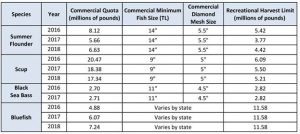
The table below summarizes commercial quotas and recreational harvest limits for summer flounder, scup, black sea bass, and bluefish (2016 values are provided for comparison purposes). Please note specifications for years 2017 and beyond may be adjusted based on changes in the fishery or new scientific information.

image003

For summer flounder, both groups approved a commercial quota of 5.66 million pounds and a recreational harvest limit of 3.77 million pounds for 2017, an approximate 30% decrease from 2016. This decrease in catch and landings limits responds to the findings of the 2016 stock assessment update, which indicates summer flounder has been experiencing overfishing since 2008. In 2015, fishing mortality exceeded its threshold by 26% (i.e., the level beyond which overfishing is occurring). The 2015 estimate of spawning stock biomass (SSB) is at 58% of the biomass target, and only 16% above the threshold. If the stock were to fall below the threshold, it would be considered overfished, requiring the development of a rebuilding plan to reduce fishing mortality and rebuild stock biomass. These results appear to be driven largely by below-average recruitment, an underestimation of the fishing mortality level in the last years of the assessment, and declining biomass indices. The assessment update indicates the stock experienced six below-average year classes from 2010 to 2015. Additionally, indices of abundance from state and federal surveys have indicated declines in abundance ranging from 9 to 97% from their most recent peaks (generally 2009 to 2012). The 2016 assessment update estimated biomass has been trending down since 2010. Summer flounder harvest limits for 2018 may be adjusted in the future based on changes in the fishery or new scientific information.

Scup and Black Sea Bass

For scup and black sea bass, the Commission and Council maintained the previously implemented multi-year specifications set in August and October 2015, respectively. The decline in harvest limits for scup since 2016 is due to a decrease in SSB as projected by the 2015 benchmark stock assessment.

For black sea bass, 2017 harvest limits remain unchanged relative to 2016 levels (in 2016, there was a reduction in the commercial quota due to overages in the previous year). Both the commercial quota and recreational harvest limit may be changed pending the results of next benchmark stock assessment, scheduled for peer review through the Northeast Regional Stock Assessment Workshop/Stock Assessment Review Committee in late 2016. The Commission and Council will consider the results of the benchmark stock assessment in early 2017.

Bluefish

For the bluefish fishery, the final 2016 commercial quota is 4.88 million pounds and the recreational harvest limit is 11.58 million pounds. The final 2016 harvest limits include a 1.58 million pound transfer from the recreational sector to the commercial sector. The Commission and Council did not make any changes to the 2017 and 2018 specifications. The 2017 and 2018 commercial quotas and recreational harvest limits are preliminary and will likely change following release of 2016 and 2017 final Marine Recreational Information Program harvest estimates. These estimates can impact how much is transferred from the recreational sector to the commercial sector.

NEW YORK: Why Are Less-Likely Species Appearing in Long Island Sound?

July 29, 2016 — What makes any species on Earth seek greener horizons? A disaster. Lack of food or water. An unsuitable change in habitat. With people, it’s sometimes the drive to merely explore. With wildlife, though, it usually boils down to survival.

Every day, there is a change occurring somewhere on this planet. It might be imperceptible to the naked eye or it might be as obvious as an earthquake or a volcano. When a change does takes place, there isn’t just one occurrence, but rather, an accompanying domino effect. The effects might be felt instantly or they may take centuries to get noticed.

We’ve seen Long Island Sound and its tributaries fall from a rich, prolific waterway to the compromised body of water left in the wake of the early industrial era. From that, we’ve learned a valuable lesson and today we see the results of a Herculean restoration effort. Many of our fisheries that had been reduced by cataclysmic proportions have rebounded or are in the process of rebounding. Some, like our river herring, are still struggling.

Very often, some sort of over-fishing is the culprit. In some cases, a die-off can be attributed to reducing a stock. For the most part, what we are seeing along the Atlantic coast and in the Sound is a change in water temperature. As a result, the Sound is attracting more food, such as schools of menhaden, squid, butterfish, spearing, and shrimp. That increase in forage, coupled with higher water temperatures, brings in more southern and mid-Atlantic species of fish, as well as northern migrants that now take a detour into the Big Pond as they perhaps once did in the past.

Read the full story at zip06.com

August 2016 Mid Atlantic Fishery Management Council Meeting Agenda​

July 20, 2016 — The Mid Atlantic Fishery Managment Council released the agenda for their August 2016 Council meeting today. The meeting will take place from August 8-August 11 in Virginia Beach, Virginia.

See the agenda for the meeting here

Summary of ASMFC Summer Flounder, Scup, and Black Sea Bass & Bluefish Management Boards

July 7, 2016 — The following was released by the Atlantic States Marine Fisheries Commission:

The Commission’s Summer Flounder, Scup and Black Sea Bass and Bluefish Management Boards met via conference call to review the latest recreational harvest estimates from the Marine Recreational Information Program. Most notably for both bluefish and black sea bass, the final 2015 recreational harvest estimates were uncharacteristically larger than the preliminary estimates. Based on this information, the Board discussed the need to change state recreational measures for the 2016 fishing season. While no management action was taken for bluefish since the 2016 annual catch limit had not been exceeded, the Board briefly discussed the possibility of transferring unused recreational quota to the commercial fishery (as allowed under the FMP). However, based on final 2015 bluefish harvest estimates, NOAA Fisheries anticipates the 2016 recreational quota will be fully utilized, prohibiting any transfer to the commercial sector. NOAA Fisheries will be releasing a final rule on 2016 bluefish fishery later this month. The Board and Mid‐Atlantic Fishery Management Council will discuss the final rule at their joint meeting in August.

Taking several factors into consideration, the Board chose to not take any management action for the recreational black sea bass fishery. Its decision was based on (1) the validity of the harvest estimates given the significant change from preliminary to final numbers; (2) concern about changing recently promulgated state regulations; (3) concern regarding socioeconomic impacts to the for‐hire industry; (4) difficultly in enforcing mid‐season regulatory adjustments; and (5) the potential for increases in discard mortality under more restrictive measures. The Board discussed a number of ways NOAA Fisheries could improve the annual specification process for these species. These include providing a more timely delivery of final recreational harvest numbers from the previous season, which would allow the states to more precisely tailor their regulations; incorporating vessel trip reports in its preliminary harvest estimates; and seeking ways to increase sample sizes in the for‐hire fishery to more accurately represent catch and effort in this sector.

See the full summary at the ASMFC

ASMFC To Review Harvest Estimates

July 1, 2016 — The following was released by the Atlantic States Marine Fisheries Commission:

The Atlantic States Marine Fisheries Commission’s Summer Flounder, Scup and Black Sea Bass and Bluefish Management Boards will meet via conference call on Wednesday, July 6 at 10:00 a.m. to review the latest recreational harvest estimates from the Marine Recreational Information Program. These data indicate that preliminary estimates of 2015 recreational harvest were underestimated for both bluefish and black sea bass. While the uptick in harvest will have no impact to 2016 bluefish recreational management measures since the annual catch limit was not exceeded, it will likely have implications for 2016 black sea bass recreational management measures. On the conference call, the Summer Flounder, Scup, and Black Sea Bass Management Board will consider possible changes to state regulations for 2016.

The public is welcome to listen in on the discussion by phone (888.394.8197; passcode 815277) and view the WEBINAR. The meeting agenda is posted to the Commission website. Meeting materials will be posted shortly. Time permitting, there will be a limited opportunity to provide comments at the end of the agenda. The Board Chair will provide additional information on the procedures for accepting public comment at the beginning of the conference call. We ask the public and other nonparticipating attendees to please mute their phones in order to minimize distractions to the Board’s deliberations.

Read the release at The Fisherman

SUSAN POLLACK: Fishing For Progress: Saying No To ‘No Women On Board’

June 10, 2016 — In 1982, as supporters of the Equal Rights Amendment fought claims that that the proposed amendment to the Constitution would destroy the American family, I confronted an older mythology: Women are bad luck on boats.

I was a young maritime reporter for The East Hampton Star on Eastern Long Island. I loved boats and the sea, and I’d always loved adventure. That summer, I planned to join local fishermen aboard a state-of-the-art Japanese squid ship. This was several years after the United States enacted its 200-mile limit, but before American fishermen had fully developed a squid fishery of their own. In exchange for sharing their technical know-how, the Japanese would be permitted to catch squid in our waters.

I was game.

But as I was readying my boots and gear, I received an unexpected warning from the American sponsors of the U.S-Japan venture: no women on board.

Surely, something must be wrong: I’d spent the previous five years in gurry-soaked oil skins reporting on life at sea on American draggers, lobster boats, bay scallopers, gillnetters, long-liners and clamming rigs. I’d photographed the sun rising over the stern of a dragger hauling its catch of yellowtail and blackback flounders, cod, haddock and scup. I’d spent bone-chilling winter days in an open skiff, culling bay scallops – separating the delicate fan-shaped bivalves from whelks, rocks and seaweed. I’d danced on the boat, not for joy, but to keep warm.

On summer evenings, I’d helped my neighbor lift his gillnets, gingerly plucking out sharp-toothed bluefish and the occasional striper. And I’d finally succeeded in filleting a flounder without mangling the fragile flesh.

Read the full story at WBUR

ASMFC Summer Flounder, Scup, and Black Sea Bass and Bluefish Management Boards to Meet Via Conference Call to Review Recent Recreational Harvest Estimates

June 24, 2016 — The following was released by the Atlantic States Marine Fisheries Commission:

ARLINGTON, Va. — The Atlantic States Marine Fisheries Commission’s Summer Flounder, Scup and Black Sea Bass and Bluefish Management Boards will meet via conference call on Wednesday, July 6 at 10:00 a.m. to review the latest recreational harvest estimates from the Marine Recreational Information Program. These data indicate that preliminary estimates of 2015 recreational harvest were underestimated for both bluefish and black sea bass.  While the uptick in harvest will have no impact to 2016 bluefish recreational management measures since the annual catch limit was not exceeded, it will likely have implications for 2016 black sea bass recreational management measures. On the conference call, the Summer Flounder, Scup, and Black Sea Bass Management Board will consider possible changes to state regulations for 2016.

The public is welcome to listen in on the discussion by phone (888.394.8197; passcode 815277) and view the webinar using this link. The meeting agenda is posted to the Commission website here.  Meeting materials will be posted next week. Time permitting, there will be a limited opportunity to provide comments at the end of the agenda. The Board Chair will provide additional information on the procedures for accepting public comment at the beginning of the conference call. We ask the public and other nonparticipating attendees to please mute their phones in order to minimize distractions to the Board’s deliberations.

  • « Previous Page
  • 1
  • …
  • 10
  • 11
  • 12
  • 13
  • 14
  • Next Page »

Recent Headlines

  • Scientists did not recommend a 54 percent cut to the menhaden TAC
  • Broad coalition promotes Senate aquaculture bill
  • Chesapeake Bay region leaders approve revised agreement, commit to cleanup through 2040
  • ALASKA: Contamination safeguards of transboundary mining questioned
  • Federal government decides it won’t list American eel as species at risk
  • US Congress holds hearing on sea lion removals and salmon predation
  • MASSACHUSETTS: Seventeen months on, Vineyard Wind blade break investigation isn’t done
  • Sea lions keep gorging on endangered salmon despite 2018 law

Most Popular Topics

Alaska Aquaculture ASMFC Atlantic States Marine Fisheries Commission BOEM California China Climate change Coronavirus COVID-19 Donald Trump groundfish Gulf of Maine Gulf of Mexico Illegal fishing IUU fishing Lobster Maine Massachusetts Mid-Atlantic National Marine Fisheries Service National Oceanic and Atmospheric Administration NEFMC New Bedford New England New England Fishery Management Council New Jersey New York NMFS NOAA NOAA Fisheries North Atlantic right whales North Carolina North Pacific offshore energy Offshore wind Pacific right whales Salmon South Atlantic Virginia Western Pacific Whales wind energy Wind Farms

Daily Updates & Alerts

Enter your email address to receive daily updates and alerts:
  • This field is for validation purposes and should be left unchanged.
Tweets by @savingseafood

Copyright © 2025 Saving Seafood · WordPress Web Design by Jessee Productions