Saving Seafood

  • Home
  • News
    • Alerts
    • Conservation & Environment
    • Council Actions
    • Economic Impact
    • Enforcement
    • International & Trade
    • Law
    • Management & Regulation
    • Regulations
    • Nutrition
    • Opinion
    • Other News
    • Safety
    • Science
    • State and Local
  • News by Region
    • New England
    • Mid-Atlantic
    • South Atlantic
    • Gulf of Mexico
    • Pacific
    • North Pacific
    • Western Pacific
  • About
    • Contact Us
    • Fishing Terms Glossary

NOAA Fisheries Implements Adjustments to the Mid-Atlantic Fishery Management Council’s Risk Policy

December 14, 2020 — The following was released by NOAA Fisheries:

NOAA Fisheries is implementing a final rule that adjusts the Mid-Atlantic Fishery Management Council’s risk policy. This action modifies the Council’s risk policy by accepting a higher level of risk for stocks that are at or above biomass targets, resulting in the ability for the Council to set higher catch limits for healthy fisheries. This action also removes the typical/atypical species designation when applied to the current risk policy allowing the Council to better use improvements in stock assessment and modeling approaches that can more appropriately account for and address overfishing vulnerability.

For more details, please read the rule as filed in the Federal Register and our bulletin. This rule is effective on December 15, 2020.

Read the full release here

Reminder: Web Page for Fishermen Resources Available

December 14, 2020 — The following was released by NOAA Fisheries:

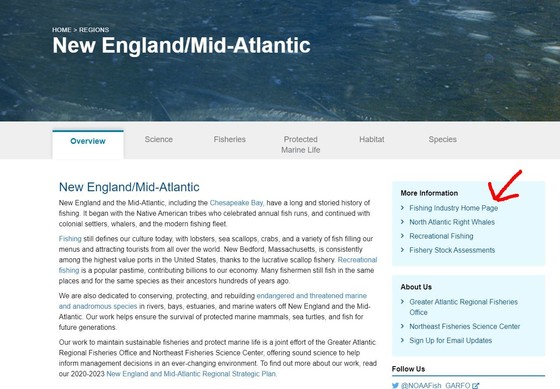
Visit our web page Resources for Fishing in the Greater Atlantic  for information on how to comment on recent rules, apply for permits, complete your reporting requirements and much more!

Bookmark this page for easy access or find it by navigating from our home page and clicking on the Fishing Industry Home Page.

image

Let us know if you have suggestions of other links you’d like to see included on this resource page for easy access.

Questions/Comments?

Contact Jennifer Goebel, Regional Office, 978-281-9175

At-sea monitoring coming to herring fishery in April

December 14, 2020 — The federal government plans to require herring fishing boats to participate in industry-funded monitoring starting in April.

At-sea monitoring programs allow the government to collect important data that helps manage fisheries. The National Oceanic and Atmospheric Administration said it intends to begin selecting vessels in the herring fishery for monitoring coverage on April 1.

NOAA said the plan could be altered by health mandates or travel restrictions related to the coronavirus pandemic. The agency said in a statement that some herring boats have the option of seeking an exempted permit to use electronic monitoring instead of at-sea monitoring.

Read the full story from the Associated Press at the Gloucester Daily Times

NORTH CAROLINA: Bluefin tuna season off to a good start in Carteret County

December 14, 2020 — As winter weather sets in, the season for Atlantic bluefin tuna has arrived along the North Carolina coast, and the early season has been good so far for at least two Carteret County charter businesses.

Bluefin tuna are a commercially valuable and highly sought-after fish, with individual fish selling for thousands of dollars on the international market. The fish are managed by the International Commission for the Conservation of Atlantic Tunas in two stocks, the eastern stock and the western stock, though the two often intermingle. In the U.S., according to the National Oceanic and Atmospheric Administration’s National Marine Fisheries Service, the baseline annual quota for bluefin tuna is 1,247.86 metric tons; this quota is further divided into sub quotas based on types of gear. The general category, which covers commercial handgear, has a sub quota of 555.7 metric tons.

Bluefin tuna traditionally show up on the North Carolina coast in December through early winter, and according Fish Whistle Fishing Charters of Morehead City’s Capt. Mike Ajamian, as of Tuesday he’s caught four.

Read the full story at the Carteret County News-Times

NOAA Fisheries Implements Amendment 21 to the Summer Flounder, Scup and Black Sea Bass Fishery Management Plan

December 11, 2020 — The following was released by NOAA Fisheries:

Effective January 1, 2021

NOAA Fisheries is implementing Amendment 21 to the Summer Flounder, Scup, and Black Sea Bass Fishery Management Plan, also known as the Summer Flounder Commercial Issues Amendment. This final rule implements the measures in the amendment.

Amendment 21 changes the state-by-state commercial quota allocations when the coastwide quota exceeds 9.55 million lb, and updates the fishery management plan goals and objectives for summer flounder. When the coastwide quota is 9.55 million lb or less, the quota would be distributed according to the current allocations. In years when the coastwide quota exceeds 9.55 million lb, any additional quota beyond this threshold would be distributed in equal shares to all states except Maine, Delaware, and New Hampshire, which would split 1 percent of the additional quota.

Read the full release here

NMFS announces snowy grouper commercial harvest closing Dec. 12

December 11, 2020 — Local commercial fishermen have until Saturday to harvest snowy grouper.

The National Oceanic and Atmospheric Administration’s National Marine Fisheries Service announced Monday the commercial harvest of snowy grouper in federal waters of the South Atlantic, including those waters off North Carolina, will close at 12:01 a.m. Saturday. During the closure, all sale or purchase of snow grouper is prohibited. Harvest or possession of snowy group in or from federal waters is limited to the recreational bag and possession limits while the recreational sector is open.

The closure is happening because commercial landings are projected to reach the increased July through December commercial catch limit. According to the accountability measure, commercial harvest must close to prevent the catch limit from being exceeded.

Read the full story at the Carteret County News-Times

Whales get a break as pandemic creates quieter oceans

December 10, 2020 — When humpback whales migrated to Glacier Bay in Alaska this year to spend the long summer days feeding, they arrived to something unusual: quieter waters.

As the COVID-19 pandemic slows international shipping and keeps cruise ships docked, scientists are finding measurably less noise in the ocean. That could provide momentary relief for whales and other marine mammals that are highly sensitive to noise.

Through networks of underwater hydrophones, scientists are hoping to learn how the mammals’ communication changes when the drone of ships is turned down, potentially informing new policies to protect them.

“More needs to be done,” says Jason Gedamke, who manages the ocean acoustics program at NOAA Fisheries. “When you have animals that for millions of years have been able to communicate over vast distances in the ocean, and then once we introduce noise and have increased sound levels and they can’t communicate over those distances, clearly there’s going to be some impact there.”

Read the full story at OPB

WA submits draft plan to distribute $50 million in federal relief funding to commercial fishing, shellfish and charter industry members

December 10, 2020 — The state announced this week that it has submitted a draft plan for how to distribute $50 million in federal relief funding to members of Washington’s commercial seafood, shellfish and charter industries to the National Oceanic and Atmospheric Administration-Fisheries (NOAA-Fisheries) for review and approval.

Under Section 12005 of the CARES Act, Congress provided $300 million to states to distribute to fisheries participants with Washington and Alaska receiving the highest allocation of $50 million each.

“The pandemic had early and dramatic impacts to shellfish and commercial fishing businesses. These activities play an outsized role in our state, especially in our tribal and natural resources dependent economies,” Gov. Jay Inslee said. “I am pleased that we will soon have more assistance available to help these hurting businesses recover.”

“Submitting this plan for federal review brings us one step closer to getting this funding into the hands of commercial fishing and shellfish industry members who need it most,” said Ron Warren, Washington Department of Fish and Wildlife (WDFW) fish policy director. “We applaud Washington’s congressional delegation for securing this relief for members of Washington’s commercial seafood, shellfish and charter industries.”

Read the full story at KBKW

Extended: Slow Speed Zone Southeast of New York City to Protect Right Whales

December 9, 2020 — The following was released by NOAA Fisheries:

NOAA Fisheries is extending a Slow Zone (voluntary vessel speed restriction zone) southeast of New York City, New York.

This Slow Zone was in already in effect when the Woods Hole Oceanographic Institute acoustic monitoring buoy again detected right whales in the New York Bight on December 9.

Mariners, please go around this area or go slow (10 knots or less) inside this area where right whales have been detected.

The New York Bight Slow Zone is in effect through December 24 for waters bounded by:

40 41 N
40 01 N
073 03 W
073 55 W

See the coordinates for all the slow zones currently in effect.

Read the full release here

New Tool Available to Explore Effects of Offshore Wind on Fisheries

December 8, 2020 — The following was released by NOAA Fisheries:

Factors to Consider

In a busy ocean, finding the right spot for offshore wind farms isn’t easy. There are a lot of factors to consider besides the windiest spots.

  • What marine life is in the proposed areas?
  • Is the area a productive scallop ground or other important fishing spot?
  • Do endangered whales or sea turtles rely on this area for food or migration?
  • Will fishermen and other vessel traffic be able to navigate safely?

Currently, there are more than 16 offshore wind energy areas in various stages of planning and development from Maine through North Carolina. These projects may install more than 2,100 turbines from 2021–2029.

New Online Tools

To help better understand the impacts offshore wind development will have on Atlantic coast fisheries, we developed some new tools and analyses.

Some of the information you can find for the currently proposed offshore wind energy areas includes:

  • Amount of individual species landed
  • Landings revenue
  • Gear types used
  • Number of vessels fishing
  • Number of fishing trips
  • Communities affected

To gather this information, we combined vessel logbooks, dealer reports, and observer data to come up with fishing footprints. We then compared them to the proposed offshore wind energy project areas.

The Bureau of Ocean Energy Management is the federal agency responsible for reviewing and permitting offshore energy projects. It has used this information in its analysis of the Vineyard Wind Project.

Anyone can download the data and generate summary reports using our query tool.

We will further develop these tools based on public input and ongoing efforts to integrate other data sources.Both the summary reports and underlying data will be continuously updated as we obtain this additional information. We are currently working on integrating party/charter vessel logbook data and data from vessels that fish for highly migratory species and for species managed in the South Atlantic. Learn more about the work we’re doing to monitor and analyze the potential fishery impacts from offshore wind development.

Questions?

Fisheries Data: Benjamin Galuardi, Regional Office, (978) 281-9187

Offshore Wind and Fisheries: Doug Christel, Regional Office, (978) 281-9141

  • « Previous Page
  • 1
  • …
  • 68
  • 69
  • 70
  • 71
  • 72
  • …
  • 259
  • Next Page »

Recent Headlines

  • US Supreme Court rejects Alaska’s petition to overturn federal authority over subsistence fishing
  • ALASKA: Bycatch Reduction and Research Act introduced in AK
  • The oxygen you breathe depends on a tiny ocean ingredient
  • Trump cites national security risk to defend wind freeze in court
  • ‘Specific’ Revolution Wind national security risks remain classified in court documents
  • New York attorney general sues Trump administration over offshore wind project freeze
  • ALASKA: New bycatch reduction, research act introduced in Congress
  • Largest-ever Northeast Aquaculture Conference reflection of industry’s growth

Most Popular Topics

Alaska Aquaculture ASMFC Atlantic States Marine Fisheries Commission BOEM California China Climate change Coronavirus COVID-19 Donald Trump groundfish Gulf of Maine Gulf of Mexico Illegal fishing IUU fishing Lobster Maine Massachusetts Mid-Atlantic National Marine Fisheries Service National Oceanic and Atmospheric Administration NEFMC New Bedford New England New England Fishery Management Council New Jersey New York NMFS NOAA NOAA Fisheries North Atlantic right whales North Carolina North Pacific offshore energy Offshore wind Pacific right whales Salmon South Atlantic Virginia Western Pacific Whales wind energy Wind Farms

Daily Updates & Alerts

Enter your email address to receive daily updates and alerts:
  • This field is for validation purposes and should be left unchanged.
Tweets by @savingseafood

Copyright © 2026 Saving Seafood · WordPress Web Design by Jessee Productions