Saving Seafood

  • Home
  • News
    • Alerts
    • Conservation & Environment
    • Council Actions
    • Economic Impact
    • Enforcement
    • International & Trade
    • Law
    • Management & Regulation
    • Regulations
    • Nutrition
    • Opinion
    • Other News
    • Safety
    • Science
    • State and Local
  • News by Region
    • New England
    • Mid-Atlantic
    • South Atlantic
    • Gulf of Mexico
    • Pacific
    • North Pacific
    • Western Pacific
  • About
    • Contact Us
    • Fishing Terms Glossary

Michigan’s commercial fishermen sue DNR over license delays

January 15, 2021 — A lawsuit filed against the Michigan Department of Natural Resources claims the state is withholding reissue of all commercial fishing licenses and calling for gear restrictions that will put the industry out of business.

“The things that were not renewed have been in place for well over 40 years in most cases, and the only the things that are a benefit to commercial fishers are gone,” says Amber Mae Petersen, who runs the Fish Monger’s Wife seafood retail outlet in Muskegon and serves as secretary-treasurer for the Michigan Fish Producers’ Association, which filed the suit in early January. “The answers are conflicting as to why they were not renewed. It seems off.”
Read the full story at National Fisherman

Agency says US, Canada fall short on protecting Great Lakes

November 29, 2017 — TRAVERSE CITY, Mich. — Despite recent improvements, the U.S. and Canada have a long way to go toward ridding the Great Lakes of pollution that endangers human health and the environment, an advisory agency said Tuesday.

Inadequately treated sewage, industrial chemicals and farm runoff are still flowing into the five lakes that provide drinking water for about 40 million people, the International Joint Commission said in its first checkup report since both nations last updated the Great Lakes Water Quality Agreement in 2012.

The report calls for improving drinking water and sewage treatment facilities, and strengthening clean-water regulations, particularly limits on phosphorus runoff that is largely responsible for explosive growth of harmful algae in Lake Erie. Agencies also should work faster to identify newer types of contamination, such as fire retardant chemicals, and develop strategies for limiting them, the report says.

“While significant progress has been made to restore and protect the lakes, the governments of Canada and the United States and Great Lakes civil society as a whole are living with the costly consequences of past failures to anticipate and prevent environmental problems,” the report says. “By now, it should be clear that prevention makes environmental, economic and common sense.”

Read the full story from the Associated Press at the New Jersey Herald


Usually the villain, invasive species odd hero for native fish

April 6, 2017 — A native fish may be poised for a comeback in the Great Lakes with the help of an invasive species.

Great Lakes cisco, also known as lake herring, are growing in number. Catch rates are increasing in recreational and commercial fisheries, said Kevin Donner, Little Traverse Bay Bands of Odawa Indians’ Great Lakes fisheries program manager. Twenty years ago, it would have been notable to catch a single cisco in a year in Lake Michigan. In the bay, they’re now pulled up by the netload.

It’s a similar story in Chaumont Bay, Lake Ontario, where researchers have caught thousands of cisco in recent years, said Curt Karboski, a biologist with the Lower Great Lakes Fish and Wildlife Conservation Office in Amherst, New York.

There are different strains of cisco in the region, but Donner describes most of them, “like a whitefish with a shinier, pointed face.”

Cisco typically grow about 12 to 15 inches long and at one point supported one of the largest commercial fisheries in the region. They disappeared from much of the basin around the 1950s, Donner said.

Now it looks like the stage has been set for their return–by an unlikely ally.

Invasive quagga mussels have depleted nutrients in the lakes, said Matt Herbert, an aquatic ecologist with the Nature Conservancy. Cisco do well in low-nutrient environments, unlike competing species like the invasive alewife. That gives cisco space to thrive.

Wendylee Stott, who works with the Great Lakes Science Center in Ann Arbor, Michigan, makes a similar observation: “There’s basically a hole in the ecosystem right now, and the idea is to fill it with a native species.”

Now that the quagga has done its part, the cisco are on a roll. Other than accidentally introducing the invasive species, humans can’t take credit for the comeback, according to Donner.

Read the full story at the Great Lakes Echo

Consumption of Omega-3s and Health Consequences

January 27, 2017 — Research reports continue to show the importance of the long-chain omega-3 fatty acids, eicosapentaenoic acid (EPA) and docosahexaenoic acid (DHA) to heart health. The problem is that many people are in the low-intake range of both EPA and DHA and are at increased risk for many chronic diseases including heart disease. A recent meta-analysis points out the strength of the evidence concerning heart disease. A research group at the Department of Epidemiology of the EpidStat Institute in Ann Arbor, MI published their results in the Proceedings of the Mayo Clinic (1). They found that subgroup analyses of data from Randomized Controlled Clinical Trials (RCT) indicated a statistically significant Coronary Heart Disease (CHD) risk reduction with EPA plus DHA provision among higher-risk populations, including participants with elevated triglyceride levels. The summary relative risk estimate (SRRE) was 0.84 which indicates a 16 percent reduced risk. The reduced risk was 14 percent (SRRE=0.86) in those with elevated low-density lipoprotein cholesterol (LDL). Meta-analysis of data from prospective cohort studies resulted in a statistically significant SRRE of 0.82 for higher intakes of EPA plus DHA and risk of any CHD event.

The researchers concluded, “Our comprehensive meta-analysis of data from RCTs and prospective cohort studies supports this recommendation. Although not statistically significant, a 6% reduced risk of any CHD event was observed among RCTs, a finding supported by a statistically significant 18% reduced risk of CHD among the prospective cohort studies. From a clinical perspective, our results indicate that EPA+DHA may be associated with reducing CHD risk to a greater extent in populations with elevated triglyceride levels or LDL cholesterol, which are risk factors that impact a significant portion of the general adult population in the United States.”


.

In 2012, I had the honor and privilege of co-authoring “The Missing Wellness Factors – EPA and DHA” with Professor Jørn Dyerberg, M.D., DMSc., the discoverer of the vital health benefits of fish oil EPA and DHA (2). Dr. Jørn Dyerberg went on five expeditions to the remote Greenland Inuits in the Arctic Circle. As we stated in Chapter Six, “(T)he take-home message of this book is that adequate amounts of the omega-3s, eicosapentaenoic acid (EPA) and docosahexaenoic acid (DHA) are needed for optimal health. Unfortunately, through the past fifty years, the amounts of EPA and DHA have decreased considerably and at an ever-increasing pace.”

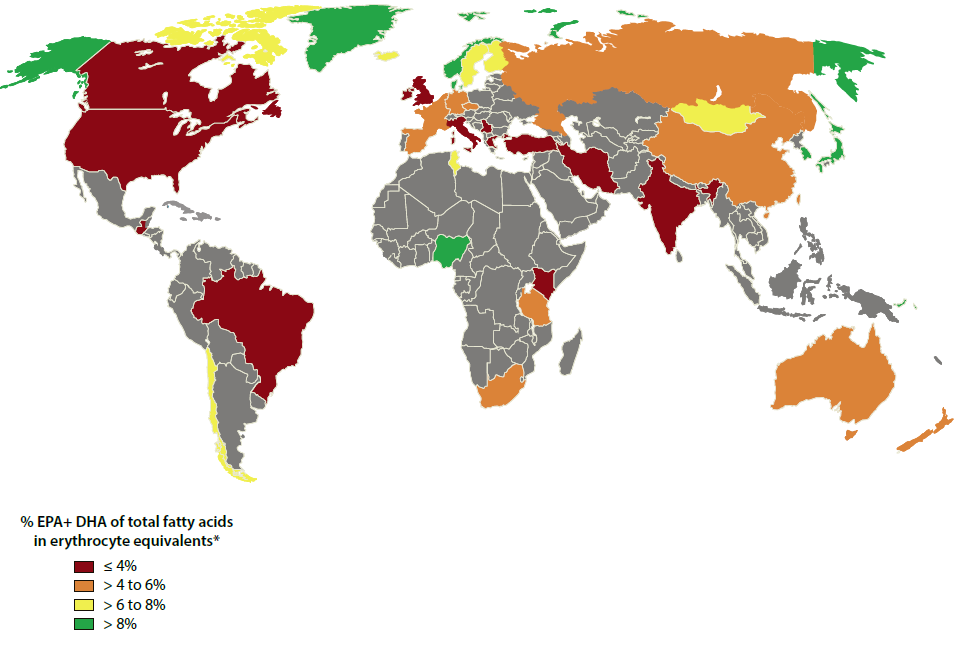
Last year, an interesting study confirmed that many people worldwide may not be getting optimal levels of the EPA and DHA (3). Professor Manfred Eggersdorfer, whom we have chatted with in this column before, was close to that study and is familiar with the study and its implications.

Read the full story at Whole Foods Magazine

Experts Urge Cautious Approach on Great Lakes Fish Farming

TRAVERSE CITY, Mich. — October 30, 2015 — If Michigan allows commercial fish farming in the Great Lakes, the industry should begin on a small and experimental scale to enable careful monitoring of the effect on the environment and wild fish populations, scientists said in a report to state officials.

The recommendation was among many in five reports submitted by a panel of scientists, economists and other experts appointed to advise regulators considering whether a process known as “net-pen aquaculture” would be suitable for Great Lakes waters within Michigan’s boundaries.

The state departments of Environmental Quality, Natural Resources and Agriculture and Rural Development requested the study and recently posted the reports online.

State officials say they’ve heard from two operators interested in raising rainbow trout in floating enclosures in Lake Michigan and Lake Huron. The fish would remain inside the large nets until big enough for the consumer food market. But no permit applications have been submitted.

Read the full story from The New York Times

Press Release: NOAA Fisheries Announces $3 Million to Restore Habitat in Great Lakes

September 17, 2015 — The following was released by NOAA:

NOAA Fisheries Announces $3 Million in Funding to Restore Habitat in Great Lakes

NOAA has selected three projects, through the Great Lakes Restoration Initiative (GLRI), totaling $3 million, to restore habitat in severely degraded areas of the Great Lakes

Funded projects are in Michigan and Ohio. They will benefit a variety of important local fish stock, including important spawning and nursery grounds for muskellunge, northern pike, pumpkinseed sunfish, largemouth bass, yellow perch, channel catfish, and bullhead. This funding builds on years of investment in the Great Lakes to restore waterways threatened by poor water quality, contaminated fish, and other environmental concerns. 

NOAA’s Restoration Center targets habitat conservation where it’s needed it most. We provide funding and technical guidance to restore coastal habitat nationwide. In the Great Lakes, we focus on restoring the most degraded environments–designated “Areas of Concern”–as well as reversing the environmental damages resulting from oil spills, and chemical releases.

“Great Lakes communities deserve a clean and healthy environment and these projects will help restore Great Lakes Areas of Concern,” said Pat Montanio, Director of NOAA’s Office of Habitat Conservation. “This work shows how the GLRI is making a difference for communities across the region.”

NOAA’s investment in the effort to restore aquatic habitat is part of a long-term effort to rebuild fisheries, many of which have declined from habitat loss, over-fishing and climate change. Recent successes show that restoring habitat is a way not only to stop the decline of fish populations, but also to regrow them to historic high numbers. 

Funded Projects: 

Maumee River Wetland Restoration at Penn 7 Project

Toledo, OH ($175,000 awarded to the City of Toledo)

Funding will support initial site characterization and feasibility study on the lower Maumee River to determine the restoration potential of 15.2 acres of emergent coastal/floodplain wetland habitat at the Penn 7 property site.

Rouge River – Henry Ford Estate Dam Fish Passage and 

Habitat Restoration Design Project

Dearborn, MI ($350,000 awarded to the Alliance of Rouge Communities)

Experts will determine the appropriate design to hydrologically reconnect 50 miles of the Rouge River and 108 additional miles of its tributaries to the Great Lakes system. Once implemented, this project will improve fish and wildlife habitat to promote healthy populations of desirable native fish, wildlife and bottom-dwelling organisms within the Rouge River Watershed.

Detroit River – Stony Island Habitat Restoration Project

Detroit, MI ($415,605 awarded to Friends of the Detroit River)

This is a multi-year project supporting the restoration of approximately 3,000 linear feet of habitat shoals, creation and protection of 50 acres of backwater habitat within Stony Island. This implementation project is a major step in completing a habitat re-construction among the islands in the lower part of the Detroit River.

Recent Headlines

  • Scientists did not recommend a 54 percent cut to the menhaden TAC
  • Broad coalition promotes Senate aquaculture bill
  • Chesapeake Bay region leaders approve revised agreement, commit to cleanup through 2040
  • ALASKA: Contamination safeguards of transboundary mining questioned
  • Federal government decides it won’t list American eel as species at risk
  • US Congress holds hearing on sea lion removals and salmon predation
  • MASSACHUSETTS: Seventeen months on, Vineyard Wind blade break investigation isn’t done
  • Sea lions keep gorging on endangered salmon despite 2018 law

Most Popular Topics

Alaska Aquaculture ASMFC Atlantic States Marine Fisheries Commission BOEM California China Climate change Coronavirus COVID-19 Donald Trump groundfish Gulf of Maine Gulf of Mexico Illegal fishing IUU fishing Lobster Maine Massachusetts Mid-Atlantic National Marine Fisheries Service National Oceanic and Atmospheric Administration NEFMC New Bedford New England New England Fishery Management Council New Jersey New York NMFS NOAA NOAA Fisheries North Atlantic right whales North Carolina North Pacific offshore energy Offshore wind Pacific right whales Salmon South Atlantic Virginia Western Pacific Whales wind energy Wind Farms

Daily Updates & Alerts

Enter your email address to receive daily updates and alerts:
  • This field is for validation purposes and should be left unchanged.
Tweets by @savingseafood

Copyright © 2025 Saving Seafood · WordPress Web Design by Jessee Productions