Saving Seafood

  • Home
  • News
    • Alerts
    • Conservation & Environment
    • Council Actions
    • Economic Impact
    • Enforcement
    • International & Trade
    • Law
    • Management & Regulation
    • Regulations
    • Nutrition
    • Opinion
    • Other News
    • Safety
    • Science
    • State and Local
  • News by Region
    • New England
    • Mid-Atlantic
    • South Atlantic
    • Gulf of Mexico
    • Pacific
    • North Pacific
    • Western Pacific
  • About
    • Contact Us
    • Fishing Terms Glossary

Feds reveal Outer Cape locations for offshore wind

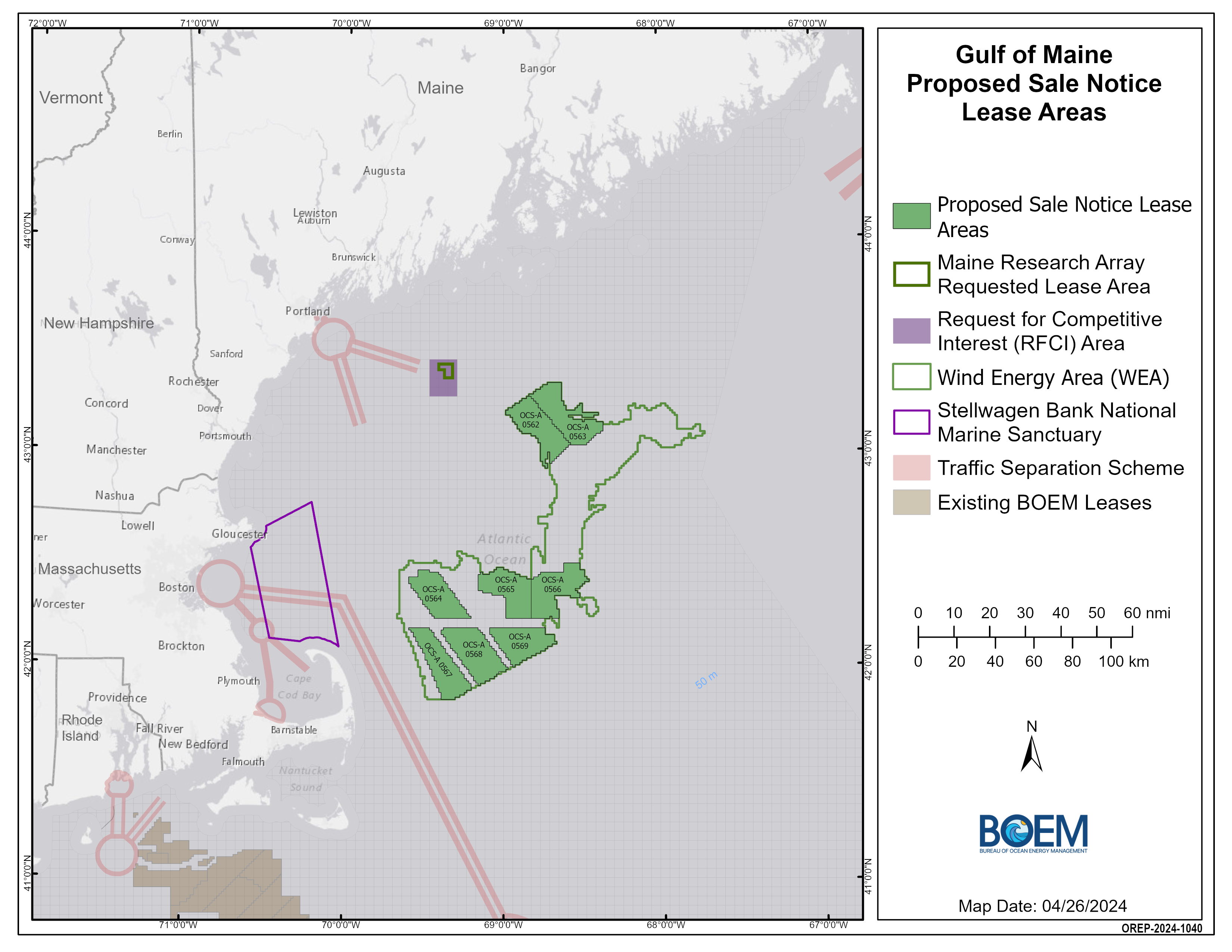
May 6, 2024 — Locations for offshore wind development have been selected off the Outer Cape.

The Biden administration this week published the location of eight areas proposed for lease in the Gulf of Maine, a body of water that runs from Cape Cod to Nova Scotia.

Wind energy developers will have the opportunity to bid on the leases in a future auction.

Six of the areas lie off the coast of Massachusetts and two off New Hampshire and Maine.

The closest to Cape Cod starts 25 miles off the Outer Cape. For comparison, that distance is about the same as the distance from Hyannis to Nantucket Harbor.

Read the full story at New Hampshire Public Radio


8 Gulf of Maine sites picked for possible commercial offshore wind leases

May 2, 2024 — The federal government is proposing eight areas in the Gulf of Maine as possible sites for commercial offshore wind farms.

The proposed lease areas cover about 1 million acres and have the potential to generate 15 gigawatts of energy, enough to power five million homes, the Bureau of Ocean Energy Management (BOEM) said Tuesday.

Two of the sites, encompassing nearly 254,000 acres, are off the Maine coast. The remaining six are located off Massachusetts.

In choosing the lease sites, BOEM said it wanted to avoid offshore fishing grounds and transit routes for ships. The eight proposed sites represent about half of the 2 million acres that BOEM chose as its “final wind energy area” for the Gulf of Maine, which the agency announced last month.

Read the full story at the Bangor Daily News

MASSACHUSETTS: New Bedford fishing pier collapses, forces vessel relocation and equipment retrieval

April 30, 2024 — Part of a New Bedford fishing pier collapsed Friday afternoon, according to police.

Scott Carola, Asst. Deputy Chief and public information officer for the New Bedford police, said officers responded to the Eastern Fisheries Pier off Hervey Tichon Avenue at around 3:30 p.m. after the outer section collapsed.

Read the full article at WJAR

MASSACHUSETTS: Offshore wind expansion will rely on ports, including New Bedford

April 30, 2024 — The federal government’s announcement last week of up to 12 more lease sales on both coasts by 2028 means more demand (and potential work opportunities) for vessels and ports, including the Port of New Bedford.

Interior Secretary Deb Haaland made the announcement at a wind industry conference in New Orleans, where she and other federal officials also shared the news of millions in funding for offshore wind research, and the streamlining of rules governing how the government holds auctions and reviews projects.

“This is so exciting because it means that developers and communities can expect predictability and transparency as they plan for future projects,” Haaland said. “It also means that all stakeholders from tribes to states to fisheries to academia have more time to weigh in on the process.”

The closest lease sales to Massachusetts will be the Gulf of Maine this year, and the New York Bight, in 2027 (the last one was in 2022 with six areas going to bid). There were no announced lease sales for the coast of Massachusetts and Rhode Island.

Read the full article at The New Bedford Light

Right Whale Day in Mass. marked during tough year for species

April 25, 2024 — Today marks the second annual Right Whale Day in Massachusetts.

The public is invited to spend it at the New England Aquarium, where beginning at 11 a.m. officials will discuss conservation efforts with Calvin, a 42-foot-long inflatable right whale, in the background.

The event falls just weeks after one of the critically endangered whales, a male known to researchers as #4143, was seen entangled off Rhode Island with rope coming out of both sides of his mouth.

Entanglement is a leading cause of death for North Atlantic right whales, whose population has fallen to around 350.

Erin Burke, the state’s protected species specialist, said her office is working with the Center for Coastal Studies in Provincetown to find #4143 before it’s too late.

Read the full article at Vermont Public Media

New Bedford Mayor, Port Authority, Successfully Advocate Opening Northern Edge Scallop Grounds to Boost Fishing Opportunities

April 18, 2024 — New Bedford Mayor Jon Mitchell delivered compelling testimony before the New England Fishery Management Council on Tuesday, urging the Council to open the Northern Edge scallop grounds to New Bedford commercial fishermen. Mayor Mitchell emphasized the potential benefits of this move, highlighting its significance as a new source of scallops while other locations recover, and scallop recruitment progresses.

Mayor Mitchell, who also serves as chairman of the New Bedford Port Authority, had previously written to Council Chair Eric Reid, noting that the work of the Habitat and Scallop Plan Development Teams has been careful and thoughtful, and has led to the cautious and prudent recommendation to pursue the opening of Concept Areas #2 and #4. Despite being the smallest of the Concept Areas evaluated, Mayor Mitchell stressed their importance in providing much-needed scallop fishing opportunities.

Concept Area #4 was highlighted for potentially harboring the highest concentration of scallops in recent surveys. Mayor Mitchell underscored that scallops have been spawning in the entire Closed Area for years, suggesting that a significant portion of the overall biomass would remain intact even after opening these areas to fishing. Additionally, the identified areas exhibit the lowest amount of complex bottom conditions, reducing the likelihood of adverse habitat impacts from scallop fishing.

Citing a long-term study conducted by the Woods Hole Oceanographic Institute, Mayor Mitchell emphasized that most habitats recover from scallop fishing impacts in less than 10 months, with even more complex habitats fully recovering within six years. This scientific evidence supports the feasibility and sustainability of opening the identified areas to scallop fishing.

It is anticipated that opening these areas wouldn’t necessitate new habitat closures elsewhere, easing the burden on other fishing interests.

National Marine Fisheries Service Regional Administrator Mike Pentony echoed support for moving forward with opening the two concept areas, noting that it was too early to abandon the concept areas over enforcement concerns, and that more can be done to improve enforceability if there are concerns.

Following Mayor Mitchell’s testimony, the Council took votes advancing Areas #2 and #4 towards a final action, possibly slated for September. This aligns with the Mayor’s request, both in his letter to Chair Eric Reid and in his in-person testimony.

The Port of New Bedford is the most valuable commercial fishing port in the U.S., maintaining its leadership position for more than two decades. With more than 7,000 jobs and 400 fishing vessels, the Port serves as a cornerstone of the regional economy, driving shoreside businesses and attracting significant public and private investments.

While New Bedford’s fishing vessels harvest multiple species, scallops remain the prime drivers of economic activity within the Port. Mayor Mitchell highlighted the fishermen’s commitment to maintaining the resource and their recognition of the strategic long-term importance of managing the scallop biomass.

The mayor’s letter to the NEFMC is available here.


Fishery council considering Mitchell’s plea to open Northern Edge to scallopers

April 18, 2024 — Mayor Jon Mitchell and New Bedford fishing representatives are urging the regional regulatory council to open up the Northern Edge — a lucrative scallop ground that has long been closed to commercial fishing. The council, which shot the motion down five years ago, has agreed to consider the request.

On Tuesday, Mitchell delivered testimony to the New England Fishery Management Council (NEFMC). He cited challenging years ahead for the scallop industry, which is being strained by a slump in prices and fewer days at sea for fishermen; and he stressed the importance of the scallop fishery as a foundational part of the port’s economy.

“The scallop fishery is facing some challenging years upcoming, after a few years of low recruitment,” Mitchell wrote in a letter to the council. “The industry would benefit greatly by adding these areas to its available fishing grounds.”

The region under consideration is the northernmost portion of the broad and productive fishing grounds called Georges Bank. In 1994, the Northern Edge was closed to commercial fishing to protect habitat for spawning cod and other bottom dwelling fisheries. Thirty years later, scallop representatives told the council, groundfish populations like cod have continued to decline while the area has remained locked up to scallopers.

Read the full story at the New Bedford Light

MASSACHUSETTS: A submerged concern: offshore wind cables

April 18, 2024 — As offshore wind turbines undergo construction in waters south of the Vineyard, and with some already standing and delivering power, the debates on the Island regarding the industry continue.

And amid the conversations over a necessity for clean energy, and whether the projects are a blow to the Vineyard’s natural charm — coupled with a mix of online misinformation campaigns against the offshore wind industry — one subject has remained submerged: undersea cables.

While cables — which connect wind farms to the New England power grid on the mainland — aren’t the flashiest parts of an offshore wind farm operation, some are nervous about what may lie ahead with them.

John Keene, president of the Martha’s Vineyard Fishermen’s Preservation Trust, told the Times that some in the fishing industry are nervous about how the electromagnetic field from the cables can affect marine life.

Keene said the concern is that the fields emitted from cables could act like a fence, particularly for migratory species, and impact the behavior of marine species.

“There’s a lot of unknowns,” he said.

Read the full story at the MV Times

MASSACHUSETTS: MAYOR MITCHELL ADVOCATES FOR SCALLOP INDUSTRY

April 17, 2024 — Mayor Jon Mitchell testified before the New England Fishery Management Council Tuesday in Mystic, Conn., urging the board to open the Northern Edge scallop grounds to New Bedford commercial fishermen.

Prior to his public comments on Tuesday afternoon, Mayor Mitchell submitted a letter to Chairman Eric Reid and the other members of the Council calling for the opening of the “key new source of scallops.”

“While there are multiple species that are harvested by New Bedford fishing vessels, scallops are the prime drivers of economic activity within the Port of New Bedford,” Mayor Mitchell wrote. “The fishermen of New Bedford know this, and they take great care in maintaining the resource and recognize the strategic long-term importance of managing the biomass.”

Read the full release at the City of New Bedford

MASSACHUSETTS: New Englanders, with their love of seafood, may be at higher risk for PFAS exposure

April 16, 2024 — A study from Dartmouth found that higher consumption of seafood is linked to a higher risk of per-and polyfluoroalkyl substances (PFAS) exposure. While the study looked specifically at people in New Hampshire, New Englanders are likely at higher risk because a legacy of PFAS pollution exists alongside a cultural preference for fish.

Researchers analyzed PFAS concentrations in fresh seafood with a statewide survey of eating habits in New Hampshire. National nutrition surveys have found that New Hampshire and all of New England are among the top consumers of seafood nationally, making New Hampshire ideal for researchers to learn more about the extent of people’s exposure to PFAS through fish and shellfish in saltwater.

“Basically, New Hampshire is a kind of case study that quantifies seafood consumption, particularly in a New England state, in order to estimate the potential risk of PFAS exposure that may come from very frequently consuming marine seafood,” Megan Romano, corresponding author and associate professor of epidemiology at Dartmouth’s Geisel School of Medicine, said.

She said the findings, published in the journal Exposure and Health, make a case for setting PFAS limits on seafood, not to stop eating seafood.

Read the full article at wbur

  • « Previous Page
  • 1
  • …
  • 36
  • 37
  • 38
  • 39
  • 40
  • …
  • 360
  • Next Page »

Recent Headlines

  • US pushes AI funding, fisheries tech at APEC amid China rivalry
  • MASSACHUSETTS: Massachusetts Division of Marine Fisheries Hiring Recreational Fisheries Surveyors for 2026 Season
  • ALASKA: Indigenous concerns surface as U.S. agency considers seabed mining in Alaskan waters
  • Seasonal Survey for the Atlantic Sea Scallop Fishery on the Eastern Part of Georges Bank Project Release
  • ALASKA: Pacific cod quota updated mid-season for Kodiak area fishermen
  • NOAA leaps forward on collaborative approach for red snapper
  • US House votes to end Trump tariffs on Canada
  • More Republicans buck Trump on offshore wind

Most Popular Topics

Alaska Aquaculture ASMFC Atlantic States Marine Fisheries Commission BOEM California China Climate change Coronavirus COVID-19 Donald Trump groundfish Gulf of Maine Gulf of Mexico Illegal fishing IUU fishing Lobster Maine Massachusetts Mid-Atlantic National Marine Fisheries Service National Oceanic and Atmospheric Administration NEFMC New Bedford New England New England Fishery Management Council New Jersey New York NMFS NOAA NOAA Fisheries North Atlantic right whales North Carolina North Pacific offshore energy Offshore wind Pacific right whales Salmon South Atlantic Virginia Western Pacific Whales wind energy Wind Farms

Daily Updates & Alerts

Enter your email address to receive daily updates and alerts:
  • This field is for validation purposes and should be left unchanged.
Tweets by @savingseafood

Copyright © 2026 Saving Seafood · WordPress Web Design by Jessee Productions