Saving Seafood

  • Home
  • News
    • Alerts
    • Conservation & Environment
    • Council Actions
    • Economic Impact
    • Enforcement
    • International & Trade
    • Law
    • Management & Regulation
    • Regulations
    • Nutrition
    • Opinion
    • Other News
    • Safety
    • Science
    • State and Local
  • News by Region
    • New England
    • Mid-Atlantic
    • South Atlantic
    • Gulf of Mexico
    • Pacific
    • North Pacific
    • Western Pacific
  • About
    • Contact Us
    • Fishing Terms Glossary

The Southeast For-Hire Integrated Electronic Reporting Program (SEFHIER) Thanks Program Participants and Offers Year End Reminders

December 17, 2021 — The following was released by the South Atlantic Fishery Management Council:

Key Message:

•NOAA Fisheries thanks fishermen for their participation in the SEFHIER program, informs participants about program requirements, reminds participants of frequently asked questions (FAQs), and provides an update of the program progress.

•For further information, SEFHIER participants can contact the program help desk at 1-833- 707-1632, and select option 3, between 8:00 a.m. and 4:30 p.m., ET, excluding federal holidays. Also, fishermen can visit the program website at https://go.usa.gov/xMBjm for more information about the program.

Thank You:

•As the first year of NOAA Fisheries’ SEFHIER program comes to a close, SEFHIER extends a sincere thank you to the constituents who are participating in the program and have offered suggestions for improving the program.

•Over the past year, SEFHIER staff has made many enhancements to the program based on input from fishermen. Through Fishery Management Council meetings, webinars, mailings, region specific toolkits, conference calls, dock talks, and calls to our hotline, constituents have listened, provided feedback, complied with regulations, and helped make this program a success.

•SEFHIER also thanks the staff of the Gulf of Mexico and South Atlantic Fishery Management Councils for helping to host webinars, create and distribute informational toolkits, and sharing SEFHIER messages to reach federally permitted for-hire fishermen.

Preliminary 2021 Highlights:

•70,834 Gulf of Mexico (Gulf) and South Atlantic/Atlantic logbooks received,

•41,033 Gulf declarations received,

•~64% of Gulf for-hire federally permitted vessels and ~60% of South Atlantic/Atlantic federally permitted vessels have registered an account with an approved reporting vendor,

•SEFHIER staff answered more than 1,000 incoming calls and assisted constituents with program-related outreach on nearly 6,000 outgoing customer service calls.

Regulation Reminders:

(Please refer to the SEFHIER FAQs page for more information.)

•Federally permitted Gulf for-hire vessels

•Trip declarations are required every time a vessel moves on the water (i.e., bait/ice trips, transportation to/from marinas and private docks, sunset cruises).

•For dually federally permitted for-hire and commercial reef fish vessels, you must complete both a commercial reef fish and for-hire trip declaration when going on a for-hire trip. NOAA Fisheries is actively investigating how to streamline the vessel monitoring system (VMS) declaration process for dually commercial reef fish and for-hire federally permitted vessels. Currently, these programs have different regulatory declaration requirements.

•For-hire declarations can only be completed using a SEFHIER approved reporting platform (VMS or software). Gulf for-hire declarations are not approved for submission on the VMS IVR line.

•All federally permitted for-hire vessels

•All federally permitted for-hire vessels are required to submit logbooks with information on catch and effort. This information is required to be reported regardless of where the vessel is fishing. All logbooks must be submitted electronically through SEFHIER approved software.

•Gulf federally permitted for-hire vessels: Logbooks must be submitted prior to removing fish from the vessel. If no fish were harvested, the logbook must be submitted within 30 minutes of landing.

•South Atlantic/Atlantic federally permitted for-hire vessels: Logbooks must be submitted weekly, by 11:59 pm, local time, the Tuesday following a reporting week (Monday-Sunday). A no-fishing report must be submitted if a vessel does not go fishing in a reporting week (Monday through Sunday).

• Reporting Highly Migratory Species (HMS)

•If you are using eTrips/Mobile2, the application will prompt for the HMS required questions, and only one submission is required to comply with both SEFHIER and HMS programs. If you are using the VESL reporting application, you will still need to complete the HMS reports using the HMS Program.

FAQ Reminders:

•Questions from participants have often been related to trip type, trip activity, economic questions, and reporting errors.

•For answers to these and additional SEFHIER questions, please refer to our SEFHIER FAQs page (broken out by topic) for detailed answers to some of our most frequently asked questions:

•General Program Requirements

•General Reporting Requirements

•Electronic Logbook Questions

•Gulf Trip Declaration Questions

•Gulf of Mexico VMS requirement Questions

•Gulf of Mexico Intercept Validation Survey Questions

•Dually Permitted For-Hire Vessel Questions

Reporting Reminders:

•eTrips:

•While eTrips/Mobile2 is approved, eTrips/Online is not approved for SEFHIER. See the program website, under Approved Software, for more information on what software is approved for the program.

•For South Atlantic/Atlantic federally permitted for-hire vessels, no fishing reports are only accepted 30 days in advance per program requirements, regardless of what the application will allow. Any form submitted in excess of the 30 days will not count towards program compliance and will need to be resubmitted.

•Landing location is a required field on the Gulf declaration. SEFHIER declarations combine traditional hail-out and hail-in information into one form. The hail-in information, estimated return time and landing location, are used by law enforcement and SEFHIER Validation Surveyors to know in advance when a vessel will be landing with catch.

•To submit a logbook, click the send/submit button on the application. Without clicking send/submit, the logbook will remain pending in the application. A confirmation screen will confirm a successful submission. This report is then saved to your device; if needed, you can show a law enforcement officer your trip submission confirmation.

•Software application vendors are required to have helpdesks. Please call them if/when you have trouble with your application. They are here to help you!

•eTrips:  Help Desk Phone Number: 1-800-984-0810

•VESL: Help Desk Phone Number: 1-202-883-8375

SEFHIER Staff Are Also Here To Help You:

•SEFHIER website

•Toll free phone number: 1-833-707-1632 (8:00 am – 4:30 pm ET, Monday through Friday),

•Program email: ser.electronicreporting@noaa.gov

•SEFHIER specific For-Hire Fishery Bulletins are now available: sign up for and view Fishery Bulletins here

•Sign up for recreational fisheries related NOAA text alerts (standard text messaging rates apply) by texting:

•GULFRECFISH to 888777 (Gulf) or

•SATLRECFISH to 888777 (South Atlantic)
 

U.S. Coast Guard Lt. James Bruce Recognized as Law Enforcement Officer of the Year

December 10, 2021 — The following was released by the South Atlantic Fishery Management Council:

As the Commanding Officer of the U.S. Coast Guard’s Southeast Regional Fisheries Training Center, Lieutenant James Bruce reflects the dedication of the U.S. Coast to the protection and enforcement of the region’s Living Marine Resources. For his service and work to improve training operations, Lt. Bruce received the Law Enforcement Officer of the Year Award at this week’s meeting of the South Atlantic Fishery Management Council in Beaufort, North Carolina. (Pictured are Lt. James Bruce, Council Chair Mel Bell (right) and Spud Woodward, Chair of the Council’s Law Enforcement Committee.)

Lt. Bruce oversees the training, curriculum, and certification for the more than 150 Coast Guard Law Enforcement Officers that annually enter the Fisheries Training Program in Charleston, South Carolina. The Southeast Regional Fisheries Training Center (SRFTC) is one of five such training centers regionally located around the country. “We are fortunate to have an excellent U.S. Coast Guard Fisheries Training Center in Charleston,” said Chairman Bell. “With his strong academic background in fisheries, including a master’s degree from Scripps, Lt. Bruce has been actively involved in the fisheries management process and a dedicated advocate for improving fisheries enforcement.”

Since assuming command of the Training Center in 2019, Lt Bruce has pioneered initiatives directly impacting fisheries enforcement. These include a coordinated effort to expand the footprint of the Training Center by providing operational support for fisheries boardings and surge operations in federal waters, resulting in a 13% increase in fisheries boardings in the South Atlantic between 2019 and 2020. Working with NOAA Fisheries Highly Migratory Species (HMS) office, Lt. Bruce led the effort to create a “Status of Fisheries” website, tracking regulations in real-time to provide information to enforcement officers. Lt Bruce also led staff at SRFTC in producing the first-of-its-kind “QR” coded reference guides for on-scene enforcement officers dealing with possible violations of HMS Lacey Act and Florida recreational lobster regulations.

The Law Enforcement Officer of the Year award was established by the Council in 2010 to recognize distinctive service, professionalism, and dedication to enforcing fisheries regulations in the South Atlantic region. Nominees for the annual award may be submitted from each of the southeastern state law enforcement agencies, the U.S. Coast Guard, and NOAA Fisheries.

According to his peers, Lt. Bruce is known for his unyielding curiosity and purposeful drive, utilizing his academic background in Marine Biodiversity and Conservation to speak formally through education programs, engage with local fish houses, and bring a real-world viewpoint to the officers he trains.

“I have to say I am humbled by the selection, especially knowing the caliber and esteem of the state and federal fisheries enforcement officers that I get the privilege to work with,” said Lt. Bruce. “The real prize is getting to work alongside NOAA OLE and the many state agencies in our South Atlantic region. It’s really great that the South Atlantic Fishery Management Council makes such an effort to recognize law enforcement and our collective effort to enforce fisheries regulations and the objectives of the Magnuson-Stevens Fisheries Conservation and Management Act to prevent overfishing, rebuild overfished stocks, and increase the long-term economic and social benefits in our region.”


Pew Trusts, MSC Say WCPFC Need to Work Faster to Adopt Sustainable Tuna Harvest Strategies

December 9, 2021 — The Marine Stewardship Council (MSC) warned that 22 tuna fisheries in the Western Central Pacific Ocean (WCPO) are at-risk of certification suspension after “disappointing progress” was made at the annual meeting of the Western Central Pacific Fisheries Commission (WCPFC) this month.

The MSC explained that the 28 MSC-certified fisheries in the WCPO have timebound conditions of certification to the MSC’s standard for sustainable fishing which requires harvest strategy adoption by 2023.

“Harvest strategies – or the rules which ensure the long-term management of stocks – act as a ‘safety net’ if currently healthy fish stocks begin to decline. They are fundamental to sound fisheries management, and are critical to future health of the stocks, especially for highly migratory species like tuna which span geopolitical boundaries,” the MSC wrote in a press release.

Read the full story at Seafood News

Streamlined West Coast HMS Reporting Benefits Science, Management—And Fishermen

December 19, 2018 — The following was released by NOAA:

Highly migratory species (HMS) like swordfish, many tunas, and thresher and mako sharks play a major role in both the commercial and recreational fisheries on the West Coast. They are vital to maintaining a balanced ocean ecosystem and generating millions of dollars from economic activities across a broad range of businesses—from marine supply and service providers, shipyards, and processors to hotels, restaurants, seafood retailers, and tackle shops.

But responsible, effective HMS management is as challenging as it is crucial. As the name suggests, these fish traverse thousands of miles of ocean each year. This poses a unique set of difficulties in assessing stock size and health, and strong cooperation is needed among scientists and managers across state, regional, and international boundaries.

Until recently, these challenges were made more daunting by outdated and inefficient data collection and reporting systems. For both recreational and commercial fisheries, data on HMS are derived from state landings information, logbooks, onboard and dockside sampling, observer reports, and other sources. The information was then sent to four different agencies working independently of one another. Creating comprehensive data for a stock assessment, management action, or treaty obligation was a time- and resource-consuming process.

Now thanks to funding from a competitive request for proposals—managed by the Fisheries Information System program in partnership with the National Observer Program and the National Catch Shares Program—West Coast HMS data management is coordinated through a single source, the eastern Pacific HMS professional specialty group. The results so far have been highly encouraging.

“The efficiencies and cost savings of the new system have only begun to be realized as duplicative reporting is eliminated and manual compilations of data in spreadsheets get replaced with automated, web-based reports,” said John Childers of the NOAA Southwest Fisheries Science Center.

For fishermen, this translates to more timely data, which means better predictability in their fishing operations. “As we approach near real-time reporting of HMS catch, fishermen have the data they need to make decisions about when and where to fish before a quota has been reached and they have to shut down for the season,” Childers said.

Another significant benefit, enhanced through participation in Fisheries Information Systems  working groups, has been better communication among disciplines and partners—such as data managers, program managers, programmers, and other staff from the NOAA Southwest Fisheries Science Center and West Coast Regional Office, the Pacific Fisheries Information Network, and the West Coast states. Improved collaboration and information-sharing is one of the key goals of the FIS program.

Read the full release here

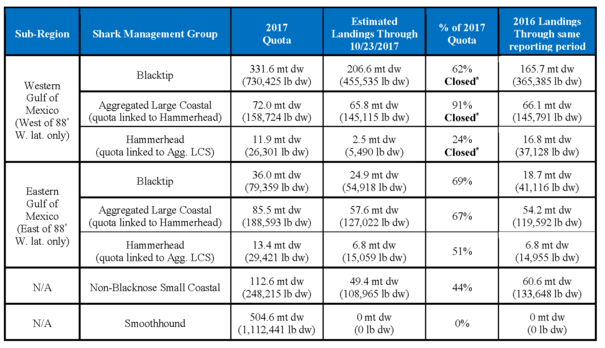
Shark Landings Update Through October 23, 2017

October 27, 2017 — The following was released by NOAA Fisheries:

The following are preliminary landings estimates in metric tons (mt) and pounds (lb) dressed weight (dw) for the Atlantic shark commercial fisheries; 1 mt is equal to 2,204.6 pounds.  These preliminary estimates are based on dealer reports and other information received from January 1 through October 23, 2017.  The estimates include landings by state-only permitted vessels, federally permitted vessels, and the 2017 shark research fishery participants.  We provide percentages of landings instead of estimated landings where needed to continue ensuring participant confidentiality.  The fishing seasons for all shark management groups opened on January 1, 2017, except for the aggregated LCS, blacktip shark, and hammerhead shark management groups in the western Gulf of Mexico sub-region which opened on February 1, 2017.

Gulf of Mexico Region

  • Includes any landings south and west 25° 20.4’ N. long.
  • As of 10/23/2017, the retention limit for directed permit holders is 45 large coastal sharks other than sandbar sharks per vessel per trip in the eastern Gulf of Mexico sub-region and no retention of large coastal sharks in the western Gulf of Mexico sub-region*.
  • The retention limit for directed permit holders can change throughout the season.

GOM

* Fishery closed at 11:30 p.m. local time on May 2, 2017 (82 FR 20447).

NMFS will announce closures of management groups when landings reach or are projected to reach 80 percent of the quota.  Management groups that are quota linked close when landings of either of the linked management groups reach or are projected to reach 80 percent of the quota.

For the full list of shark landings by region visit NOAA Fisheries

NOAA Fisheries Reminds Commercial HMS Permit Holders of U.S. Coast Guard Commercial Fishing Vessel Dockside Safety Examination Requirements

January 31, 2017 — The following was released by the National Oceanic and Atmospheric Administration:

NOAA Fisheries is reminding commercial Highly Migratory Species (HMS) vessel permit holders that they are required to obtain a United States Coast Guard (USCG) Commercial Fishing Vessel Dockside Safety Examination.

Effective October 15, 2015, the law requires completion of a mandatory dockside safety exam at least once every five years.  See USCG Marine Safety Information Bulletin, or MSIB, 12-15 for clarification about the five-year mandatory dockside safety exam.

Commercial fishing means a vessel that commercially engages in the catching, taking, or harvesting of fish which, either in whole or in part, is intended to enter commerce through sale, barter, or trade. 

So, whether your vessel is USCG documented or State registered, if you catch fish beyond 3 nautical miles with the intent to sell them, you are operating a commercial fishing vessel.  The USCG categorizes vessels that hold one or more of the follow HMS permits as commercial fishing vessels subject to mandatory dockside safety exams:

  • Atlantic Tunas General Category
  • Atlantic Tunas Harpoon Category
  • HMS Charter/Headboat Category
  • General Commercial Swordfish
  • Atlantic Tunas Longline
  • Atlantic Tunas Purse Seine
  • Atlantic Shark Directed Limited Access
  • Atlantic Shark Incidental Limited Access
  • Atlantic Smoothhound
  • Atlantic Swordfish Directed Limited Access
  • Atlantic Swordfish Incidental Limited Access
  • Atlantic Swordfish Harpoon Limited Access

Commercial fishing vessels are required to comply with the commercial fishing vessel safety regulations found in 46 CFR Part 28.

For more info about dockside safety exams and how to obtain a decal: https://www.uscg.mil/msib/docs/012_15_10-20-2015.pdf

USCG has a helpful tool to assist vessel owners/operators prepare their fishing vessel prior to examination.  Commercial Fishing Vessel Checklist Generator: https://www.uscg.mil/d13/cfvs/test/1ChecklistCover.html

This notice is a courtesy to commercial HMS permit holders to help keep you informed about the fishery.  For additional information, call (978) 281-9260, or go to hmspermits.noaa.gov.  Official notice of Federal fishery actions is made through filing such notice with the Office of the Federal Register.

Directed Sustainable Fisheries, Inc. Distributes Fisheries Mgmt Events Calendar

October 13, 2015 — The following was released by Directed Sustainable Fisheries, Inc:

2015-2016 Fisheries Events Calendar Version 12

Commercial ACL Info http://sero.nmfs.noaa.gov/sustainable_fisheries/acl_monitoring/commercial_sa/index.html

Recreational ACL Info http://sero.nmfs.noaa.gov/sustainable_fisheries/acl_monitoring/recreational_sa/index.html

January 01, 2015

National Marine Fisheries Service (NMFS) Highly Migratory Species (HMS) shark quotas open, except Atlantic Large Coastal Shark quota opened July 01, 2015 and Porbeagle shark quota is closed in 2015

http://www.nmfs.noaa.gov/sfa/hms/news/news_list/2014/12/120114_2015_final_shark_specs.html

January 01

South Atlantic Fishery Management Council (SAFMC) Calendar and Closures

http://www.safmc.net/fish-id-and-regs/fishing-season-calendar-closures

January 01

Gulf of Mexico Fishery Management Council (GMFMC) Commercial Regulations Mixing Zones

http://www.gulfcouncil.org/fishing_regulations/CommercialRegulations.pdf See Page 3 (PDF Page 5)

October 13

Written Comments Due on ESA Petitions for Smooth Hammerhead and Bigeye Thresher sharks

https://www.federalregister.gov/articles/2015/08/11/2015-19550/endangered-and-threatened-wildlife-90-day-finding-on-a-petition-to-list-the-smooth-hammerhead-shark

https://www.federalregister.gov/articles/2015/08/11/2015-19551/endangered-and-threatened-wildlife-90-day-finding-on-a-petition-to-list-the-bigeye-thresher-shark-as

October 14-15

SAFMC Visioning Meeting in Charleston, South Carolina

http://safmc.net/Oct2015_VisioningWorkshop

October 20-22

SAFMC SSC Fall Meeting Date

http://www.safmc.net/Meetings/SSCMeetings

October 29

NMFS SERO Written Comment Due on Dolphin Allocation & Generic Amendment Proposed Rule

https://www.federalregister.gov/articles/2015/09/29/2015-24576/fisheries-of-the-caribbean-gulf-of-mexico-and-south-atlantic-snapper-grouper-fishery-and-golden-crab

November 03-04

SAFMC Snapper-Grouper Advisory Panel meeting in North Charleston, South Carolina

http://safmc.net/meetings/current-advisory-panel-meetings

November 04

Written Nominations for HMS Shark SEDAR Pool requested by this date

http://www.nmfs.noaa.gov/sfa/hms/news/news_list/2015/10/100215_sedar_pool_nominations.html

November 17-20

SEDAR 41 Red Snapper/Gray Triggerfish Assessment Workshop in Morehead City, North Carolina

http://sedarweb.org/sedar-41

December 07-11

SAFMC Meeting, Hilton Oceanfront Hotel, 2717 W. Fort Macon Rd, Atlantic Beach NC

http://safmc.net/sites/default/files/meetings/pdf/Council/2015/2015_SAFMC_MeetingDates.pdf

January 01, 2016

Many SAFMC Snapper-Grouper Species Annual Catch Limits (ACLs) Open http://safmc.net/

Most HMS Shark, Swordfish and Tuna Quotas Open http://www.nmfs.noaa.gov/sfa/hms/

January 19-22

SAFMC Citizen Science Workshop in Charleston, South Carolina

http://safmc.net/sites/default/files/meetings/pdf/SSC/2015/10_2015_SSC/A9_SA_CitSci_one-pager_062615.pdf

March 07-11

SAFMC Meeting in Jekyll Island, Georgia

http://www.safmc.net/meetings/council-meetings

March 15-18

SEDAR 41 Review Workshop Red Snapper & Gray Triggerfish in Atlantic Beach, North Carolina http://sedarweb.org/sedar-41

June 13-17

SAFMC Meeting in Cocoa Beach, Florida

http://www.safmc.net/meetings/council-meetings

View a PDF of the DSF events calendar

Recent Headlines

  • Scientists did not recommend a 54 percent cut to the menhaden TAC
  • Broad coalition promotes Senate aquaculture bill
  • Chesapeake Bay region leaders approve revised agreement, commit to cleanup through 2040
  • ALASKA: Contamination safeguards of transboundary mining questioned
  • Federal government decides it won’t list American eel as species at risk
  • US Congress holds hearing on sea lion removals and salmon predation
  • MASSACHUSETTS: Seventeen months on, Vineyard Wind blade break investigation isn’t done
  • Sea lions keep gorging on endangered salmon despite 2018 law

Most Popular Topics

Alaska Aquaculture ASMFC Atlantic States Marine Fisheries Commission BOEM California China Climate change Coronavirus COVID-19 Donald Trump groundfish Gulf of Maine Gulf of Mexico Illegal fishing IUU fishing Lobster Maine Massachusetts Mid-Atlantic National Marine Fisheries Service National Oceanic and Atmospheric Administration NEFMC New Bedford New England New England Fishery Management Council New Jersey New York NMFS NOAA NOAA Fisheries North Atlantic right whales North Carolina North Pacific offshore energy Offshore wind Pacific right whales Salmon South Atlantic Virginia Western Pacific Whales wind energy Wind Farms

Daily Updates & Alerts

Enter your email address to receive daily updates and alerts:
  • This field is for validation purposes and should be left unchanged.
Tweets by @savingseafood

Copyright © 2025 Saving Seafood · WordPress Web Design by Jessee Productions