Saving Seafood

  • Home
  • News
    • Alerts
    • Conservation & Environment
    • Council Actions
    • Economic Impact
    • Enforcement
    • International & Trade
    • Law
    • Management & Regulation
    • Regulations
    • Nutrition
    • Opinion
    • Other News
    • Safety
    • Science
    • State and Local
  • News by Region
    • New England
    • Mid-Atlantic
    • South Atlantic
    • Gulf of Mexico
    • Pacific
    • North Pacific
    • Western Pacific
  • About
    • Contact Us
    • Fishing Terms Glossary

Fatty acids lower your risk of heart disease. Without fish, you’re missing out.

August 17, 2017 — Are you getting enough omega-3s? These vital fats are beneficial for heart, brain and eye health, but it’s not just the amount that matters. The type of omega-3s in your diet could determine the health benefits you’re getting — especially if you don’t eat fish.

Long-chain omega-3 fatty acids called EPA (eicosapentaenoic acid) and DHA (docosahexaenoic acid) are found in marine sources such as fatty fish and fish oils. Another type of omega-3s is ALA (alpha-linolenic acid), which is found in plant sources such as flax seeds, canola, chia and walnuts.

Most Americans aren’t getting enough EPA and DHA. That’s of concern because there is strong evidence that these omega-3s reduce triglyceride levels to help lower the risk for heart disease or heart attack. There is some evidence that these healthy fats may also reduce blood pressure and improve blood vessel function. And those are just some of the heart-health benefits. The evidence for these benefits in ALA isn’t as strong.

Penny Kris-Etherton, distinguished professor of nutrition at Pennsylvania State University, points out that, “We really haven’t seen evidence for benefits of plant omega-3s on cognition or in preventing stroke.”

Bruce Holub, professor at The University of Guelph adds, “EPA and DHA are shown to be quite effective at lowering triglyceride levels in the blood, while equal amounts of ALA had no effect.”

Getting enough DHA is especially important for pregnant women because it’s essential for healthy development of a baby’s brain and eyes.

Read the full story at the Washington Post

What are the benefits of eating more fish?

August 14, 2017 — Jane DeWitt and Sabrina Lombardi are clinical nutrition coordinators of Food and Nutrition Services for Hackettstown Medical Center and Newton Medical Center at Atlantic Health System, respectively.

Q. What are the benefits of eating more fish?

A. Fish: Some people love eating it, and some people do not. But its health benefits are something that everyone can agree on.

“Studies show that increasing your fish intake is good for you, especially for your heart,” said Jane DeWitt, clinical nutrition coordinator of Food and Nutrition Services for Hackettstown Medical Center. “It’s leaner than red meat and some, like salmon, arctic char and sardines, are full of omega-3 fatty acids, which are great for your heart.”

Omega-3 fatty acids, which are essential fatty acids for human health, can help reduce inflammation as well as the risk for heart disease, notes DeWitt. The American Heart Association recommends up to two servings of fish per week, up to 8 ounces total. Omega 3 fatty acids are also beneficial for brain health as well help with memory, performance, and cognition.

Read the full story at the New Jersey Herald

Omega 3 Health Benefits, Nutrition Facts And Sources

October 31st, 2016 — According to a lot of research, omega 3 benefits each of the body’s systems in its own way. The greatest benefits can be found in the heart and the brain.

omega-3-nutrition

In places where other fats clog the arteries and contribute to heart disease, the omega 3 fatty acids helps to fight off the heart disease in many ways.

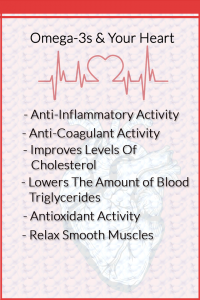
Here I have contributed a list of the things that omega 3 can do for your heart:

  • Anti-Coagulant Activity – helps prevent the formation of clots in the blood
  • Antioxidant Activity – they help to prevent oxidation of the fats that are found in the bloodstream. When the fats become oxidized, they can stick to the artery walls and harden atherosclerosis
  • Relax Smooth Muscles – the help reduce the blood pressure, which can reduce the risk of stroke and heart attack
  • Improves The Levels Of Cholesterol – Cholesterol isn’t all bad. Most individuals who have problems with cholesterol have high levels of LDL and low levels of HDL. Theheart-omega-3-oil particles of LDL are most likely to stick to the walls of the arteries and create clots. HDL is what helps remove the particles of LDL from the blood. Omega 3 supplements have been known to increase the amount of HDL.
  • Lowers The Amount of Blood Triglycerides – triglycerides are the fats found in the blood. The more fats that are found in your blood, the more likely you are to develop blood clots, have a stroke, ordevelop heart disease. The prescription medication LOVAX used for high levels of triglycerides is really nothing but omega 3 fish oil
  • Anti-Inflammatory Activity – when the oxidized fats get stuck to the artery walls, they create swelling or inflammation, which makes the arteries even narrower

Read the full report at Cooking Detective 

Recent Headlines

  • Scientists did not recommend a 54 percent cut to the menhaden TAC
  • Broad coalition promotes Senate aquaculture bill
  • Chesapeake Bay region leaders approve revised agreement, commit to cleanup through 2040
  • ALASKA: Contamination safeguards of transboundary mining questioned
  • Federal government decides it won’t list American eel as species at risk
  • US Congress holds hearing on sea lion removals and salmon predation
  • MASSACHUSETTS: Seventeen months on, Vineyard Wind blade break investigation isn’t done
  • Sea lions keep gorging on endangered salmon despite 2018 law

Most Popular Topics

Alaska Aquaculture ASMFC Atlantic States Marine Fisheries Commission BOEM California China Climate change Coronavirus COVID-19 Donald Trump groundfish Gulf of Maine Gulf of Mexico Illegal fishing IUU fishing Lobster Maine Massachusetts Mid-Atlantic National Marine Fisheries Service National Oceanic and Atmospheric Administration NEFMC New Bedford New England New England Fishery Management Council New Jersey New York NMFS NOAA NOAA Fisheries North Atlantic right whales North Carolina North Pacific offshore energy Offshore wind Pacific right whales Salmon South Atlantic Virginia Western Pacific Whales wind energy Wind Farms

Daily Updates & Alerts

Enter your email address to receive daily updates and alerts:
  • This field is for validation purposes and should be left unchanged.
Tweets by @savingseafood

Copyright © 2025 Saving Seafood · WordPress Web Design by Jessee Productions