Saving Seafood

  • Home
  • News
    • Alerts
    • Conservation & Environment
    • Council Actions
    • Economic Impact
    • Enforcement
    • International & Trade
    • Law
    • Management & Regulation
    • Regulations
    • Nutrition
    • Opinion
    • Other News
    • Safety
    • Science
    • State and Local
  • News by Region
    • New England
    • Mid-Atlantic
    • South Atlantic
    • Gulf of Mexico
    • Pacific
    • North Pacific
    • Western Pacific
  • About
    • Contact Us
    • Fishing Terms Glossary

U.S. Government Decides Against Adding Great Hammerhead Shark To Endangered Species List

November 10, 2022 — It was a report many were looking forward to – whether or not the United States National Marine Fisheries Service (NMFS) would decide for or against adding the great hammerhead shark (Sphyrna mokarran) to the Endangered Species List (ESA).

Known for its unmistakeable hammer shaped head and a tall first dorsal fin, these nomadic, generally solitary, and highly migratory species have a circumglobal distribution. The largest species in the Sphyrnidae family, it was listed on the International Union for the Conservation of Nature (IUCN) Red List as Critically Endangered due to being caught globally as target and bycatch in coastal and pelagic large- and small-scale longline, purse seine, and gillnet fisheries. Retained by many fishers for its large fins, combined with high bycatch mortality, makes this long-lived predator vulnerable to overfishing pressures. With this evidence, many hoped for good news today. Instead, they received disappointing news.

On June 16, 2022, the NMFS received a petition from the Center for Biological Diversity (CBD) to list the great hammerhead shark as a threatened or endangered species under the ESA and to designate critical habitat concurrent with the listing. The CBD argued that the 2019 assessment carried out by the IUCN had designated the species as “critically endangered,” which meant “the species satisfies the listing criteria under the ESA.”
Read the full article at Forbes

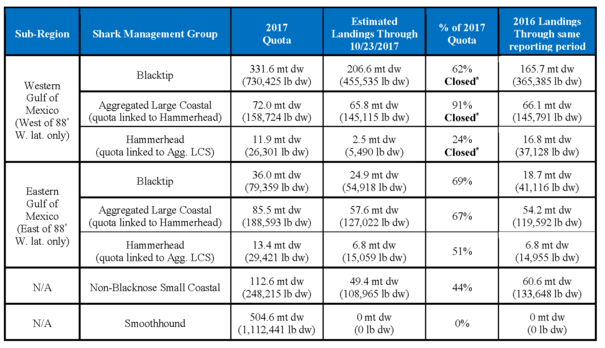
Shark Landings Update Through October 23, 2017

October 27, 2017 — The following was released by NOAA Fisheries:

The following are preliminary landings estimates in metric tons (mt) and pounds (lb) dressed weight (dw) for the Atlantic shark commercial fisheries; 1 mt is equal to 2,204.6 pounds.  These preliminary estimates are based on dealer reports and other information received from January 1 through October 23, 2017.  The estimates include landings by state-only permitted vessels, federally permitted vessels, and the 2017 shark research fishery participants.  We provide percentages of landings instead of estimated landings where needed to continue ensuring participant confidentiality.  The fishing seasons for all shark management groups opened on January 1, 2017, except for the aggregated LCS, blacktip shark, and hammerhead shark management groups in the western Gulf of Mexico sub-region which opened on February 1, 2017.

Gulf of Mexico Region

  • Includes any landings south and west 25° 20.4’ N. long.
  • As of 10/23/2017, the retention limit for directed permit holders is 45 large coastal sharks other than sandbar sharks per vessel per trip in the eastern Gulf of Mexico sub-region and no retention of large coastal sharks in the western Gulf of Mexico sub-region*.
  • The retention limit for directed permit holders can change throughout the season.

GOM

* Fishery closed at 11:30 p.m. local time on May 2, 2017 (82 FR 20447).

NMFS will announce closures of management groups when landings reach or are projected to reach 80 percent of the quota.  Management groups that are quota linked close when landings of either of the linked management groups reach or are projected to reach 80 percent of the quota.

For the full list of shark landings by region visit NOAA Fisheries

Retention Limit of Commercial Aggregated Large Coastal Shark and Hammerhead Shark Management Groups: Atlantic Region Increased to 45 Sharks per Trip

July 8, 2016 — The following was released by NOAA:

The National Marine Fisheries Service (NMFS) is increasing the retention limit for the commercial aggregated large coastal shark (LCS) and hammerhead shark management groups for directed shark limited access permit holders in the Atlantic region from 3 to 45 LCS other than sandbar sharks per vessel per trip as of July 15, 2016.  This adjustment is intended to promote equitable fishing opportunities in the Atlantic region, while allowing majority of quota to be harvested later in the year.  All other retention limits and shark fisheries remain unchanged in the Atlantic region.

The retention limit will remain at 45 LCS other than sandbar sharks per vessel per trip in the Atlantic region through the rest of the 2016 fishing season or until NMFS announces via a notice in the Federal Register another adjustment to the retention limit or a fishery closure.   This retention limit adjustment affects anyone with a directed shark limited access permit fishing for LCS in the Atlantic region.


Thanks to ‘Dr. Shark,’ researchers can learn and let live

June 24, 2016 — A UNE researcher known as ‘Dr. Shark’ develops a method that allows fish data collection without killing the specimens.

A decade ago, when James Sulikowski first came to the University of New England, scientists who studied shark reproduction had to kill and gut their specimens to unlock the secrets of how these elusive fish gave birth.

Sulikowski wanted to learn more about the reproductive process in hopes of bolstering shark numbers, and didn’t like the idea of having to kill pregnant sharks and their unborn young to do it. That study method also made it impossible to study the reproductive habits of endangered sharks, such as the basking, hammerhead or tiger shark, even though information about how these threatened groups lived and loved would have helped policymakers protect their mating or pupping grounds and possibly help stabilize their populations.

Scientists had begun using blood samples to supplement their shark necropsies, measuring hormone levels to establish the stage of pregnancy, but Sulikowski, a father of three, thought researchers could go further. About five years ago, he turned to the same kind of sonogram technology that doctors use to monitor pregnant women – complete with a transducer, an image screen and conductive jelly – and adapted it for use on pregnant sharks, as well as other elusive or endangered fish species, such as sturgeon.

“There is so much that we still don’t know, like where different species of sharks go to give birth,” Sulikowski said, “and so much that we think we do know, like the length of gestation for our local spiny dogfish that we are just now learning through the use of this technology and tagging that is just plain wrong. I love that. I love challenging accepted science. For me, it’s always about being inquisitive, testing what we think we know, asking what we don’t and figuring out new ways to come up with answers to questions we didn’t even know to ask just a few years ago.”

Read the full story at the Portland Press Herald

Aggregated Large Coastal Shark and Hammerhead Shark Management Groups Reduced to 3 Sharks per Trip

March 30, 2016 — The following was released by the National Marine Fisheries Service:

The National Marine Fisheries Service (NMFS) is reducing the retention limit for the commercial aggregated large coastal shark (LCS) and hammerhead shark management groups for directed shark limited access permit holders in the Atlantic region from 36 to 3 large coastal sharks (other than sandbar sharks) per vessel per trip as of 11:30 p.m. on April 2, 2016. As agreed upon by the Atlantic States Marine Fisheries Commission’s Coastal Sharks Management Board (in December 2015), the Commission will follow NMFS for in-season changes to the retention limit.

NMFS takes this action because 24% or 6.6 mt dressed weight (dw) of the available quota for the hammerhead shark fishery has been harvested. If the average catch rate continues, it is projected that landings would reach 80% of the quota by mid-May. The LCS management group is affected because the quotas for the LCS and hammerhead shark management groups are linked.

The retention limit for the LCS and hammerhead shark management groups will remain at 3 large coastal sharks (other than sandbar sharks) per vessel per trip in the Atlantic region (federal and state waters) through the remainder of the 2016 fishing season or until NMFS announces via the Federal Register that another adjustment to the retention limit or a fishery closure is warranted. As previously stated, NMFS intends to increase the commercial retention limit around July 15, 2016, as this was the date used for recent prior season opening dates. However, any future change in the retention limit will not be made unless deemed appropriate.

Read the ASFMC release

Recent Headlines

  • Scientists did not recommend a 54 percent cut to the menhaden TAC
  • Broad coalition promotes Senate aquaculture bill
  • Chesapeake Bay region leaders approve revised agreement, commit to cleanup through 2040
  • ALASKA: Contamination safeguards of transboundary mining questioned
  • Federal government decides it won’t list American eel as species at risk
  • US Congress holds hearing on sea lion removals and salmon predation
  • MASSACHUSETTS: Seventeen months on, Vineyard Wind blade break investigation isn’t done
  • Sea lions keep gorging on endangered salmon despite 2018 law

Most Popular Topics

Alaska Aquaculture ASMFC Atlantic States Marine Fisheries Commission BOEM California China Climate change Coronavirus COVID-19 Donald Trump groundfish Gulf of Maine Gulf of Mexico Illegal fishing IUU fishing Lobster Maine Massachusetts Mid-Atlantic National Marine Fisheries Service National Oceanic and Atmospheric Administration NEFMC New Bedford New England New England Fishery Management Council New Jersey New York NMFS NOAA NOAA Fisheries North Atlantic right whales North Carolina North Pacific offshore energy Offshore wind Pacific right whales Salmon South Atlantic Virginia Western Pacific Whales wind energy Wind Farms

Daily Updates & Alerts

Enter your email address to receive daily updates and alerts:
  • This field is for validation purposes and should be left unchanged.
Tweets by @savingseafood

Copyright © 2025 Saving Seafood · WordPress Web Design by Jessee Productions