Saving Seafood

  • Home
  • News
    • Alerts
    • Conservation & Environment
    • Council Actions
    • Economic Impact
    • Enforcement
    • International & Trade
    • Law
    • Management & Regulation
    • Regulations
    • Nutrition
    • Opinion
    • Other News
    • Safety
    • Science
    • State and Local
  • News by Region
    • New England
    • Mid-Atlantic
    • South Atlantic
    • Gulf of Mexico
    • Pacific
    • North Pacific
    • Western Pacific
  • About
    • Contact Us
    • Fishing Terms Glossary

Top 10 list of most-consumed seafood species in US revealed

May 17, 2022 — Consumption of seafood per capita among American consumers sunk slightly in 2020 compared to 2019, due in large part to the disruptions wrought by the COVID-19 pandemic, according to the National Fisheries Institute’s (NFI) recently-released top 10 list.

The National Oceanic and Atmospheric Administration’s (NOAA) latest Fisheries of the United States report – which NFI uses to compose its routine top species breakdown – found that Americans consumed 19 pounds of seafood per capita in 2020, down from the 19.3-pound average tallied in 2019.

Read the full story at SeafoodSource
 

US fishing haul fell 10% during first pandemic year

May 13, 2022 — America’s commercial fishing industry fell 10% in catch volume and 15% in value during the first year of the COVID-19 pandemic, federal regulators said Thursday.

The 2020 haul of fish was 8.4 billion pounds, while the value of that catch was $4.8 billion, officials with the National Oceanic and Atmospheric Administration said. The early months of the pandemic posed numerous challenges for the U.S. fishing industry, which has remained economically viable despite the difficult year, NOAA officials said.

“It was fishery closures, boats not going out due to COVID, border closings due to COVID, lots of disruption in the flow of goods and services,” said Michael Liddel, NOAA’s commercial fishery statistics branch chief.

NOAA made the announcement as it unveiled its “Status of the Stocks” report, which provides details about the health of the nation’s commercial fishing industry.

The report said there were 51 fish stocks on the federal government’s “overfished list” in 2021. That list includes stocks that have been depleted by excessive fishing and the number was an increase of two from the previous year.

Read the full story from the Associated Press


U.S. fish stocks continue era of rebuilding and recovery

May 12, 2022 — The following was released by NOAA:

Today, NOAA released the 2021 Status of Stocks report, highlighting the efforts to rebuild and recover U.S. fisheries by providing a snapshot of the more than 460 stocks managed by NOAA Fisheries. In addition, NOAA issued an update to the Fisheries of the United States report, which provides details about the economic impacts of fisheries, and tracks annual seafood consumption and the productivity of top fishing ports.

In 2021, U.S. fisheries held steady with more than 90% of stocks not subject to overfishing, and 80% with population sizes sufficient to be considered not overfished. The number of stocks on the overfishing list held steady at 26, and the number of overfished stocks slightly increased to 51, up from 49. Data also reveals that in 2020, seafood landings in the U.S. were down 10% — likely due to the impacts of the COVID-19 pandemic — and overall seafood consumption had slightly decreased from the previous year, to 19 pounds per person.

A stock is on the overfishing list when the annual catch rate is too high. A stock is on the overfished list when the population size of a stock is too low, whether because of fishing or other causes.

“NOAA’s annual Status of Stocks report shows that the United States continues to be a global leader in sustainable fisheries management, as we work to understand how climate change is affecting fisheries and the communities that this sector supports,” said Dr. Rick Spinrad, NOAA Administrator. “The report demonstrates that we remain on track to maximize marine fishing opportunities while ensuring long-term ecological and economic sustainability in our changing world.”

This year’s report also featured the first-ever assessment of the Atlantic blacktip shark. NOAA Fisheries determined the stock is not subject to overfishing, not overfished and is above the sustainable level. Assessing stocks for the first time significantly contributes to the science-based information used to set appropriate management measures.

“Maintaining sustainable fisheries contributes significantly to the U.S. economy and helps meet the growing challenge of increasing our nation’s seafood supply,” said Janet Coit, NOAA Fisheries Assistant Administrator. “This year, improved methodologies, updated stock assessments and innovative tools and approaches provided new information to inform fisheries management in the face of climate change.”

For the first time, Fisheries of the United States data is now available via a new interactive web portal, which includes a detailed historic record of economic analysis of seafood consumption, landings totals and imports and exports of fishery products in the U.S. This portal will allow for more frequent updates throughout the year to improve data sharing and collaboration.

In April, NOAA Fisheries also shared a new tool to better track the location and movement of marine fish and invertebrate species in U.S. waters, which may be shifting in response to changing ocean conditions. This resource facilitates decision-making about fishery management and science, and increases overall knowledge of species distributions for stock assessments.

Sustainable U.S. fisheries play an important role in the nation’s economy, providing opportunities for commercial, recreational and subsistence fishing, and sustainable seafood for consumers. By ending overfishing and rebuilding stocks, NOAA Fisheries strengthens the value of U.S. fisheries to the economy, communities and marine ecosystems.

US seafood landings in 2020 hit hard by COVID-19, NOAA Fisheries reports

May 12, 2022 — A pair of fishery status updates released by NOAA Fisheries on Thursday, 12 May, 2022, have revealed the profound impact the COVID-19 pandemic had on the U.S. fishing industry, which experienced double-digit percentage decreases in landings and value.

According to an update made to NOAA Fisheries’ “Fisheries of the United States 2020” report, U.S. fishermen reported 8.4 billion pounds of landings for 2020, down 10.4 percent from 2019. The value of those products was reported at USD 4.8 billion (EUR 4.63 billion), down 14.6 percent from the year before.

Read the full story at SeafoodSource


Alaska tops nation in total fishing volume for 20th year

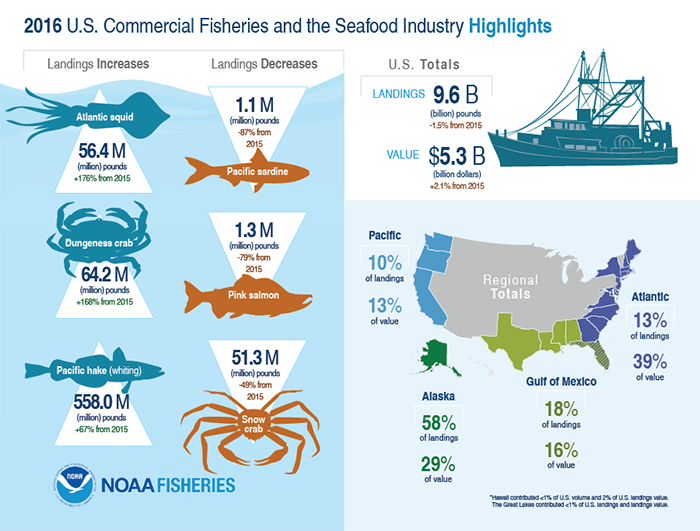
November 8, 2017 — The annual report detailing national and regional economic impacts of U.S. fisheries totaled $9.6 billion in value in 2016 with Alaska as usual producing more than the rest of the nation combined.

Alaska produced 58 percent of all landings and for the 20th straight year brought in the highest volume, according to the 2016 Fisheries of the United States report by the National Marine Fisheries Service.

The top spot for all ports in the nation went to Dutch Harbor, which brought in 770 million pounds with Alaska pollock accounting for 89 percent of that volume. Dutch Harbor also produced the second-highest value in the nation at $198 million, behind New Bedford, Mass, which reeled in 77 percent of its overall catch in sea scallops to account for its No. 1 spot in the nation at $327 million in value.

The Aleutians, where Trident Seafoods operates the largest processing plant in the nation on Akutan, was the second-ranked port by landings in the nation with 508 million pounds for $105 million. Kodiak was ranked No. 4 in landings with 417 million pounds and a value of $109 million.

The report on landings of Alaska pollock, 3.4 billion pounds, increased from 2015 numbers. That fishery brought in 336.2 million pounds more than the previous five-year average.

Read the full story at the Alaska Journal of Commerce


US fishermen’s catch up in value, volume declines slightly

November 1, 2017 — The federal government says American fisheries grew by a little more than 2 percent in value last year, even with fishermen bringing slightly less fish to shore.

The National Oceanic and Atmospheric Administration says in an annual report released Wednesday that U.S. commercial fishermen brought 9.6 billion pounds (4.3 billion kilograms) of seafood to land last year — down 1.5 percent from 2015.

Read the full story from the Associated Press at the Washington Post


NOAA: American fisheries remain a strong economic driver

November 1, 2017 — The following was released by NOAA Fisheries:

Commercial and recreational fisheries remain a strong contributor to the United States economy, according to the annual Fisheries of the United States report released today by NOAA.

Saltwater recreational fishing remains one of America’s favorite pastimes and a key contributor to the national economy—with 9.6 million anglers making nearly 63 million trips in 2016, catching more than 371 million fish (61 percent of which are released alive), and in 2015, contributing $36 billion to the national economy. By weight, striped bass remains the top harvested catch among saltwater anglers, followed by dolphinfish, bluefish, yellowfin tuna, spotted seatrout, and summer flounder.

Also in 2016, U.S. commercial fishermen landed 9.6 billion pounds of seafood (down 1.5 percent from 2015) valued at $5.3 billion (up 2.1 percent from 2015). The highest value commercial species were lobster ($723 million), crabs ($704 million), scallops ($488 million), shrimp ($483 million), salmon ($420 million), and Alaska walleye pollock ($417 million). By volume, the nation’s largest commercial fishery remains Alaska walleye pollock, which showed near record landings of 3.4 billion pounds (up 3 percent from 2015), representing 35 percent of total U.S. commercial and recreational seafood landings.

In 2016, the U.S. imported 5.8 billion pounds of seafood (up 1 percent compared to 2015) worth $19.5 billion (up 3.5 percent). However, a significant portion of this imported seafood is caught by American fishermen, exported overseas for processing, and then reimported to the United States. Shrimp and salmon are two of the top three imported species and much of that is farm-raised. The U.S. ranks 16th in total aquaculture production around the world—far behind China, Indonesia and India. In 2015, 1.4 billion pounds of aquaculture production was reported in the U.S.

“With the United States importing billions of pounds of seafood annually, and with so much of that seafood foreign farm-raised, the numbers in this report underscore the untapped potential of aquaculture here at home,” said Secretary of Commerce Wilbur Ross. “Expanding our nation’s aquaculture capacity presents an opportunity to reduce America’s reliance on imports while creating thousands of new jobs.”

The report also shows that the average American ate 14.9 pounds of fish and shellfish in 2016, a decrease from 15.5 pounds the year before. U.S. dietary guidelines recommend 8-12 ounces of a variety of seafood species per week, or 26 to 39 pounds per person per year.

For the 20th consecutive year, the Alaskan port of Dutch Harbor led the nation in 2016 with the highest amount of seafood landed—770 million pounds, valued at $198 million. Walleye pollock accounted for 89 percent of that volume. Likewise, for the 17th year in a row, New Bedford, Massachusetts, claimed the highest value catch from one port—107 million pounds, valued at $327 million. Sea scallops accounted for 77 percent of that value.

NOAA Fisheries will release a detailed look at economic impact of recreational and commercial fisheries on the U.S. economy in the upcoming Fisheries Economics of the United States report.

View more facts and figures or read the report.

New Secretary of Commerce Wilbur Ross Lists U.S. Fisheries as a Top Department Priority

WASHINGTON (Saving Seafood) – March 1, 2017 – In his first address (starts at 9:41 in the video) to Department of Commerce employees this morning, newly confirmed Secretary of Commerce Wilbur Ross included U.S. fisheries among his top priorities for the department.

In a list of ten challenges facing the Commerce Department’s 47,000 employees, including the launch of more NOAA satellites and changes to the methodology of the 2020 U.S. Census, Mr. Ross specifically identified the need for “obtaining maximum sustainable yield for our fisheries.”

Maximum sustainable yield (MSY) refers to the largest catch that can be sustainably taken from a fish stock over an indefinite period of time. Promoting sustainable fishing by achieving maximum sustainable yield is one of the primary goals of the Magnuson-Stevens Fishery Conservation and Management Act (MSA), the chief law governing fisheries management in the U.S.

The U.S. commercial fishing industry is a vital part of the U.S. economy, with landings of 9.7 billion pounds of seafood in 2015 worth $5.2 billion, according to the latest “Fisheries of the United States” report from NOAA Fisheries. Nevertheless, nearly 90 percent of seafood consumed in the U.S. is imported into the country.

Mr. Ross has previously expressed his support for domestic fisheries and his desire to reduce America’s reliance on seafood imports, which has created an $11 billion trade deficit for the U.S. seafood industry.

“Given the enormity of our coastlines, given the enormity of our freshwater, I would like to try to figure out how we can become much more self-sufficient in fishing and perhaps even a net exporter,” Mr. Ross said at his January confirmation hearing, according to Politico.

Mr. Ross was confirmed in a Senate vote 72-27 Monday night. He is a successful billionaire investor and founder of the private equity firm WL Ross & Co., from which he has agreed to divest as he takes on his new government role.

Alaska Continues to Lead All States in Volume of Seafood Landings

December 1, 2016 — A new federal report on the nation’s fisheries confirms that Alaska, with six billion pounds, led all states in volume of seafood landings in 2015, and that seafood consumption by the average American rose by nearly a pound.

The National Marine Fisheries Service report on Fisheries of the United States rounded out the top five states in harvest volume with Louisiana, 1.1 billion pounds; Virginia, 410.3 million pounds, Washington, 363 million pounds, and Mississippi, 304.1 million pounds.

Dutch Harbor, Alaska, for the 19th consecutive year, was the leading US port in quantity of commercial fishery landings, with 787 million pounds, followed by Kodiak, Alaska, 514 million pounds; Aleutian Islands (Other), Alaska, 467 million pounds; Intracoastal city, Louisiana, 467 million pounds, and Empire-Venice, Louisiana, 428 million pounds.

Other Pacific Northwest ports included among the top 20 for quantity were Alaska Peninsula (Other) 268 million pounds; Naknek, 176 million pounds, Cordova, 162 million pounds; Seward, 94 million pounds; Astoria, Oregon, 92 million pounds; Sitka, 87 million pounds; Ketchikan, Alaska, and Westport, Washington, 84 million pounds; and Petersburg and Bristol Bay (Other), 70 million pounds each.

Read the full story at Fishermen’s News

New Jersey anglers throw back three times more fish than they keep

November 4, 2016 — According to a fisheries report, in 2015 New Jersey anglers kept 4 ½ million fish, but they threw back 14.8 million, or roughly three times the amount they brought home.

The three to one catch and release rate is the about the same rate as in 2014. But, the same report found there was a substantial drop off in the number of fish anglers caught.

In 2014 anglers put 6.2 million fish in their coolers while releasing 19.9 million.

The numbers were provided in the National Oceanic and Atmospheric Administration’s annual Fisheries of the United States report, released last week.

The report didn’t provide analysis, but the reason for the dip could be related to the fact that fewer fishermen fished in 2015. Nearly 625,000 anglers fished in 2014, compared to almost 540,000 last year. The result was about 600,000 less fishing trips.

In total 23 marine coastal states, plus Puerto Rico were in the survey and combined to keep 151 million fish last year while releasing 200 million.

Of all the coastal states only Maine and Massachusetts anglers kept more fish than they threw back.

Read the full story at the Asbury Park Press 

  • 1
  • 2
  • Next Page »

Recent Headlines

  • Scientists did not recommend a 54 percent cut to the menhaden TAC
  • Broad coalition promotes Senate aquaculture bill
  • Chesapeake Bay region leaders approve revised agreement, commit to cleanup through 2040
  • ALASKA: Contamination safeguards of transboundary mining questioned
  • Federal government decides it won’t list American eel as species at risk
  • US Congress holds hearing on sea lion removals and salmon predation
  • MASSACHUSETTS: Seventeen months on, Vineyard Wind blade break investigation isn’t done
  • Sea lions keep gorging on endangered salmon despite 2018 law

Most Popular Topics

Alaska Aquaculture ASMFC Atlantic States Marine Fisheries Commission BOEM California China Climate change Coronavirus COVID-19 Donald Trump groundfish Gulf of Maine Gulf of Mexico Illegal fishing IUU fishing Lobster Maine Massachusetts Mid-Atlantic National Marine Fisheries Service National Oceanic and Atmospheric Administration NEFMC New Bedford New England New England Fishery Management Council New Jersey New York NMFS NOAA NOAA Fisheries North Atlantic right whales North Carolina North Pacific offshore energy Offshore wind Pacific right whales Salmon South Atlantic Virginia Western Pacific Whales wind energy Wind Farms

Daily Updates & Alerts

Enter your email address to receive daily updates and alerts:
  • This field is for validation purposes and should be left unchanged.
Tweets by @savingseafood

Copyright © 2025 Saving Seafood · WordPress Web Design by Jessee Productions