Saving Seafood

  • Home
  • News
    • Alerts
    • Conservation & Environment
    • Council Actions
    • Economic Impact
    • Enforcement
    • International & Trade
    • Law
    • Management & Regulation
    • Regulations
    • Nutrition
    • Opinion
    • Other News
    • Safety
    • Science
    • State and Local
  • News by Region
    • New England
    • Mid-Atlantic
    • South Atlantic
    • Gulf of Mexico
    • Pacific
    • North Pacific
    • Western Pacific
  • About
    • Contact Us
    • Fishing Terms Glossary

Red snapper season could be too little, too late

November 2, 2017 — After three years of no allowable red snapper fishing off the South Atlantic coast, it opens back up today for the first in consecutive 3-day weekends for recreational fishermen. For a lot of charter fishermen, however, the chance to take advantage of the reopened fishery may have come and gone.

Scott Griffin of Goin’ Coastal Charters said he and his fellow captains really had less than a week to get the word out, and even then, years of atrophy to offshore charter business already had an impact.

“Most of the guys are concentrating inshore for trout and redfish right now,” Griffin said. “If it had been during the tourist season, it would have been a whole different story. We could’ve booked all six days. So, giving us one week’s notice in the middle of the fall, it basically does nothing for us. It’s a shame, too, because the fish are out there.”

The area covered goes from 3 miles out from the coast, to 200 miles, administered through federal regulatory bodies.

In the South Atlantic Fishery Management Council meetings on Jekyll Island in March, discussion shifted between whether they were in a position to accurately know the health of the fishery, to the amount of by-catch — usually dead snapper thrown back into the water when caught during fishing for other species — to the continuing frustration of recreational anglers who maintain there are more than enough red snapper for both harvesting and maintaining the population.

Read the full story at the Brunswick News


Whale research to highlight changes in gulf

November 2, 2017 — BAR HARBOR, Maine — Upcoming new research into the feeding habits of baleen whales in the Gulf of Maine – one of the fastest-warming bodies of water on the planet – could shed light on impacts of climate change on oceans worldwide.

The study of whale foraging ecology will be undertaken by members of College of the Atlantic’s Allied Whale marine mammal research program, in partnership with Cetos Research Organization, during a five-year project beginning in spring 2018.

Paired with data from a similar Allied Whale study done before temperatures began rising so dramatically in the gulf in 2004, this new research will give scientists their first broad picture of how the ocean’s top predators are adapting to a rapidly changing environment.

“The warming gulf has the potential to radically affect prey structure, and we have the control data from before the warming started to go by,” said Allied Whale Director Sean Todd, the Steven K. Katona Chair in Marine Science at COA and a principal investigator on the project.

Read the full story at the Mount Desert Islander


Commercial Closure in Federal Waters for Atlantic Migratory Group Spanish Mackerel Northern Zone on November 7, 2017

November 2, 2017 — The following was released by NOAA Fisheries: 

WHAT/WHEN:

The commercial harvest of Atlantic migratory group Spanish mackerel northern zone in federal waters will close at 12:01 a.m., local time, on November 7, 2017. The northern zone for Atlantic migratory group Spanish mackerel includes federal waters off New York, New Jersey, Delaware, Maryland, Virginia, and North Carolina. During the commercial closure, harvest or possession of Spanish mackerel in or from the northern zone federal waters is limited to the recreational bag and possession limits while the recreational sector is open.

WHY THIS CLOSURE IS HAPPENING:

  • Originally, the 2017/2018 commercial quota for Atlantic migratory group Spanish mackerel northern zone was 662,670 pounds. However, regulations allow for quota transfers between the northern and southern zones with the approval from the Regional Administrator of NOAA Fisheries to allow the commercial quota for both zones to be fully harvested. 100,000 pounds of Spanish mackerel were transferred from the southern zone quota to the northern zone quota. Therefore, the revised quotas are 2,567,330 pounds for the southern zone and 762,670 pounds for the northern zone.
  • Commercial landings are projected to reach the revised commercial quota for Atlantic migratory group Spanish mackerel northern zone. According to the accountability measure, harvest must close to prevent the quota from being exceeded.

DURING THE CLOSURE:

  • The closure applies in both state and federal waters for vessels that have a federal commercial permit for Coastal Migratory Pelagics.
  • The prohibition on sale or purchase during a closure for Spanish mackerel does not apply to fish that were harvested, landed ashore, and sold prior to 12:01 a.m., local time, November 7, 2017, and were held in cold storage by a dealer or processor.
  • During the closure, a person on board a vessel that has been issued a valid Federal commercial or charter vessel/headboat permit for coastal migratory pelagic fish may continue to retain Atlantic migratory group Spanish mackerel in the northern zone under the recreational bag and possession limits, as long as the recreational sector for Atlantic migratory group Spanish mackerel is open.
  • Commercial harvest for Atlantic migratory group Spanish mackerel northern zone will re-open on March 1, 2018.

This bulletin provides only a summary of the existing regulations. For a full list of regulations visit the Federal Register here.


Cape Cod fishermen have high hopes for halibut

November 2, 2017 — CHATHAM, Mass. — On the U.S. side of the border Atlantic halibut are listed as a species of concern by the National Oceanic and Atmospheric Administration and fishermen are limited to one fish per trip.

Less than a half a day’s steam to the east, the same fish is the poster child for sustainable fishery management and generates between $100 million and $200 million a year for Canadian fishermen.

It’s a divergence shrouded in mystery as deep as the ocean on either side of the Hague Line, the boundary that separates the two nations out to the 200 mile limit of their exclusive economic zones. The target date to rebuild the U.S. Atlantic halibut stock to healthy levels is 2056, nearly 40 years in the future.

But Cape Cod fishermen believe the future may be happening now. They have been seeing more halibut in recent years and believe the science is wrong.

“Yes, we’re seeing more halibut, continuously,” said Jason Amaru, the captain and owner of the Chatham-based trawler Joanne A III. “The population seems to be recovering.”

Last year, the Nature Conservancy received a $270,000 federal grant to work with fishermen, scientists from NOAA, the University of Massachusetts Dartmouth, the Department of Fisheries and Oceans in Canada, and the Cape Cod Commercial Fishermen’s Alliance to place satellite tags on halibut and take biological samples.

Grant money pays for Amaru to attach the tracking devices, which cost more than $3,000 each. He also takes biological samples: the ear bones that determine age, gonads that tell the stage of sexual maturity, the heart for genetic analysis, and documents where the fish was caught, its weight and length.

“Four years ago, we were talking to fishermen. They said they were seeing more halibut than ever before. It used to be like seeing a unicorn, one a year, then once a month, now every day,” said Christopher McGuire, marine program director for The Nature Conservancy in Massachusetts, who spearheaded the drive for research money after listening to Cape fishermen. “We see that one fish a day being landed by a lot of fishermen.”

McGuire said he hopes the new data will show whether a resurgent Canadian halibut population is repopulating U.S. waters, or whether the U.S. fish are experiencing their own population boom.

Read the full story at the Cape Cod Times  


Fisheries council to undertake independent review

November 3, 2017 — The New England Fishery Management Council is undertaking an independent review it hopes will provide a sense of what it does well and where it needs to improve in the administration and management of the region’s fisheries.

The council on Thursday announced it is forming an external panel of managers and scientists from other regions and fisheries to administer the council program review, stating those selected will have “a strong understanding of U.S. federal fisheries management but no recent involvement or affiliation” with the council.

“As with the case of many organizations, it’s good to have third-party individuals look at our processes and see if they can be improved upon,” council Chairman John Quinn said Thursday. “We want to hear from everybody, from members of the fishing industry, non-governmental organizations and even government entities with whom we frequently interact.”

Quinn said the council hopes to answer three elemental questions with the review: What it’s doing right, what it’s doing wrong and “How can we improve the way we serve the people who are involved in our fisheries and the public overall.”

Read the full story at the Gloucester Times 


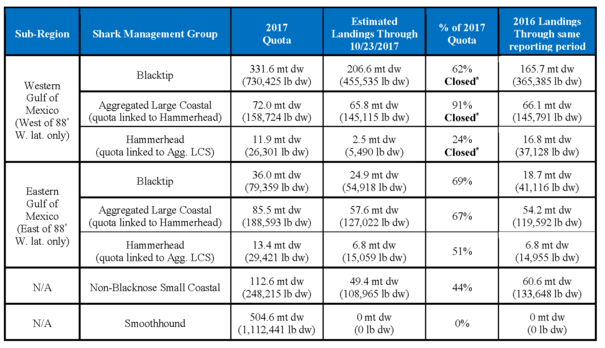
Shark Landings Update Through October 23, 2017

October 27, 2017 — The following was released by NOAA Fisheries:

The following are preliminary landings estimates in metric tons (mt) and pounds (lb) dressed weight (dw) for the Atlantic shark commercial fisheries; 1 mt is equal to 2,204.6 pounds.  These preliminary estimates are based on dealer reports and other information received from January 1 through October 23, 2017.  The estimates include landings by state-only permitted vessels, federally permitted vessels, and the 2017 shark research fishery participants.  We provide percentages of landings instead of estimated landings where needed to continue ensuring participant confidentiality.  The fishing seasons for all shark management groups opened on January 1, 2017, except for the aggregated LCS, blacktip shark, and hammerhead shark management groups in the western Gulf of Mexico sub-region which opened on February 1, 2017.

Gulf of Mexico Region

  • Includes any landings south and west 25° 20.4’ N. long.
  • As of 10/23/2017, the retention limit for directed permit holders is 45 large coastal sharks other than sandbar sharks per vessel per trip in the eastern Gulf of Mexico sub-region and no retention of large coastal sharks in the western Gulf of Mexico sub-region*.
  • The retention limit for directed permit holders can change throughout the season.

GOM

* Fishery closed at 11:30 p.m. local time on May 2, 2017 (82 FR 20447).

NMFS will announce closures of management groups when landings reach or are projected to reach 80 percent of the quota.  Management groups that are quota linked close when landings of either of the linked management groups reach or are projected to reach 80 percent of the quota.

For the full list of shark landings by region visit NOAA Fisheries

March/April 2017 Issue of ASMFC Fisheries Focus Now Available

May 2, 2017 — The following was released by the Atlantic States Marine Fisheries Commission:

The Atlantic States Marine Fisheries Commission has released the 14th report in its Habitat Management Series entitled, Atlantic Sciaenid Habitats: A Review of Utilization, Threats and Recommendations for Conservation, Management and Research. Prepared by ASMFC staff, sciaenid experts, and a subset of the Commission’s Habitat Committee, the report is the most comprehensive compilation of habitat information to date on Commission-managed and other common sciaenid species found throughout the Western Atlantic. These species include Atlantic croaker, black drum, red drum, spot, spotted seatrout, weakfish, northern kingfish, southern kingfish and Gulf kingfish. The report provides a habitat description for all stages of each species’ life cycle, their associated Essential Fish Habitats and Habitat Areas of Particular Concern (when applicable), threats and uncertainties to their habitats, and recommendations for habitat management and research. It was developed to serve as a resource for fisheries managers to use when amending existing fishery management plans.

Sciaenids are found throughout the Western Atlantic Ocean from Maine to Mexico, in shallow coastal waters and larger bays and estuaries, including their tributaries. They utilize a variety of habitats throughout their life stages, including estuaries, salt marshes, freshwater marshes, oyster reefs, sea grasses and mud banks/shores. Because of the way different species of sciaenids use various types of habitats throughout their life, several different habitats are key for maintaining healthy populations.

Read the full release here

EU Commission proposes fishing opportunities in Atlantic & North Sea

October 27, 2016 — In preparation for the December Fisheries Council, where Member States will negotiate fishing quotas in the Atlantic and North Sea for 2017, the Commission is presenting its proposal for healthy and sustainable stocks.

Karmenu Vella, Commissioner for Environment, Maritime Affairs and Fisheries, said: “Our goal is clear: we need to bring all stocks to healthy and sustainable levels as soon as possible so that our fishing industry can remain viable. This is not up to the Commission alone: stakeholders are fundamental enablers in this process. We are proposing an ambitious programme for 2017 and the only way forward will be to work with fishermen, scientists and national authorities to develop real solutions that lead to fisheries that are both economically profitable and sustainable”.

Later this autumn the Commission will also propose some additional quotas, the so-called ‘quota top-ups’, for the fisheries that fall under thelanding obligation in 2017. These extra quotas are granted on account of the fact that fishermen can no longer discard the fish caught unintentionally but have to land it. The allowed quota is therefore increased to facilitate the transition to the new system of no discards. The exact top-ups per fishery will be determined on the basis of scientific advice expected in mid-November and of the quantities that need to be landed according to the regional discard plans.

Read the full story at Green4Sea

Could Seismic Tests Harm Fish?

June 16, 2016 — Fish might not have fancy communication equipment like whales and dolphins, but they do have their specialized ways of navigating through an ocean filled with predators and mobile food sources. And these honed adaptive responses could potentially be harmed by seismic air guns.

But as the federal Bureau of Ocean Energy Management continues to review the effects of proposed seismic surveys on marine mammals in the Atlantic, an environmental advocacy group is putting out alarms that the tests’ potentially ill effect on fish will be glossed over in the review process that is close to completion.

“There are fisheries impacts that are not very well understood, and now is the time to do these reviews,” said Zachary Lees, ocean and coastal policy attorney for Clean Ocean Action, a New Jersey-based nonprofit group.

Eight companies are currently seeking to conduct seismic surveys in areas off the southern Atlantic coast between Delaware and Florida to look for oil and natural gas resources. Although oil leases in the Atlantic have been canceled until at least 2023, the federal government is moving forward with mapping the sea floor for hydrocarbon deposits.

After approving a final programmatic environmental impact statement, or PEIS, on seismic surveys in 2014, BOEM was made aware earlier this year of new information on protected marine mammals that triggered additional review.

Read the full story at CoastalReview.com

Status and Trends of the US Sea Scallop Fishery

April 18, 2016 — Rotational area management is the cornerstone of U.S. sea scallop fisheries management; areas that contain beds of small scallops are closed before the scallops experience fishing mortality, then the areas re-open when scallops are larger, producing more yield-per-recruit. When scallop vessels are fishing in these areas they are limited in terms of total removal. The scallops are harvested for their mussel (“meats”) by being hand shucked at sea; the vast majority being landed iced.

There have been many issues associated with commercial fishing gear in recent years as we move towards more sustainable fisheries. Important objectives to scallop gear operations include increasing the size of scallops retained in the gear, preventing damage to scallops not ready for harvest, avoiding mortality to unwanted fish species, mitigating any adverse impact to habitat, and reducing risk to threatened and endangered species. Scallops are primarily harvested by dredges that sweep across the surface of the sea floor. Besides catching scallops, the gear also captures as a bycatch flatfish such as yellowtail flounder and winter flounder. Many of these flatfish stocks are in an overfished condition due to past heavy pressure from targeting fisheries and environmental change, including rising ocean temperatures. Reduction of bycatch in the scallop fishery has been accomplished by gear modifications, time/ area closures (e.g., seasonal restrictions), and the higher scallop catch per unit effort (CPUE) achieved by rotational management.

Another issue relates to the concerns that some stakeholders have about adverse impacts of scallop dredging on the habitat. While many studies indicate that fishing has relatively little long term impact on the types of high energy habitats scallops inhabit, management takes the precautionary approach of minimizing the swept area of the fishery. The 2016 projection for swept area is 3,600 square nautical miles. This is down from the 16,000 square nautical miles fished in the 1990’s, which produced substantially less yields — another major benefit of the rotational fishing strategy.

The scallop fishery also had an issue with the bycatch of loggerhead sea turtles in the mid-Atlantic; estimates suggested that the fishery killed or injured over 700 loggerheads in 2003 alone. The industry and its scientific partners have since developed gear solutions and now virtually no turtle mortality has been observed.

By solving issues related to scallop stock management, bycatch, habitat, and protected species, the U.S. scallop producers applied for and received the “Certified Sustainable Seafood” credential from the Marine Stewardship Council, aiding in the worldwide marketing of the U.S. sea scallop.

See the full story at the Northeast Agriculture Insights and Perspectives.

  • « Previous Page
  • 1
  • …
  • 11
  • 12
  • 13
  • 14
  • 15
  • …
  • 17
  • Next Page »

Recent Headlines

  • Scientists did not recommend a 54 percent cut to the menhaden TAC
  • Broad coalition promotes Senate aquaculture bill
  • Chesapeake Bay region leaders approve revised agreement, commit to cleanup through 2040
  • ALASKA: Contamination safeguards of transboundary mining questioned
  • Federal government decides it won’t list American eel as species at risk
  • US Congress holds hearing on sea lion removals and salmon predation
  • MASSACHUSETTS: Seventeen months on, Vineyard Wind blade break investigation isn’t done
  • Sea lions keep gorging on endangered salmon despite 2018 law

Most Popular Topics

Alaska Aquaculture ASMFC Atlantic States Marine Fisheries Commission BOEM California China Climate change Coronavirus COVID-19 Donald Trump groundfish Gulf of Maine Gulf of Mexico Illegal fishing IUU fishing Lobster Maine Massachusetts Mid-Atlantic National Marine Fisheries Service National Oceanic and Atmospheric Administration NEFMC New Bedford New England New England Fishery Management Council New Jersey New York NMFS NOAA NOAA Fisheries North Atlantic right whales North Carolina North Pacific offshore energy Offshore wind Pacific right whales Salmon South Atlantic Virginia Western Pacific Whales wind energy Wind Farms

Daily Updates & Alerts

Enter your email address to receive daily updates and alerts:
  • This field is for validation purposes and should be left unchanged.
Tweets by @savingseafood

Copyright © 2025 Saving Seafood · WordPress Web Design by Jessee Productions