March 13, 2014 — The following was released by NOAA Fisheries:
Amendment 5 revises management of the herring fishery to improve the monitoring and sampling of catch at-sea and address bycatch issues.

March 13, 2014 — The following was released by NOAA Fisheries:
Amendment 5 revises management of the herring fishery to improve the monitoring and sampling of catch at-sea and address bycatch issues.
March 17, 2014 — The following was released by NOAA:
NOAA Fisheries is seeking public comment on a proposal to modify a reporting requirement for sector vessels to improve the accuracy of reporting of the Eastern U.S./Canada Management Area. If approved, only sector vessels that have declared into the Eastern U.S./Canada Area would be required to submit daily catch reports. The proposal also will clarify that, for vessels declared only into the Western U.S./Canada Area, sectors must continue to submit weekly sector catch reports. We are also proposing a limited amount of carryover of unused 2013 catch allocation into the 2014 fishing year. Providing a nominal amount of carryover is an important safety consideration because, by allowing some carryover, vessels could elect to forego some portion of, or entire, late-season fishing trips for safety reasons, knowing that they could instead harvest a nominal portion of their unused catch allocation in the next fishing year.
For more on these proposals or to provide public comment please click here.
March 17, 2014 — The following was released by NOAA:
NOAA Fisheries today announced proposed management measures for the groundfish fishery for the 2014 fishing year, which begins on May 1. These measures, recommended by the New England Fishery Management Council, include proposed increases in catch limits for three groundfish stocks and a lower catch limit for another stock, new rebuilding timeframes for Gulf of Maine cod and American plaice, and the establishment of accountability measures (the use of selective fishing gear in certain areas) for fishing vessels using small-mesh gear if they exceed their annual allotment of Georges Bank yellowtail flounder. Several measures are also being proposed that are intended to increase flexibility for U.S./Canada stocks and/or help fishermen achieve optimum yield. To read more about these proposed measures and other measures under development please click here.
March 17, 2014 — The following was released by NOAA:
NOAA Fisheries is seeking public comment on proposed sector operations plans for the 2014 fishing year. Nineteen sectors submitted operations plans and contracts for fishing year 2014. NOAA Fisheries approval is required annually for sectors to receive their yearly groundfish stock quotas. Because sectors have annual quotas, they can also request exemptions from existing regulations that apply to fishing vessels operating under the old management system (limits on the number of fishing days, gear restrictions, etc.). For 2014, sectors requested 28 exemptions, 20 of which we are considering approving through this action.The other eight exemption requests are not being considered in this action because they are either prohibited by the Council, or have been requested previously and rejected due to inadequate information demonstrating that they would not have adverse impacts on habitat, protected species or depleted groundfish stocks.
Among the proposed measures that we are considering approving are the removal of the 100% coverage requirement for the redfish exemption; and greater flexibility in parts of the Nantucket Lightship Closed Area (the western portion of this area would allow trawl vessels to fish with standard gear).
To read more about proposed measures and to learn more about how to provide public comment on them click here.
ARLINGTON, Va — March 14, 2014 — The following was released by the Atlantic States Marine Fisheries Comission:
The Atlantic States Marine Fisheries Commission’s Summer Flounder, Scup and Black Sea Bass Management Board approved a combination of state and regional proposals for the 2014 summer flounder recreational fishery (see Table 1) and state proposals for the 2014 black sea bass recreational fishery in accordance with Addendum XXV to the Summer Flounder, Scup and Black Sea Bass Fishery Management Plan.
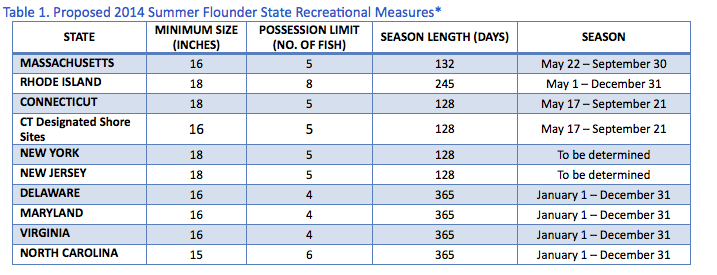
*States are undergoing their administrative processes to adopt regulations. Once regulations are finalized, they will be available on state and Commission websites.
For the summer flounder fishery, the Board approved regional management measures for two regions (1) Delaware, Maryland, and Virginia, including the Potomac River Fisheries Commission, and (2) Connecticut, New York, and New Jersey. Adopted regulations for the first region (DE-VA) include a 16-inch minimum size limit, 4 fish bag limit, and a year-round season, while the second region’s (CT-NJ) regulations include an 18-inch minimum size, 5 fish bag limit, and 128 day open season with not more than 45 days open from May 1 – June 30. Further, states have the option to develop a program that allows
for a 16-inch minimum size limit at state designated sites offering only shore-based fishing access. For North Carolina, the Board approved the state’s maintenance of 2013 regulations for the 2014 fishery. The overall intent of the regional management measures for the summer flounder recreational fishery is to provide more equity in recreational harvest opportunities along the coast.
The Board also approved a request from Massachusetts and Rhode Island to split its region into individual state regions to account for the significantly different recreational fisheries of the two states. Both states will maintain their 2013 regulations for the 2014 fishery so that the effect of these measures, when combined with the other regions’ measures, will constrain the coastwide harvest to the recreational harvest limit of 7.01 million pounds.
For black sea bass, the Board approved the methodologies used by the states of Massachusetts through New Jersey to establish their minimum size, bag limits, and season lengths to achieve a 7% reduction in the 2014 recreational harvest levels from the 2013 harvest level. The 7% reduction is in response to harvest overages that occurred in 2013. States will be finalizing their regulations over the next couple of weeks. The Board also agreed to a send letter to NOAA Fisheries requesting a review of the 2013 final Marine Recreational Information Program black sea bass harvest numbers when determining the final rule for 2014 measures.
Motions from the Board meeting can be found on the Commission website under Meeting Archives (http://www.asmfc.org/home/meeting-archive) or here. For more information, please contact Kirby Rootes-Murdy, Fishery Management Plan Coordinator, at krootes-murdy@asmfc.org or 703.842.0740.
March 7, 2014 — The following was released by the NOAA Fisheries Alaska Regional Office:
NOAA Fisheries is providing notice of the immediate effect of regulations of the International Pacific Halibut Commission (IPHC). The commercial IFQ halibut season opens at noon local time tomorrow in Alaska.
At its annual meeting in January, the IPHC recommended to the governments of Canada and the United States catch limits for 2014 totaling 27,515,000 pounds. The IPHC adopted area-specific catch limits for 2014 that were lower than 2013 in all of its management areas except Area 2C (Southeast Alaska). The halibut stock has been declining due to reduced recruitment, lower growth rates, and higher than target harvest rates, and is at risk of further declines. Conservation of the halibut resource will best serve the economic interests of both the charter and commercial fisheries over the long term.
In 2014, advised by the Catch Sharing Plan recommended by the North Pacific Fishery Management Council, the IPHC set combined charter and commercial catch limits for Areas 2C and 3A (Southcentral Alaska). Voluntary annual transfers of commercial halibut individual fishing quota to charter halibut permit holders in Areas 2C and 3A will be available as "guided angler fish" for additional harvest opportunities in the charter fishery.
Read the full press release at NOAA Fisheries
NEW BEDFORD, Mass. — February 26, 2014 — NOAA Fisheries is giving boats fishing under days-at-sea rules some extra time to file applications for permit transfers.
Days-at-sea boats now have until March 14 to announce their intentions to NOAA. No transfer of days-at-sea permits will be allowed to happen until they are approved by NOAA.
Read the full story at the New Bedford Standard-Times
February 25, 2014 — The following was released by NOAA Fisheries:
We are extending the deadline to submit a day-at-sea (DAS) lease application from March 1, 2014, to March 14, 2014, to allow permit holders more flexibility with DAS leasing.
Read the full release from NOAA Fisheries
February 25, 2014 — The following was released by NOAA Fisheries:
You can now choose to receive texts from NOAA Fisheries' Greater Atlantic Regional Fisheries Office (GARFO) on your cell phone. Alerts will include information about emergency actions, area openings and closings, and possession limit adjustments. To ensure that you don't receive too many texts, we are limiting the texts we send to only time sensitive notifications. This means that you will receive about 10-12 texts per year, and you may not receive one for some time.
If you would like to receive text messages from the GARFO, go to http://www.nero.noaa.gov/fish and complete the simple form. The information you submit will be anonymous, and no other information will be recorded. If you have any questions, would like to change your cell number, or stop getting text alerts, please text back or send an email to nmfs.ner.feedback@noaa.gov. You may also contact Olivia Rugo, Stakeholder Engagement, GARFO, at 978-675-2167 or email her at Olivia.rugo@noaa.gov
February 18, 2014 — The following was released by the Maine Department of Marine Resources: In order to protect public health and consumer confidence while building on recently received data, the Maine Department of Marine Resources will close a small area at the mouth of the Penobscot River to harvesting of crabs and lobsters for a minimum of two years.
The closure of an area that extends from Wilson Point across to Fort Point and north into the river, will take effect February 22, 2014.
“This closure is being taken as a precautionary measure in response to information the Department of Marine Resources recently received about mercury contamination in muscle tissue from lobsters found in this area,” said Department of Marine Resources Commissioner Patrick Keliher.
The information, which came to DMR’s attention in November 2013, is contained in a federal court-ordered study. After being notified of the study’s findings, the DMR asked State Toxicologist Andrew Smith from the Maine Center for Disease Control and Prevention to analyze the study’s data. The DMR took the original study and Smith’s analysis under advisement and ultimately opted to implement a discrete closure to ensure that no lobsters from this area make it into the marketplace.
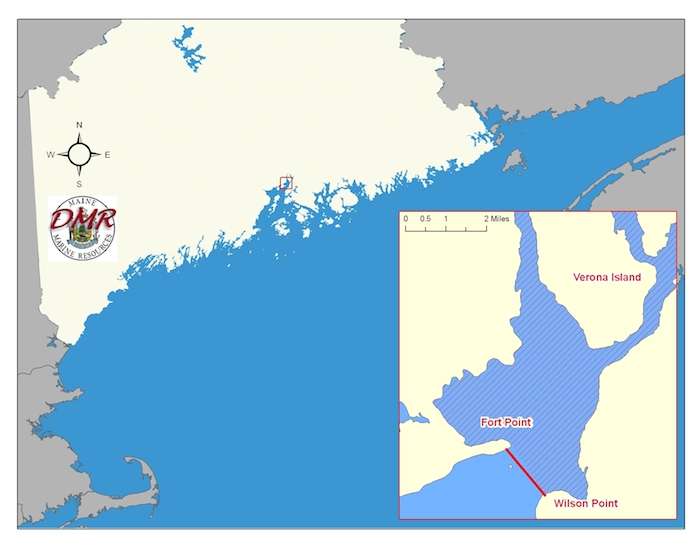 The area within the closure where lobsters are harvested is approximately 7 square miles out of more than 14,000 square miles in the Gulf of Maine where lobsters are harvested. “We chose to close this small area to harvesting for both commercial and recreational fishermen as a precautionary approach that protects public health and ensures consumer confidence that eating Maine lobster is safe and healthy while we conduct our own monitoring effort that will build on these new data,” said Commissioner Keliher.
Maine Marine Patrol will be working with harvesters to ensure all gear is removed from the affected area as soon as possible. Currently, there is very limited commercial harvesting of any species in the mouth of the Penobscot River, as most local commercial harvesters have either stopped for the season or moved their operations down the bay. The Department has begun to reach out to harvesters and dealers to discuss the closure and plans for on-going monitoring.
DMR, the Maine Department of Environmental Protection and the Maine Department of Health and Human Services will be working together over the next two years to conduct seasonal monitoring of mercury levels in marine organisms of commercial and food web significance in and near the closed area. “The monitoring will be conducted in and adjacent to the closed area and will evaluate the accumulation of contaminants by marine species,” said Commissioner Keliher. “We will decide, after two years, whether or not to re-open the area or to continue the closure.”
“Maine lobster is the best in the world and we’re taking very precautious steps to protect this valuable, unique resource and to assure consumers that they can continue to be confident that our lobsters are safe and healthy to eat,” said Commissioner Keliher.
More information about the closure can be found at http://www.maine.gov/dmr/news/2014/PenobscotClosure.htm.